



 141 / 208

[
] 141
S
ustainability
P
olicies
, P
rogrammes
and
their
E
conomic
I
mpact
sibilities enshrined in the United Nations Framework Convention
on Climate Change, Africa will have to play a role.
Towards green growth in Africa
The focus on green growth is a focus on the quality of growth. There
should not be a trade-off between development objectives and their
sustainability. The very rationale behind the concept of green growth
is that by not adequately valuing social and environmental assets,
the current economic model leads to false development choices.
A green growth model for African economies will need to be
tailored to their particular development circumstances, and there
will be marked differences between middle-income and low-income
countries. The definitions used by the Organisation for Economic
Cooperation and Development (OECD), the World Bank and others
recognize this. However, in practice the discourse is often reduced to
a discussion on low-carbon development. As a result, green growth
may be perceived as a constraint to development rather than as a
necessity or an opportunity for countries where aggregate and per
capita emissions have been low.
For the least developed countries, increasing access to energy,
improving transportation systems and strengthening urban infra-
structure are essential prerequisites for development. Meeting these
objectives may require increases in emissions, albeit from a very
low baseline in comparison with other regions in the world. It has
to be clear that these essential development objectives cannot be
let go. However, there are multiple ways to reach these objectives.
Decisions taken on infrastructure today have long-term implica-
tions for development pathways. Recognizing that we are living in
an interconnected world that is increasingly crowded and carbon-
constrained enables us to identify opportunities early on that meet
these development objectives in a more energy-efficient
manner.
Integrating these regional and global trends into
development programming, creating the right incen-
tives and regulatory frameworks, can help countries
avoid locking into development pathways that are not
sustainable and will require costly changes of direction
later on. In fact, greenhouse gas abatement cost curves
for Africa by McKinsey suggest there are many sector-
specific measures that can result in cost savings. Yet
these measures often are not taken due to lack of aware-
ness, upfront investment and political will.
Another important aspect of any green growth strat-
egy in Africa will have to be an emphasis on sustainable
land and water management. As a continent facing steep
environmental gradients, widespread land degradation
and climate change, Africa needs to shift to a sustain-
able and efficient use of its natural assets if it is to meet
the needs of a growing population.
With increasingly integrated markets, African
countries must strengthen their risk management
mechanisms and diversify their economies to reduce
vulnerabilities to environmental and socioeconomic
changes and to buffer themselves against exogenous
shocks. This includes helping livelihoods and economic
sectors manage current climate risks and adapt to
climate change over time, but it also means building
the resilience of Africa’s development against other
types of shocks, such as fluctuating prices for Africa’s
commodities on world markets. Hence, strengthening
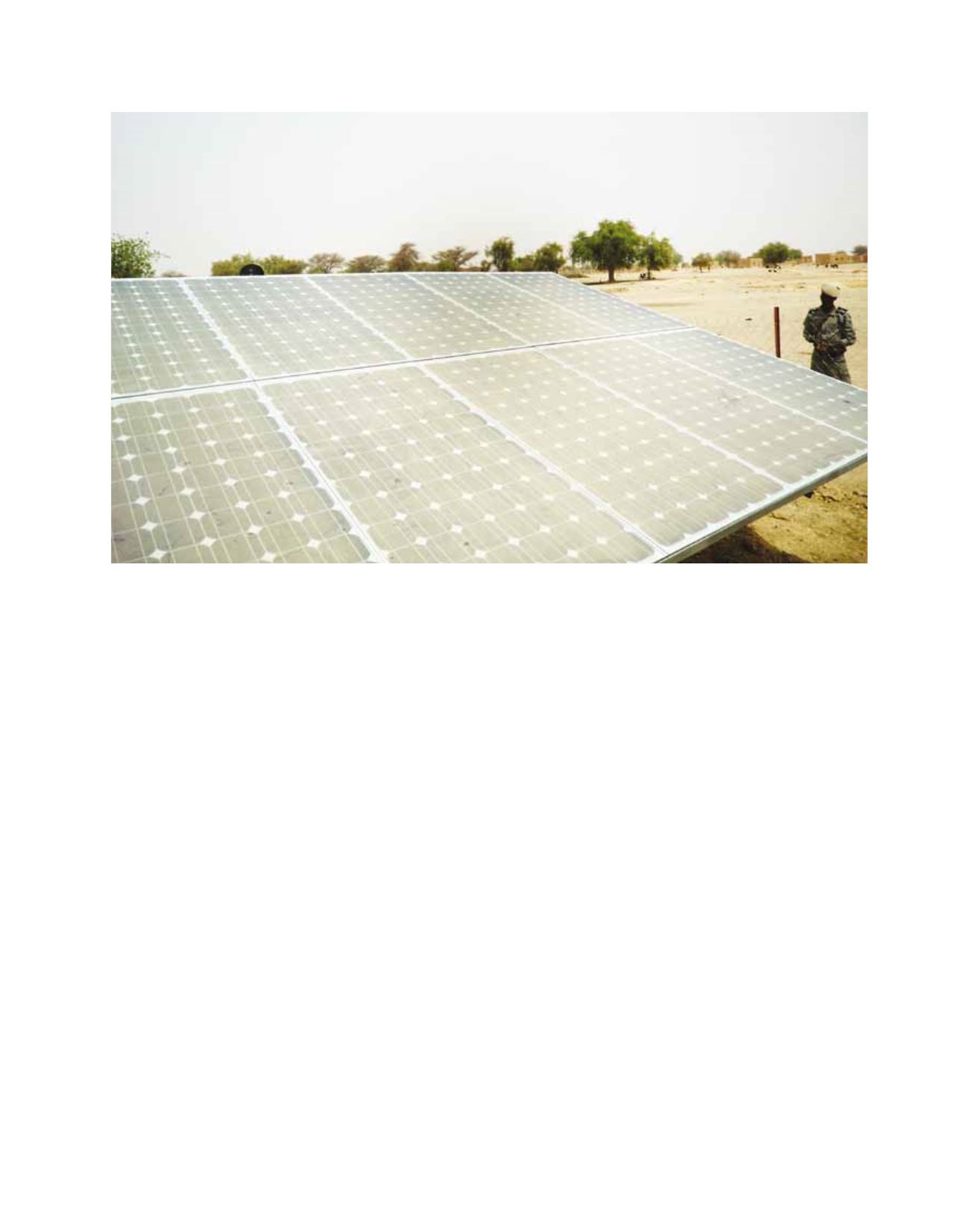
Solar power project
Image: AfDB