


 137 / 208

[
] 137
S
ustainability
P
olicies
, P
rogrammes
and
their
E
conomic
I
mpact
facilitates policy dialogue and technical discussion by regularly
hosting international conferences and seminars. The most recent
KEI International Conference was held in November 2011, focusing
on Global Green Growth partnerships. The conference provided an
open forum for discussion on green growth in developing countries
and strategies for green ODA.
KEI has led the way in developing an international research network
known as the Network of Institutions for Sustainable Development
(NISD) in collaboration with UNEP’s Economics and Trade Branch
(ETB). The network was launched in March 2004, at the 8th
Special Session of the UNEP Governing Council/Global Ministerial
Environment Forum (GC/GMEF) and consists of 49 membership
organizations from 33 countries. NISD is a platform for enhancing
information exchange, capacity-building and outreach activities and
promoting regional cooperation. Its objectives are to foster participa-
tion in policy research, expand environmental knowledge, enhance
programmes for sustainable development in developing countries and
advance discussion on international environmental issues.
KEI also offers its expertise and knowledge through joint research
and partnership projects. Key areas include the Integrated Water
Management Model on the Selenge River Basin in Mongolia and
Russia (2007-2010), in collaboration with the Institute of Geoecology
of the Mongolian Academy of Science, Baikal Institute of Nature
Management and Siberian Branch of the Russian Academy of Sciences.
The objectives of the project were to build an integrated water
management model that will serve as an important policy tool for
sustainable management of the Selenge River Basin and to analyse the
growing problems of managing water resources with a
view to fostering the peaceful settlement of water-related
disputes at local, regional and international levels.
Another key project, Sustainable Development in the
Context of Regional Economic Integration: Strategies
for Environmental Sustainability and Poverty Reduction
(2005-2008), was designed to provide policymakers with
ways of promoting sustainable development in regional
economic integration, while identifying strategies for
environmental sustainability and poverty reduction.
Project participants included KEI, the Institute of Global
Environmental Strategies in Japan, McGill University
in Canada, the National Institute for Environmental
Strategies in Japan and UNEP-ETB. Other institutions
within Asia involved in national activities included the
Policy Research Centre for Environment and Economy of
the State Environment Protection Administration of China,
Indonesian Institute of Sciences, Thailand Environment
Institute, and the Institute of Environmental Science and
Technology at the University of Hanoi in Vietnam.
KEI is also committed to sharing knowledge and
best environmental practices for sustainable devel-
opment to support capacity-building in developing
countries. The organization develops and delivers
bilateral programmes such as the Mongolian Capacity-
Building Programme on EIA in mining development,
Sri Lankan Waste Policy Education Programme and
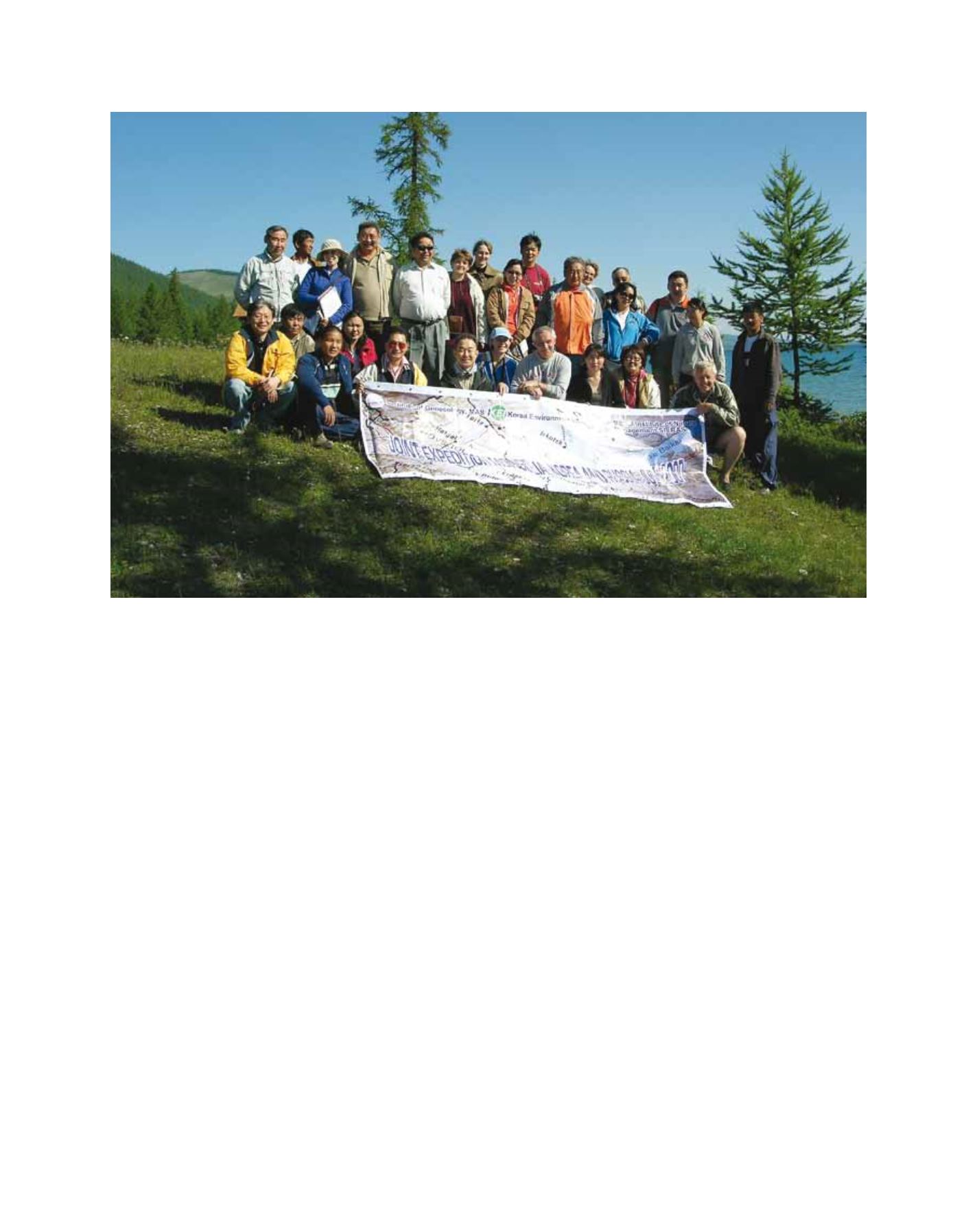
Field visit for ‘Integrated Water Management Model on the Selenge River Basin in Mongolia and Russia (2007-2010)’, in collaboration with Institute of Geoecology
of Mongolian Academy of Science (IGMAS), Baikal Institute of Nature Management, and Siberian Branch of the Russian Academy of Sciences (BIN SB RAS)
Image: Korea Environment Institute