


 132 / 208

[
] 132
S
ustainability
P
olicies
, P
rogrammes
and
their
E
conomic
I
mpact
political concept of sustainable development during a
course of extensive public hearings, which were distin-
guished by their inclusiveness, and published its report,
‘Our Common Future’, in April 1987. The Brundtland
Commission provided the momentum for UNCED and
for Agenda 21. Brundtland was elected Director-General
of the World Health Organization (WHO) in May 1998,
and in this capacity adopted a far-reaching approach
to public health by establishing the Commission on
Macroeconomics and Health, and addressing violence as
a major public health issue. Under her leadership, WHO
was one of the first major employers to make freedom
from tobacco addiction a condition for employment. In
May 2007, Ban Ki-moon named Brundtland, along with
Ricardo Lagos (the former president of Chile) and Han
Seung-soo (the former Prime Minister of South Korea), as
United Nations Special Envoys for Climate Change.
In 2011 President Lee Myung-bak of the Republic of
Korea (ROK) was awarded the Zayed Prize for contrib-
uting to climate change adaptation and creating jobs
through green growth policies. The Selection Committee
recognized that President Lee’s vision and leadership had
created the opportunity for the ROK to become a green
economy through low-carbon high efficiency. It added that
in 2008, with the announcement of green growth policies
aimed at achieving long-term sustainable development,
Korea had taken the lead in green strategy. In the midst
of the recent economic and financial crisis, the President
committed his country to ‘green growth,’ a new paradigm
for economic development that binds together environ-
ment protection and economic prosperity, by creating new
been shown on the BBC since 1997. The series reaches nearly 300
million homes worldwide and around one million hotel rooms across
200 countries. The BBC broadcast its 300th Earth Report in December
2003, with a programme covering the devastating impact of industrial
soy cultivation in the Brazilian Amazon. The series and its monthly
interactive reports brought about real change by inspiring businesses,
non-governmental organizations and governments to adopt more envi-
ronmentally friendly technologies, lifestyles and policies.
Former United Nations Secretary-General Kofi Annan received his
award in 2006, after doing more than most to catalyse political and
public opinion to make environmental understanding a fundamental
pillar of sustainable development. In this context, important reports
in the run-up to the 2005 World Summit in New York included A
More SecureWorld: Our Shared Responsibility and In Larger Freedom.
The Jury also noted his personal leadership at UNWSSD, where water,
energy, health, agriculture and biodiversity themes were addressed.
Recognizing the potential threat that environmental degradation posed
for people around the world, Annan called for the first international
scientific assessment of the health of the world’s ecosystems. The
Millennium Ecosystem Assessment reported in 2005 and again prior
to September’s World Summit in 2005. Convinced that global environ-
mental challenges require global cooperation, Annan has emphasized
the importance of the multilateral system in all facets of his work,
Norwegian politician, diplomat, physician and international leader in
sustainable development and public health, the former Prime Minister
of Norway, Dr Gro Harlem Brundtland, received her award in 2008.
She served as the Director-General of the World Health Organization
and now serves as Special Envoy on Climate Change for United Nations
Secretary-General Ban Ki-moon. Brundtland was Chair of the World
Commission on Environment and Development, widely known
as the Brundtland Commission. This group developed the broad
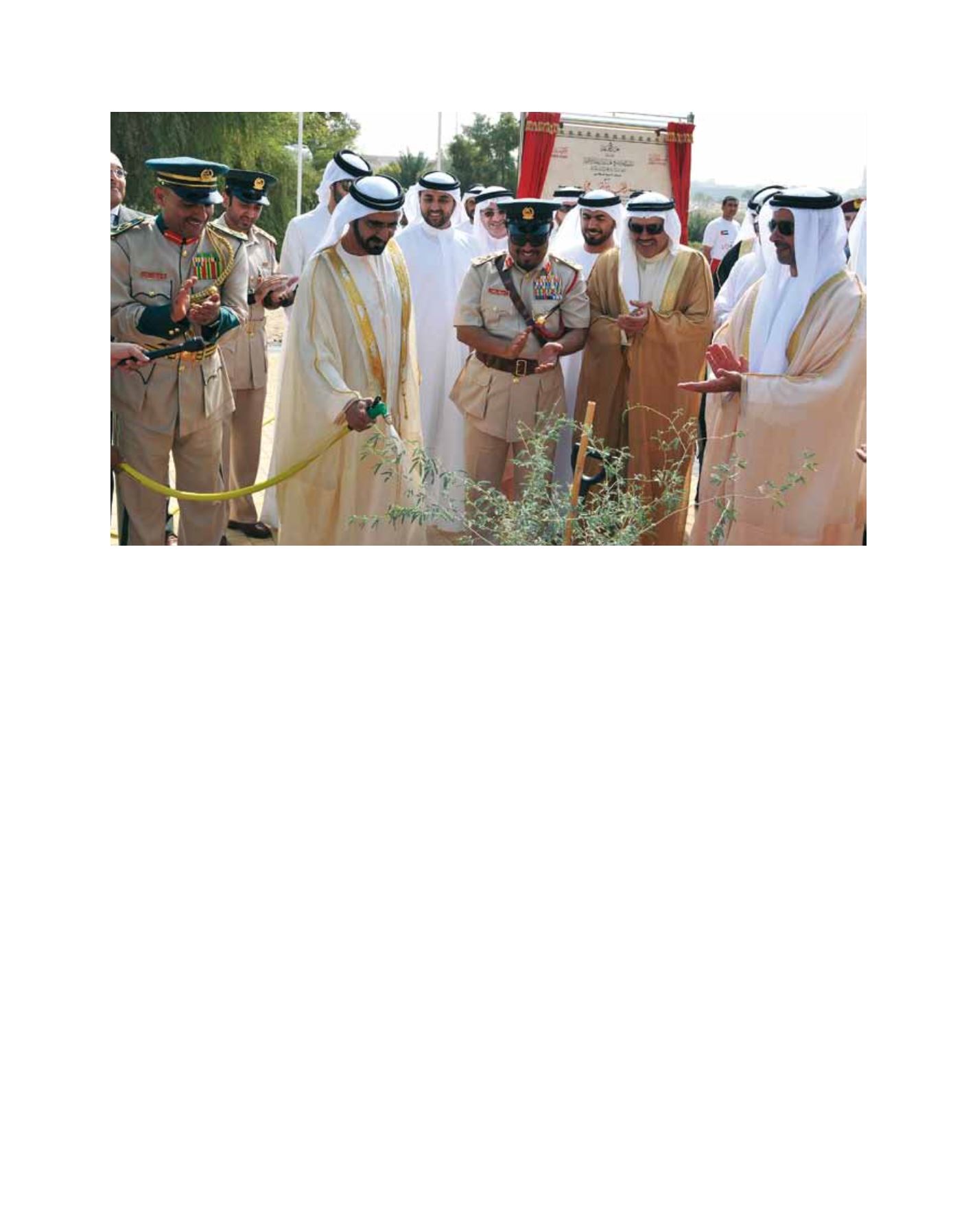
The international Million Tree Initiative launched in the Dubai Police Academy has been honoured by the Zayed Prize
Image: Zayed International Prize for the Environment