



 124 / 208

[
] 124
S
ustainability
P
olicies
, P
rogrammes
and
their
E
conomic
I
mpact
Shipping is a critical link in the liquefied natural gas
(LNG) value chain that extends from Qatar’s North
Gas Field to markets throughout the world. In 2008,
research by Exxon Mobil Corporation in partnership
with Qatar Petroleum resulted in an industry break-
through in LNG carrier design and size, enabling
transport technology that can carry 80 per cent more
liquefied natural gas than current carriers and substan-
tially reducing the energy used per delivered unit.
In 2009 Qatar Petroleum established a partnership
with the World Bank’s Global Gas Flaring Reduction
Partnership (GGFR) programme. This has resulted in
significant changes in gas flaring, despite the increase
in production and expansion of oil and gas facilities.
The joint effort by the GGFR partnership and the US
National Oceanic and Atmospheric Administration
highlighted a 14 per cent reduction of Qatar’s flare
volumes, from 2.2 billion cubic metres in 2009 to 1.9
billion cubic metres in 2010.
1
The National Flaring and Venting Reduction Project
will further reduce emissions from gas flaring, initially
targeting the largest companies responsible for the bulk
of flaring-related emissions. By 2016 the Government
is committed to halving the volume of gas flaring to
0.0115 billion cubic metres per million tons of energy
produced.
As part of its broader economic strategy, Qatar will
continue to exploit its rich hydrocarbon endowment
and further develop its energy-intensive petrochemical
and metallurgy sectors, consolidating its position as a
major force in world energy markets. At the same time,
the country will look for opportunities to diversify its
to rising living standards for a growing population and for future
generations.
Prioritizing sustainable development in industry
While investing in sources of future prosperity, the Government is
adopting and adapting the most effective policies and technologies
for protecting environmental assets and reducing pollution. The
Government also recognizes the imperative of cultivating a sense of
environmental responsibility within industry while building a legal
system, effective institutions and partnerships that support environ-
mental protection over time.
In recent years Qatar has made efforts to prioritize sustainable
development at all levels of economic activity and development, most
notably in the oil and gas industry. Qatar has taken major steps to
reduce carbon emissions – especially from gas flaring, which accounts
for about 12 per cent of total emissions. These steps include legis-
lation to limit emissions, investment in cleaner technologies and
improvements to industrial processes. Innovative research is under-
way at Qatar’s Science and Technology Park on new carbon capture
technology and on sequestration in carbonate reservoirs for storing
carbon dioxide from the oil and gas industries.
In 2007 Qatar introduced its first United Nations Framework
Convention on Climate Change Clean Development Mechanism, the
Al Shaheen Oil Field Gas Recovery and Utilization Project, which
reduced flaring by about 80 per cent. The Al Shaheen Oil Field is a
production oil and gas field off the north-east coast of Qatar in the
Persian Gulf, 180 kilometres north of Doha. The oil field lies over
the North Gas Field, the largest gas field in the world. Currently
there are seven offshore fields, which are under various stages of
development in the North Gas Field. Facilities completed at the
Al Karkara field in 2011 are designed to achieve zero gas flaring by
injecting excess sour gas back into the reservoir.
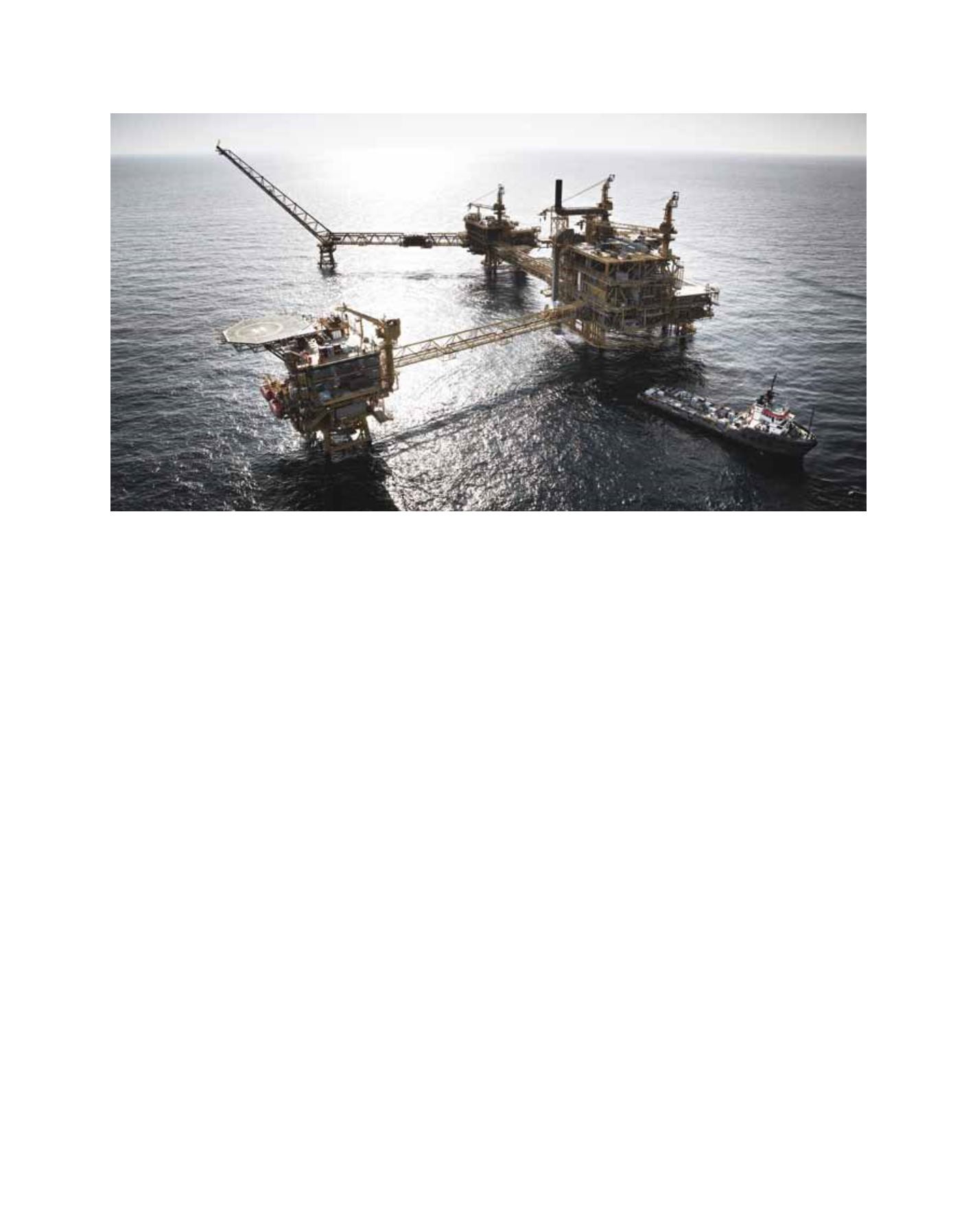
Al Shaheen Oil Field, Qatar is committed to reducing CO
2
emissions from gas flaring through investment in innovative, cleaner technologies and improvements in
industrial processes
Image: Qatar Petroleum/Maersk Oil (2012)