



 191 / 208

[
] 191
Innovating to develop sustainable
environments on an urban scale
Steve Lewis, Chief Executive Officer, Living PlanIT
E
very civilization has contended with powerful trends
that have shaped how and where human settlements are
built. Each has built its cities and expansions of those
cities, with the best technology, materials and skills available
at the time.
Today however, rapid population growth, increasing urbanization,
environmental pollution and resource depletion are some of the
megatrends that will challenge urban dwellers for many years to
come. But when cities for the future are built today most, if not all,
these problems can be alleviated by the best technology available
now. This includes technologies for designing and operating the
urban environment to produce smart sustainable eco-cities run on
clean energy, or ‘living cities’.
Living Cities incorporates key concepts we believe are integral to
successfully envisioning, retrofitting, building and managing cities
in the 21st century including: recognition of the need for contin-
ual evolution, the importance of clear metrics and analytics, the
increased connection between urban dwellers and the buildings
in which they live and work, a sense of possibility and openness,
increased efficiency, generative structures that learn,
agile infrastructures that serve multiple functions and
respond to environmental and other changes, and resil-
ient systems able to recover without breaking down and
resist obsolescence. We see Living Cities as generative,
inclusive, agile, dynamically evolving and resilient.
While both governments and industry acknowledge
that sustainable development is driving innovation, they
are uncertain of how this can be properly structured,
financed and profitably managed, beyond existing prod-
ucts or services. Using the full range of new software,
networking and sensors needed to run a smart city is
enormously complex and beyond the scope of even
sophisticated and well-established industries, partly
because many and diverse technologies and practices
are involved. But it is also because a smart community
can only become cost-effective through efficiencies
created in its planning, design, financing, commis-
sioning, construction and operation. And it can only
be sustainable if built to be economically, socially and
S
ustainable
cities
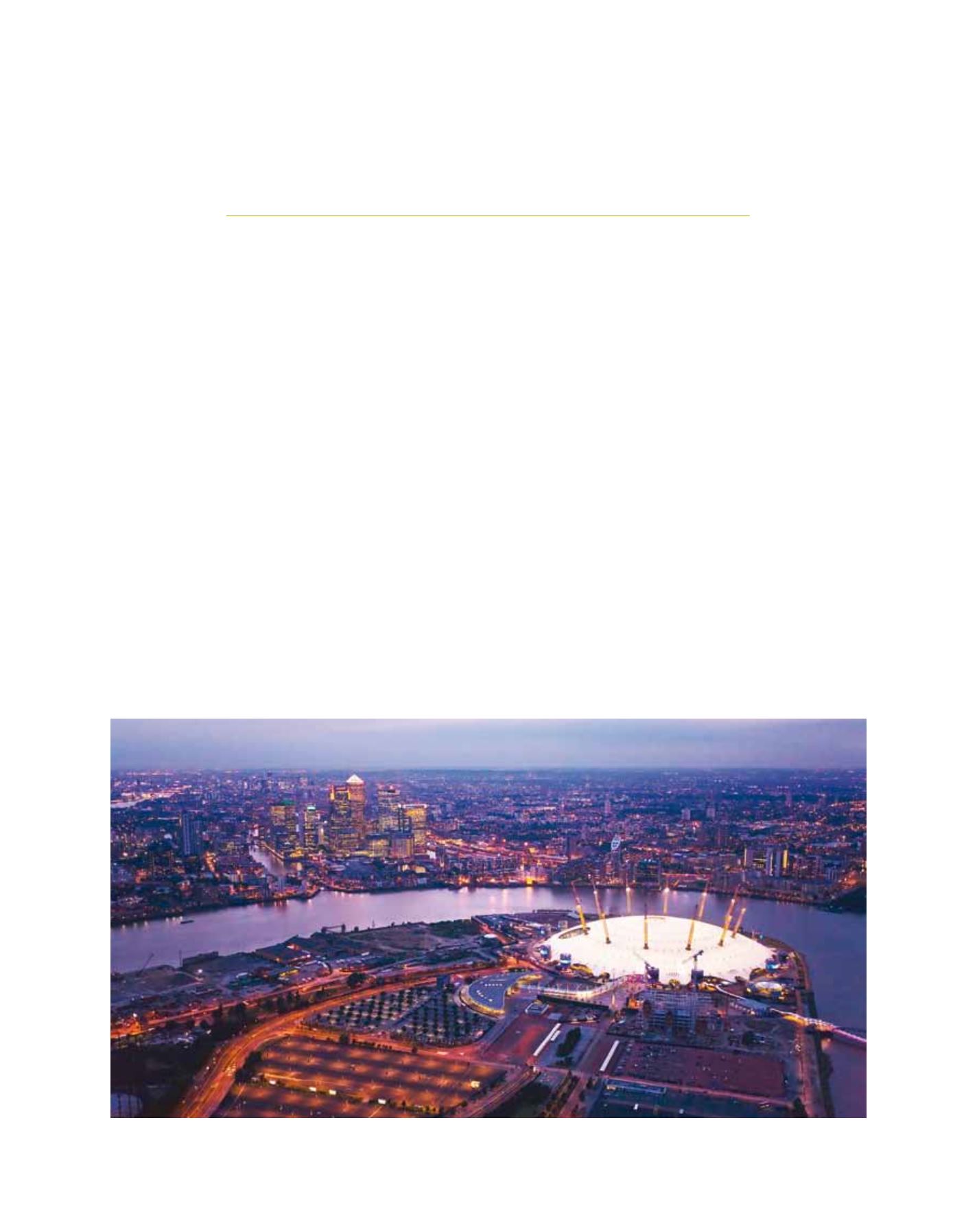
The O2 Centre and the Greenwich Peninsula. Canary Wharf is directly north, opposite the peninsula
Image: Quintain Estates and Development 2012