



 188 / 208

[
] 188
Taking responsibility
for people and the planet
Jana Velichkova, Director, Investments, Innovation and Entrepreneurship,
Ministry of Economy, Energy and Tourism, Bulgaria
T
he 20-year period following the United Nations Conference
on Environment and Development in Rio de Janeiro has
been marked by progress on a number of issues concerning
poverty and imbalance in the environment. Nonetheless, many
issues related to implementation of the Millennium Development
Goals still need to be addressed. A broader and more pragmatic
approach is required to find solutions.
Against the background of these global issues, the attention of the
world public is turning again to Rio. The Republic of Bulgaria, as
a European Union Member State, is involved in efforts to solve the
challenges associated with laying the foundation for the transition to
a green economy and sustainable development. We consider that the
transition to a competitive economy and a society with low carbon
intensity is important to stimulate sustainable growth and inno-
vation, enhance energy security while decreasing dependency on
imported fossil fuels, ensure new jobs, strengthen competitiveness,
improve air quality and diminish risks to human health. The inte-
gration of sector policies concerning climate change is another key
issue. Energy, transport, industry and urban construction all play
important roles in this process.
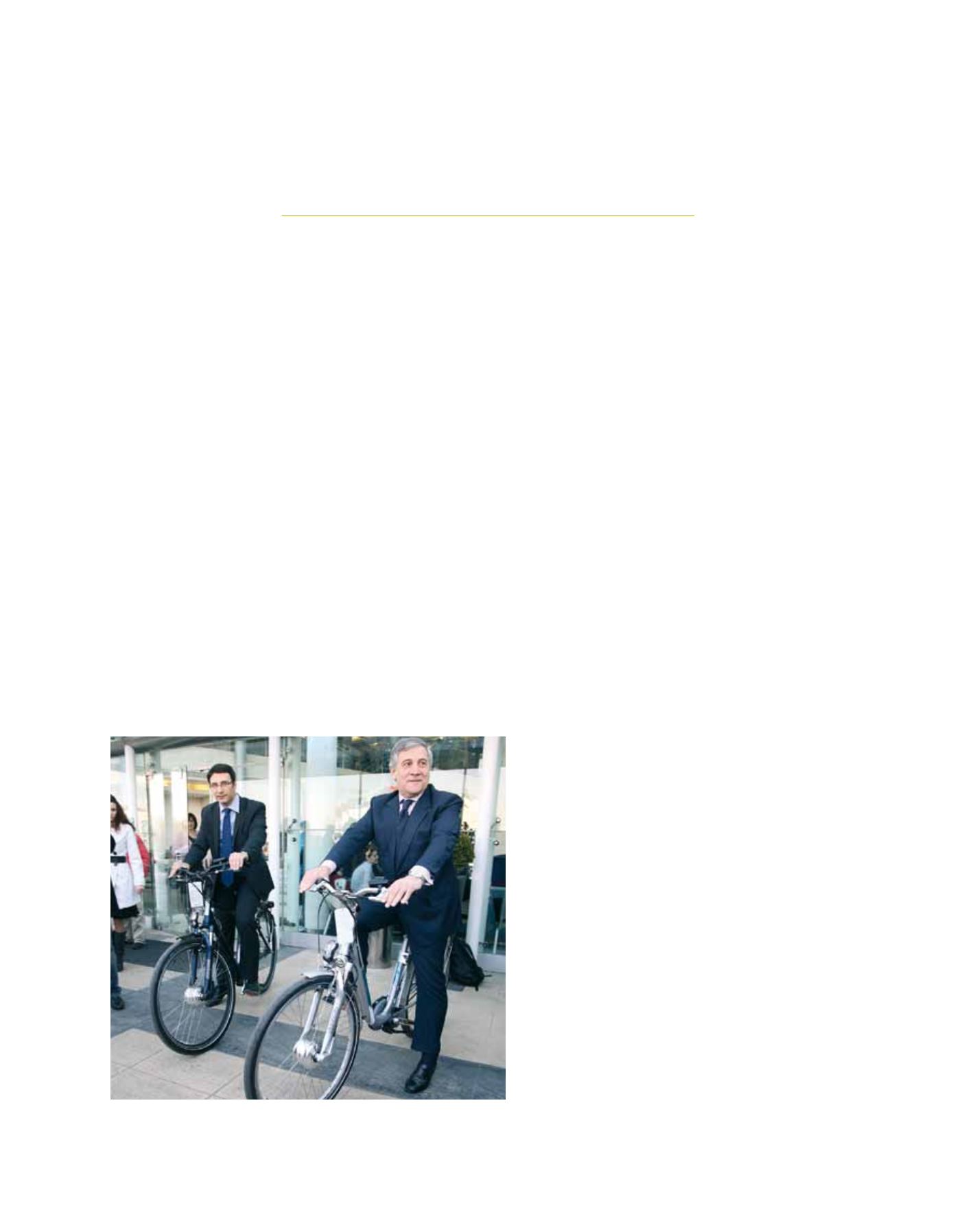
The EU recently adopted several strategic documents
on medium- and long-term planning for low carbon
development. One of these is the European Strategy
on Clean and Energy Efficient Vehicles, which has a
key role to play in implementation of the priorities for
intelligent and sustainable growth. Within this process,
Bulgaria is one of the nine EU Member States that have
signed the Joint Declaration on Electric Mobility in
Europe, which places electric motor vehicles in the
spotlight and offers perspectives on how a competi-
tive approach can combine industrial development and
sustainability.
Bulgaria’s decision to give priority to electric car
production as a part of its development strategy is
based on an economic policy aimed at promoting
investment activities in priority sectors which create
higher added value and increase the competitiveness
of the economy. The electric motor car sector fully
corresponds to this economic strategy. The innova-
tive technology will accelerate the development of
other sectors such as information and communica-
tions technology, intelligent energy networks and
services. Sales of ‘eco’ automobiles are forecast to
exceed €40 billion by 2015, including electric motor
cars and hybrid vehicles.
1
According to the most optimistic prognosis, the share
of ‘eco’ motor cars may exceed 15 per cent of total cars
by 2020, after which it could sharply increase under the
influence of economic and technological factors.
Because this is a relatively new industry, which
will be developed both in Europe and globally, new
market niches and opportunities will emerge. Bulgaria
has traditions, expertise and advantages that equip
it to successfully enter this market. At present many
Bulgarian enterprises, some of them owned by well-
known international companies, partner with leading
automobile companies as sub-contractors of units,
components and auto parts. We expect that they will
also take advantage of the new market opportunities in
the production of electric motor cars and development
of charge networks. The Bulgarian Government pursues
a proactive investment policy in this field. We share the
opinion of some European countries that under good
management, electromobility could be developed to
become one of the key technologies to secure employ-
ment and growth in the next decades.
E
nergy
access
,
efficiency
and
sustainability
The European Strategy on Clean and Energy Efficient Vehicles supports
sustainable growth
Image: Diana Gyncheva