



 183 / 208

[
] 183
E
nergy
access
,
efficiency
and
sustainability
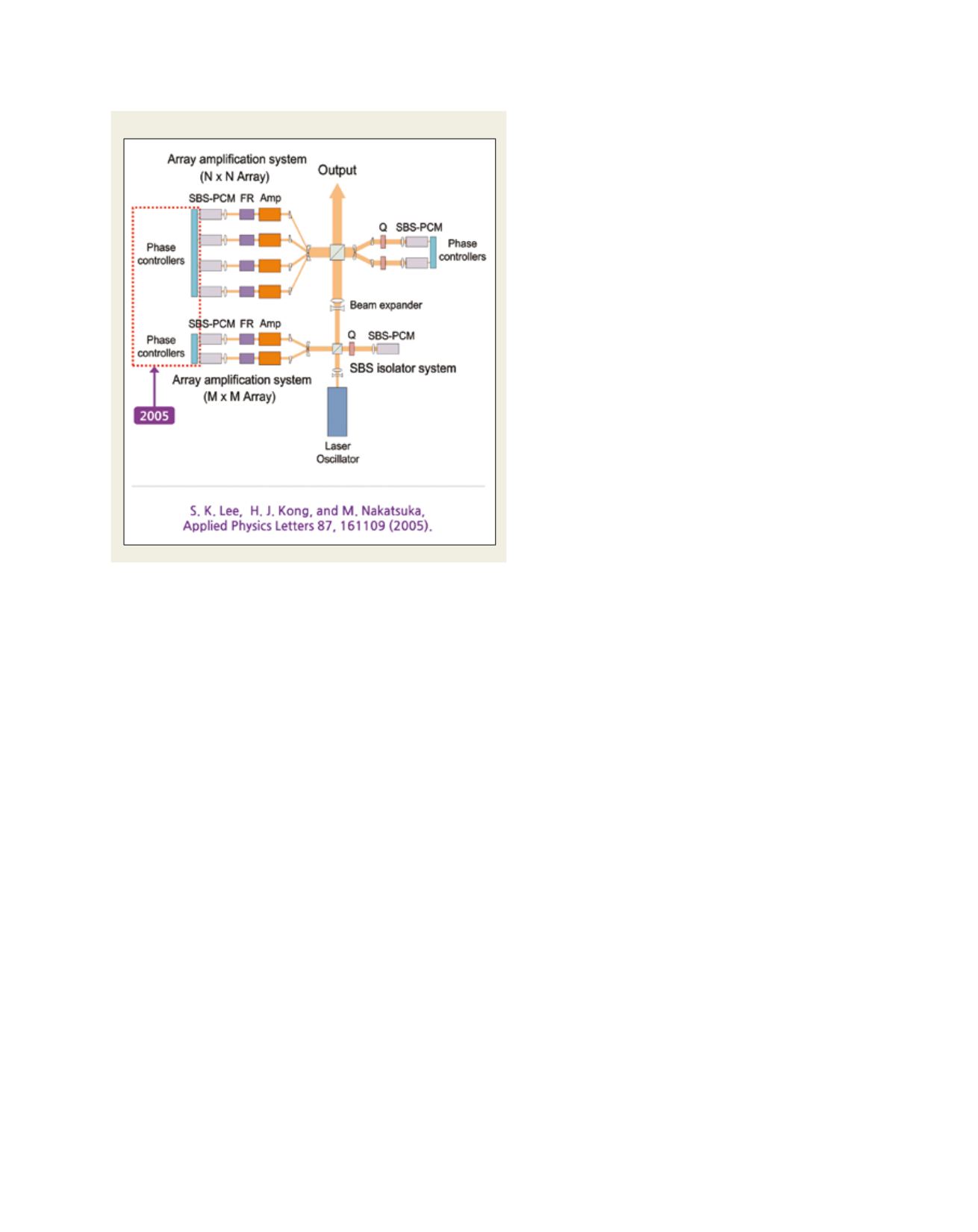
by combining multiple laser beams; for example, the Stimulated
Brilloium Scattering (SBS)-phase conjugate mirror (PCM) method
researched by Professor H.J. Kong at KAIST.
1
Besides, in order
to produce a laser beam with the power and repetition rate high
enough for commercial power generation, the laser medium should
not only be large, but should also be able to be cooled down rapidly.
In order to maximize the energy efficiency of the present laser fusion,
the excess neutrons from the fusion reaction may be utilized to induce
a high-yield fission reaction in the surrounding subcritical fission-
able blanket. The net yield from the hybrid fusion-fission process can
provide a targeted gain of three or four times over that from the fusion
alone, which may be enough to tilt the viability equation of the fusion
energy sooner. For such a technology, development of a subcritical
fissional blanket that can be used within a fusion reactor is imperative.
The atomic power industry in Korea, which has been successful as a
major export industry with its products, should be able to tackle the
task. GILT is collaborating with the existing atomic power industry in
the development of subcritical safe power plants.
The critical technologies vital for the task at this juncture are the
laser diode, which is the key for the high power and high repeti-
tion rate laser, and the technology for design and qualification of
an unconventional and safe reactor. Fortunately, Korea also has
strength in the solid-state electronics necessary. GILT is partnering
with the major IT industries in Korea to develop laser diode produc-
tion technology to lower the cost of laser-driven power plants.
For this kind of research, education not only for the existing
researchers but also for future researchers is imperative. Education
is paramount because the endeavour demands not only a steady
supply of experts to develop the necessary core technology itself, but
also active participation of the entire global community including
developing countries. Higher education has a vital role
to play in shaping the way in which future generations
learn to cope with the complexities of sustainable devel-
opment. In order to cultivate the emerging new fields
of green science and laser technology, the Handong
Graduate School of Advanced Green Energy &
Environment (HGS AG&E) opened in September 2011
to offer Masters and PhD level programmes in the fields
of laser technology and green science. HGS AG&E is
partnering with the UNESCO/UNITWIN International
Centre for Global Development and Entrepreneurship
at HGU and the United Nations mandated University
for Peace Asia-Pacific Centre.
UNAI Global Hub for Capacity Building
HGUhas had a global educational vision since its opening
in 1995, and it has been focusing on global education
for capacity-building of sustainable development ever
since. As a result, in April 2007, UNESCO designated
HGU as the UNESCO/UNITWIN International Centre
for Capacity Building of Sustainable Development.
In January 2011, the United Nations also designated
HGU as the United Nations Academic Impact (UNAI)
Global Hub for Capacity-Building,
2
which focuses on
the following three fields:
• global collaborative research for green growth for
sustainable development through GILT
• education for global development and
entrepreneurship to strengthen endogenous
capacity-building for sustainable development in
developing countries
• global partnership for prosperity through the
reduction of the knowledge gap between developed
and developing countries, through the ongoing
programme of UNESCO/UNITWIN capacity-
building for sustainable development.
Pursuing the goal of ultimate energy for green
growth
In solving the global issues facing us in the twenty-
first century, global collaboration is essential. As
the frontier research programme for green technol-
ogy for sustainable development of green growth,
GILT of HGU in Korea, in partnership with NIF of
LLNL in the US, will focus on the development of the
high power and high repetition rate laser with self-
navigation capability, which will serve as a beacon in
the quest for the holy grail of ultimate green energy
for commercial power generation. For that effort,
GILT, in cooperation with the Government of the
Republic of Korea, is aiming to develop a pilot-scale,
stable atomic fusion energy, fusion-fission hybrid
power plant of a 500MW class by 2030 through
domestic and global collaboration.
Through global collaborative research between GILT/
HGU and NIF/LLNL, the long-sought ultimate dream
of bringing star power to Earth as the limitless and
ultimate green, clean energy source for sustainable
development could finally be realized by the year 2030.
Wavefront dividing method
Source: Handong Global University