



 180 / 208

[
] 180
The quest for the ultimate energy for sustainable
development through laser technology
Young-Gil Kim, PhD, President, Handong Global University, Korea
A
t the World Future Energy Summit in January 2012,
the United Nations called for action to achieve
sustainable energy for all by 2030. “We are here to
build a new energy future… A future that harnesses the
power of technology and innovation in the service of people
and the planet,” said United Nations Secretary General
Ban Ki-Moon in his opening remarks at the summit in Abu
Dhabi, United Arab Emirates. Ban Ki-Moon stressed that
energy is central to everything, from powering economies to
achieving the anti-poverty targets known as the Millennium
Development Goals (MDGs); from combating climate change
to underpinning global security. He emphasized the need to
scale up successful examples of clean energy and energy-effi-
cient technologies, innovation that can spread throughout the
developing world, partnerships with the private sector, and
visionary leadership.
In June 1992, the Rio Declaration on Environment and
Development proclaimed in its ninth Principle: “States
should cooperate to strengthen endogenous capacity-
building for sustainable development by improving
scientific understanding through exchanges of scientific
and technological knowledge, and by enhancing the
development, adaptation, diffusion and transfer of tech-
nologies, including new and innovative technologies.”
In order to address the development of green tech-
nology for sustainable development in the twenty-first
century, the construction of global research networks
has never been so vital.
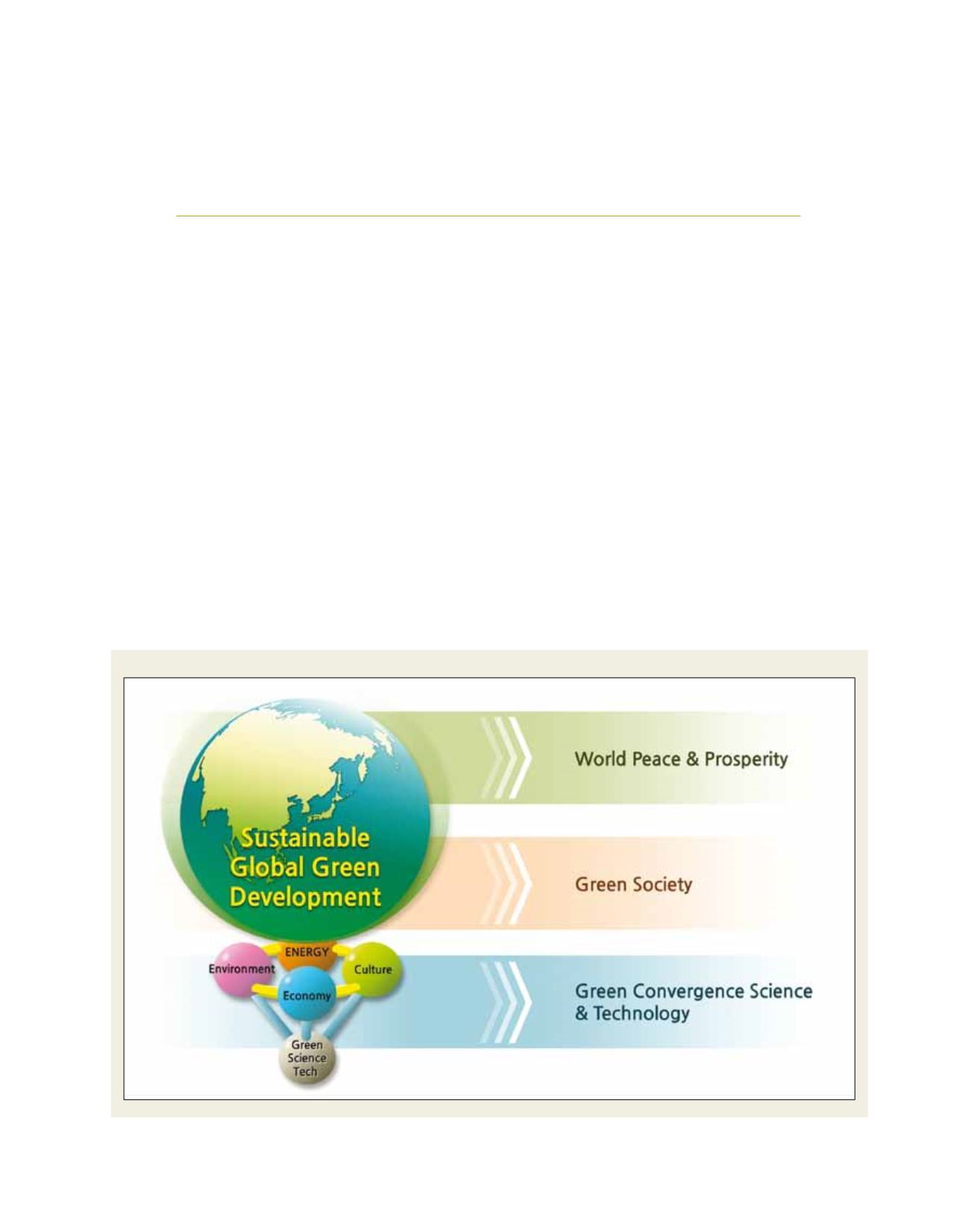
Green technology for sustainable development
In the technology-driven world of the twenty-first
century, the global community is confronted with a
E
nergy
access
,
efficiency
and
sustainability
The role of green science and technology
Source: Handong Global University