



 178 / 208

[
] 178
S
ustainability
P
olicies
, P
rogrammes
and
their
E
conomic
I
mpact
reduce the risk of loss of ecosystem service flows in the
face of disturbances in the environment. People directly
consume provisioning and cultural services. When
combined with elements of built (or technical) and
human (labour) capitals, these services generate products
that have market values. There are buyers and sellers, and
each product’s value can be estimated from this interac-
tion. As a consequence, provisioning and cultural services
are an important part of the flows of goods and services
that compose national and global economies.
Transforming societies towards HSE
To move from a traditional economy towards HSE,
societies have to be prepared to follow a different devel-
opment path. We envision six major transformations.
The first transformation requires that societies main-
tain their critical natural capital. Critical natural capital
is the portion of a region’s natural capital that is irre-
placeable for the functioning of the ecosystem, and
hence for the provisioning of its services for local soci-
eties. We believe that without critical natural capital,
societies are not resilient against global changes and
cannot sustain socioeconomic development. The
conservation of critical natural capital requires careful
design and implementation of networks of protected
areas, as well as all other strategies that seek to maintain
or restore ecosystems outside protected areas.
perform labour so as to produce economic value. Social capital
includes institutions and social relations that determine, depending
on the context, how efficiently the first three types of capital can be
combined (for example, governance).
The four capitals outlined above comprise the productive base of an
economy. However, non-renewable natural capital (nature and its serv-
ices) underpins all other capitals. Its contribution to an economy is best
understood through an analysis of its services. Ecosystem services are
defined as the direct and indirect contributions of ecosystems to human
well-being. There are four major categories of ecosystem services:
• Habitat or supporting – those services associated with the
maintenance of species and all ecological processes that
comprise the base for all other ecosystem services
• Regulating – those services that ecosystems provide by regulating
the ecological processes that are critical for human survival, such
as air quality, flood and disease control, pollination and biological
control
• Provisioning – those services that provide the material outputs
from ecosystems, such as water and food
• Cultural – those services that include the non-material benefits
(for example aesthetic, spiritual and psychological) that people
obtain from contact with nature.
Supporting and regulating services influence one another. They are
mostly intermediate ecosystem services; those that are not directly
consumed by people but which underpin the production and/or flow
of other services. Regulating services have insurance values, as they
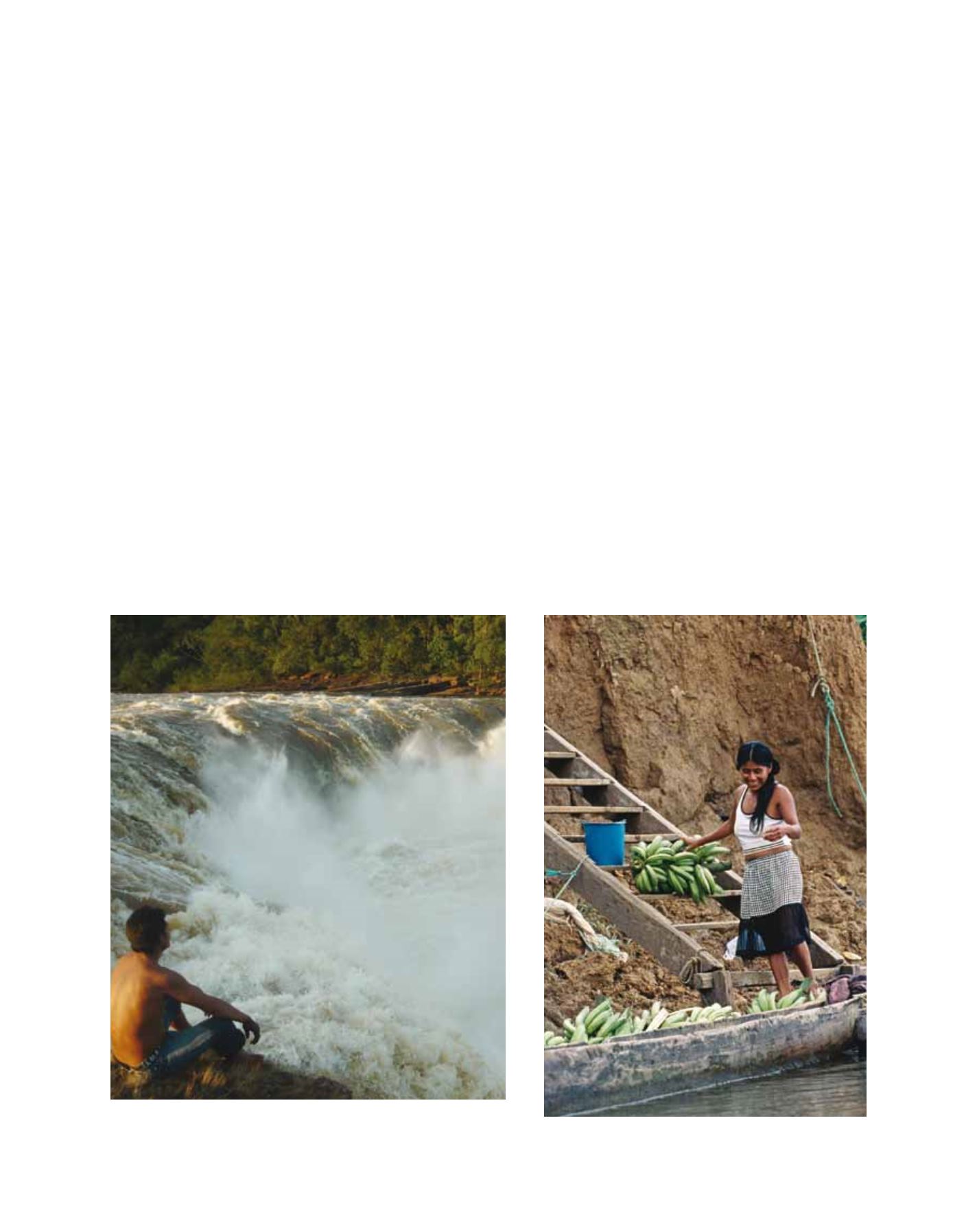
The Apaporis River in the Colombian Amazon: non-renewable natural capital
must be protected
Local community, Choco Manabi corridor, Ecuador 2006
Image: ©Isai Victorino
Image: ©Conservation International/photo by Haroldo Castro