



 182 / 208

[
] 182
E
nergy
access
,
efficiency
and
sustainability
a diversification of energy sources, and can offer a model for the
sustainable, clean energy we seek.
Bringing star power to Earth
For the last 50 years or so, it has been recognized that nuclear fusion
may provide a highly attractive solution to society’s demand for safe,
secure, environmentally sustainable energy on a scale that would
meet its long-term needs. The clean sources of energy pursued
currently by mankind all originate from the Sun’s energy, which
is itself generated by the nuclear fusion reactor of the Sun located
in space. The nuclear fusion reactor described above is essentially
an artificial realization on Earth of the ultimate source of the Sun’s
energy, and may be the answer to the quest for the ultimate source
of energy. There are two major alternatives to this nuclear fusion:
magnetic field and laser inertial confinement. Despite its tantalizing
benefits, laser inertial confinement fusion has largely been ignored
in energy policy discussions. It has been viewed as a technology too
immature to affect energy production over the next few decades,
when it is most needed. However, drawing on huge investment
in the Laser Inertial Fusion Energy (LIFE) research programme
conducted by the National Ignition Facility (NIF) at the Lawrence
Livermore National Laboratory (LLNL) of the Department of Energy
of the US, and linking it with recent innovations in the semiconduc-
tor industry, we are about to see a major shift in the paradigm for
using atomic energy, from conventional nuclear fission (atoms split-
ting) to nuclear fusion (atoms fusing) for new power generation.
Dedicated in May 2009, the NIF is the world’s largest and
highest-energy nuclear fusion system. Its goal is to ignite a self-
sustaining nuclear fusion reaction and produce net energy gain
(more fusion energy out than the energy the laser beams deliver
to the target) – the very same fusion energy genera-
tion process that makes the stars shine and the Sun
provide life-giving energy. NIF’s 192 laser beams are
capable of directing nearly 2 megajoules of ultraviolet
laser energy in billionths of a second to a fusion target.
Global Institute of Laser Technology
In response to the need for safe, secure, environmen-
tally sustainable energy, the Global Institute of Laser
Technology (GILT) was established in May 2009 at
Handong Global University (HGU) in Pohang, Korea
through the formation of a global network of universi-
ties, research institutes and industries in the field of
laser fusion energy. In December 2011, HGU signed
an agreement with LLNL in Livermore, California to
promote collaboration in the design and development
of power plants based on LIFE for an abundant, inher-
ently safe, cost-effective, low-carbon and low-waste
source of base-load electricity.
GILT is now cooperating with the NIF while search-
ing for complementary core technologies as well as
alternatives to those being worked on now. As for the
development of a high repetition rate power laser tech-
nology, GILT possesses its own technology for which
it is trying to improve its power. So far, the laser fusion
community has not yet found a solution for a laser
driver with high enough energy (>500 kJ) along with a
high enough repetition rate (>10 Hz) with an alignment
precise enough for the target. The solution to the high
power/high repetition rate problem can be achieved
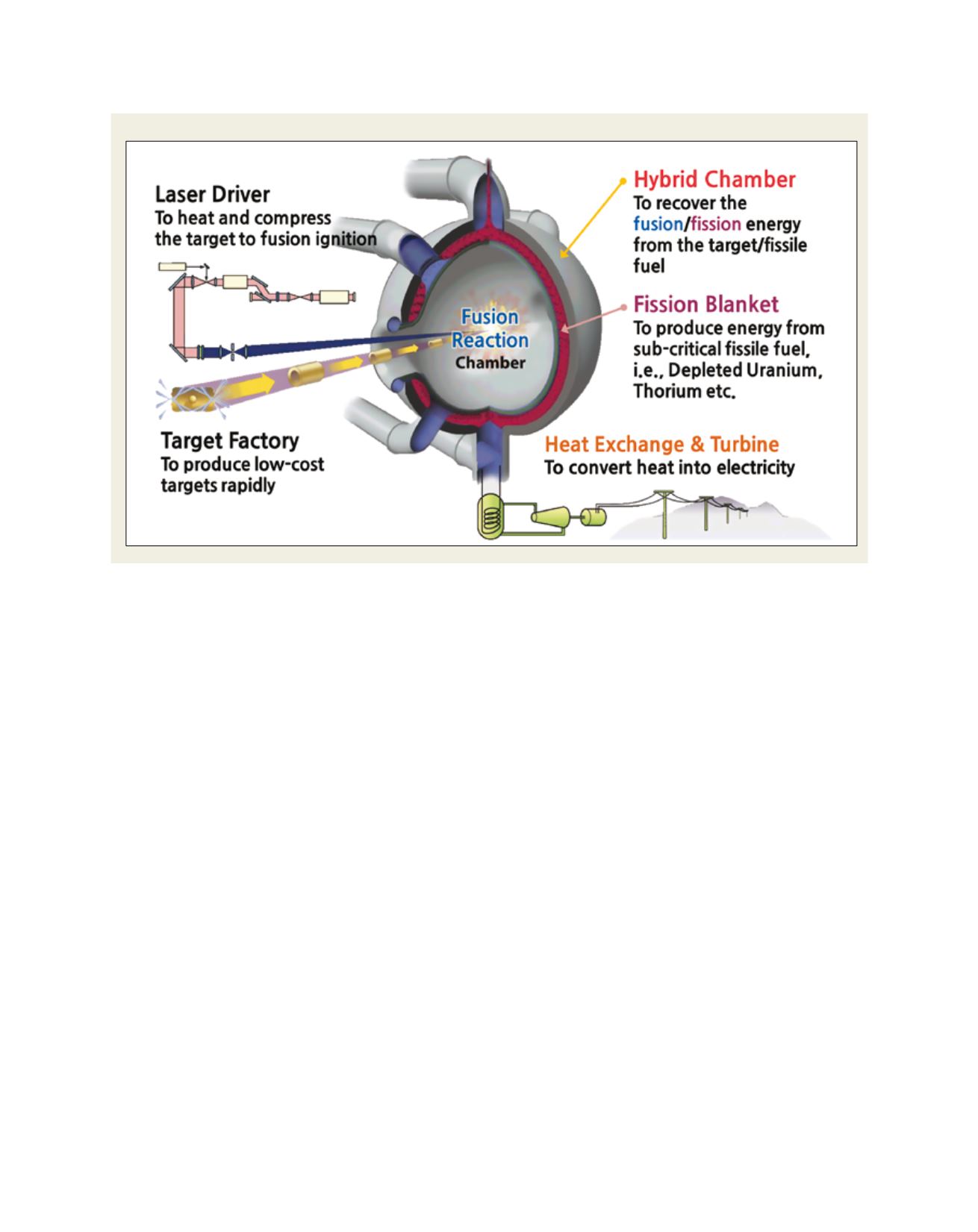
Conceptual design of a stable atomic fusion energy hybrid power plant
Source: Handong Global University