



 193 / 208

[
] 193
S
ustainable
cities
Led by Living PlanIT with Cisco Systems and Infusion as part-
ners, this initiative encourages independent developers to write
applications for retail and transportation uses. General Electric,
Hitachi Consulting Company and Philips have all recently formed
partnerships with Living PlanIT, with some considering locating
research and development resources at the Peninsula so that they
can integrate their technologies with the UOS and establish their
interests there. The companies will eventually work together to put
in place technology strategies that will optimize and integrate build-
ing control systems and promote utility efficiency. The collaboration
will lead to a wide range of new choices for residents, workers and
students at the the Peninsula, by enabling the development and
distribution of applications on the UOS platform – essentially a
Windows for the built environment.
To research and perfect new urban technologies at full scale,
Living PlanIT hopes to deploy its technologies with selected strategic
partners. Living PlanIT, the Lend Lease Corporation and Quintain
Estates Development are discussing the introduction of innovation
in real estate operation and efficiency at the Peninsula, using Living
PlanIT’s UOS as the centrepiece for management of the growing
digital community in London. The move is attracting major technol-
ogy companies to the Peninsula development, which is a £5 billion
programme that will create a new district of 10,000 homes along with
22,500 new jobs over the next decade.
Achieving sustainable development goals
The wider adoption of smart city concepts would impact on urgent
problems such as population growth, increasing urbanization,
climate change and resource depletion. These well-designed and
well-managed smart eco-cities can be net energy producers – carbon
neutral and powered by waste recycling and clean energy sources.
Smart cities can be cost-effective investments due to
efficiencies created in their planning, design, financing,
commissioning, construction and operations.
Smart technologies provide significant economic
development, growth and job creation opportunities
by opening up new production sectors. Public sector
investments for urban development can be significantly
reduced when financing smart sustainable cities in part-
nership with the private sector, because they are able
to become self-financing. New urban growth can be
absorbed in cost-effective ways to limit new slum and
informal settlements formation, particularly in least
developed countries. It is crucial that governments
provide the appropriate policies along with the fiscal
and regulatory environments to support private sector
collaboration.
Sustainable development policy
Despite these advantages, the widespread adoption
of smart cities requires the long-term commitment
of public institutions and private sector partners for
sustainable development to fully benefit from the latest
and best technology. Municipal governments need to
embrace smart city concepts in their planning, zoning
and regulatory requirements. Policies to stimulate
private sector innovation and promote the wider appli-
cation of smart city concepts need to be developed,
documented and disseminated.
Companies involved in smart city investment need to
engage with urban planners, architects, municipalities
and national governments on classifications and tech-
nology choices. There is also a need to design smart
city technologies for developing countries and capac-
ity-building to managing these, so that existing urban
software systems for municipal services, such as traffic
control, public lighting, waste treatment and energy
networks can be rationalized for efficiency gains.
The cost-effectiveness of investments in smart cities and
their capacity for innovative financing must be carefully
analysed to determine the positive impact of efficiencies
created from urban planning, architectural design, financ-
ing, commissioning, construction and operations.
A proof-of-concept smart city development is needed
to serve as a test bed for smart technologies; a centre
for publicizing innovation and an incubator for tech-
nology start-ups, demonstrating how public-private
engagement across multiple industries and levels
of government can work. This model city would be
designed to show that collaborative communities can
research, develop and demonstrate integrated urban
technical, economic and social infrastructure. It would
seek to integrate companies, education and government
into the urban environment.
In order to promote greater international cooperation
in this field, the terms, definitions and units of measure-
ment of smart eco-cities will require greater attention
so that they may contribute to establishing international
norms, standards and trade. The term ‘living cities’, as
described here, deserves careful consideration.
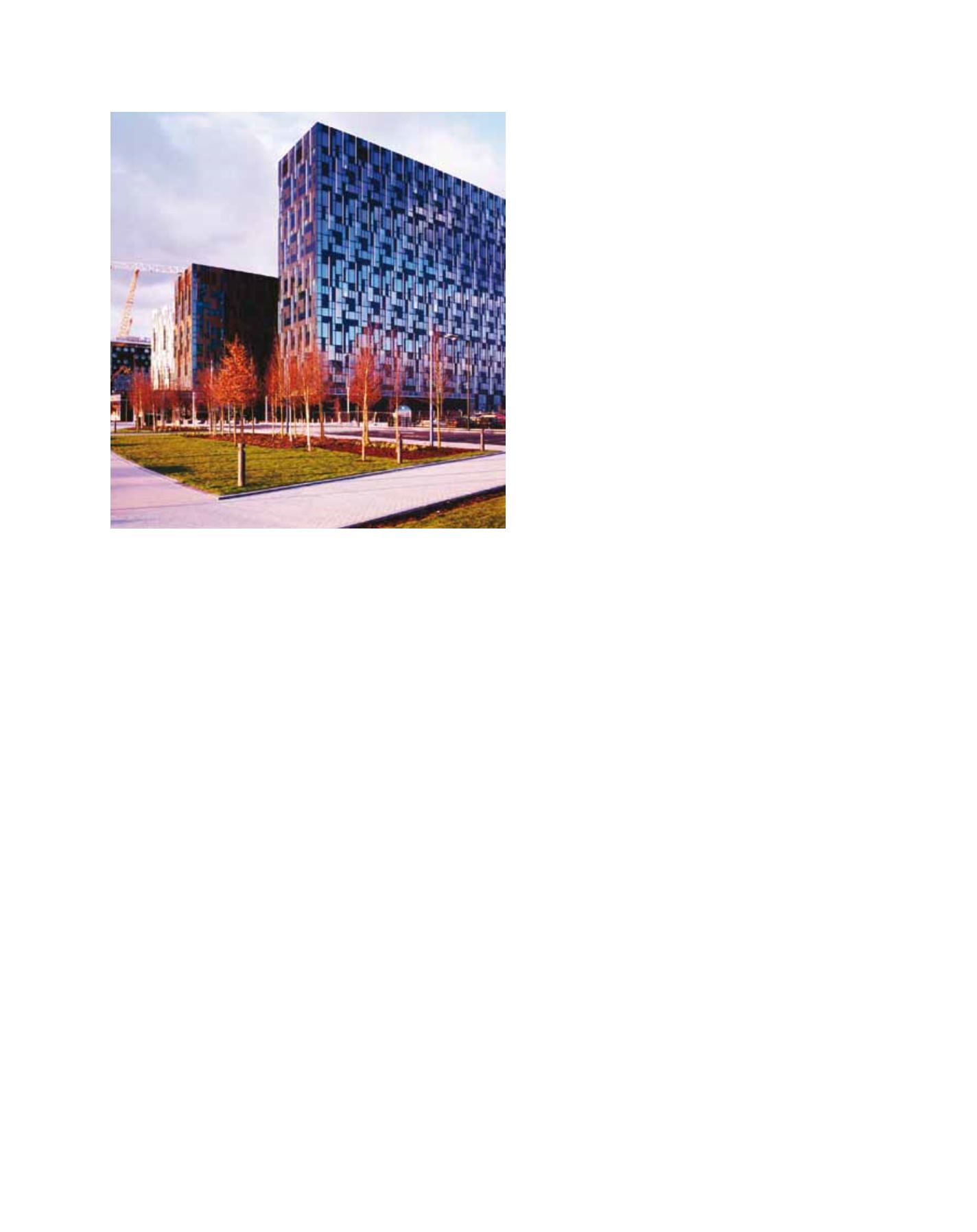
6 Mitre Passage is a green office building at the heart of central London’s newest
business district
Image: Quintain Estates and Development 2012