



 198 / 208

[
] 198
S
ustainable
cities
of the Communication Strategy for Sustainable
Development and adopted by the Government in
2010, to support implementation of the NSSD while
promoting the sustainable development concept and
enabling the public to understand it. The goal of this
document was to ensure a strategic and coherent
approach from the various ministries communicating
with the public on issues of sustainable develop-
ment and to strengthen the inter-sectoral cooperation
within Government. As a result of their cross-sectoral
nature, both strategies required new and permanent
institutional mechanisms for their implementation.
Innovative policy design is the way forward
One of the most recent innovative policies embedded
within the integrative approach to policy design is the Law
on the Legalization of Informal Objects. The problem of
illegal and informal construction impacts many reinforc-
ing aspects of development in Montenegro, including
economic capabilities and possibilities, disaster risk over
extended infrastructure and stress on ecosystem services.
In the most underdeveloped region of Montenegro, the
north, the likelihood of living in an informal settlement
increases proportionately with the poverty rate, result-
designed, are unlikely to be implemented effectively and efficiently.
So in 2011, the Government of Montenegro established two perma-
nent multi-sectoral bodies for sustainable development, comprising
representatives from each ministry. The former Office for Sustainable
Development acts as secretariat to these bodies, a necessary precondi-
tion for their effective work.
Integrated policies as preconditions
Strengthening the institutional system has been followed by increased
integration of sectoral issues when both designing policies and dealing
with some of the key development-related challenges. The first
strategic document amalgamating all three pillars of sustainable devel-
opment and giving a long-term development vision of Montenegro
was the NSSD.
• The NSSD was prepared through a process of wide consultations
and the assistance of international partners (UNEP/MAP, UNDP,
Italy). Adopted during 2007 in an integrative and balanced
manner, with a five-year action plan, it contains measures for
concretization of the five NSSD-defined visions of sustainable
development of Montenegro, including ethical and cultural
goals, alongside economic, social and ecological development.
The NSSD will be revised after Rio+20
• The all-encompassing participatory spirit in which the
NSSD was created has been replicated during preparation
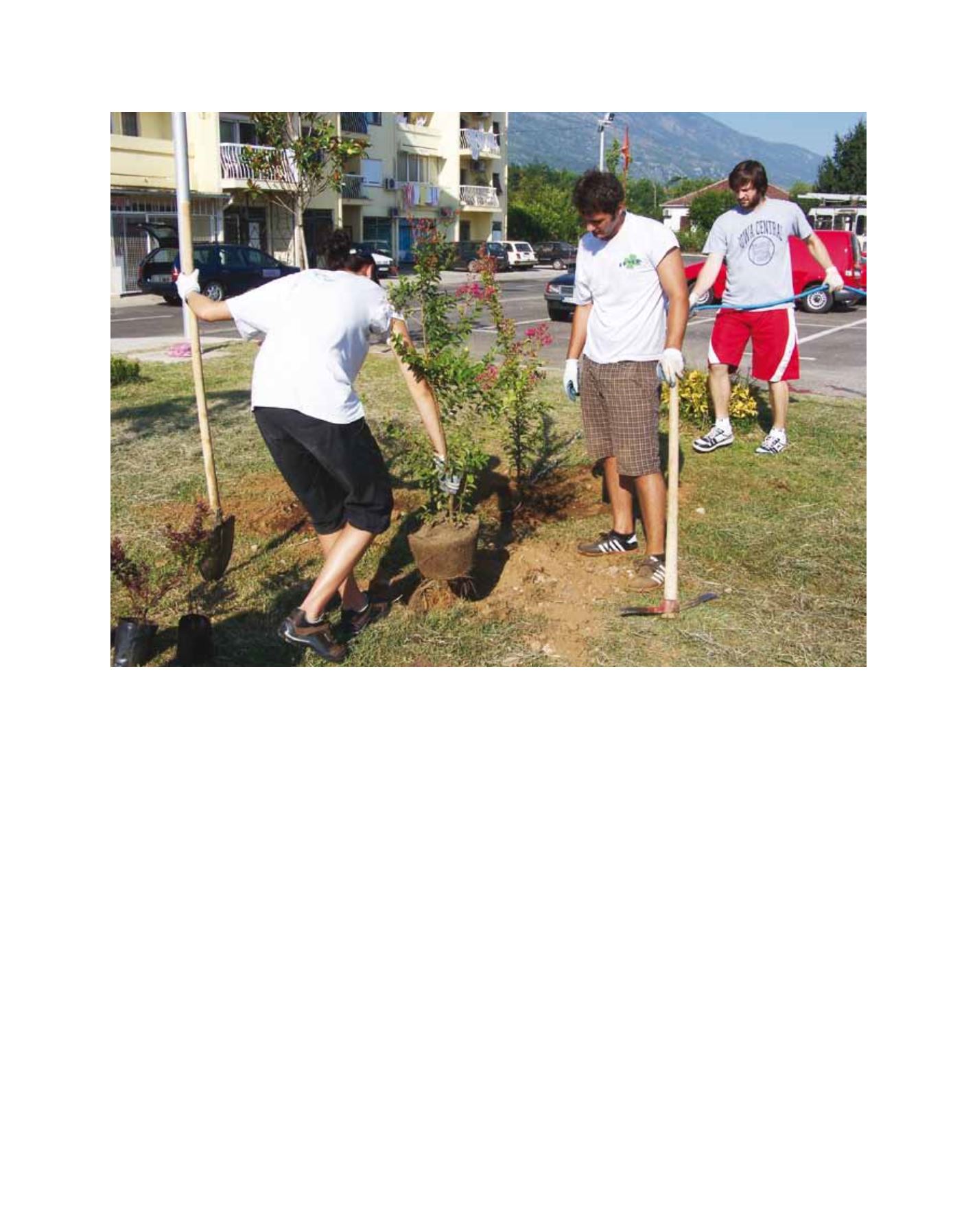
Students and youth volunteers responding to the call from the Local Council for Sustainable Development in the Municipality of Danilovgrad to join in greening the city
Image: NGO ADP ZID