



 201 / 208

[
] 201
R
esilience
and
disaster
preparedness
Oceans, Singapore’s geographic location shelters it from
most natural disasters. However, during its earlier years
of nation-building, Singapore could not insulate itself
from man-made menaces such as ethnic conflicts, high
levels of unemployment, lack of sanitation and scarcity
of potable water – all of which affect peace, stability
and security, and in turn influence growth.
Major policies, strategies, mechanisms and activi-
ties were adopted and adapted to mitigate Singapore’s
vulnerabilities, promote peace and stability and estab-
lish foreign investors’ confidence for international trade
and economic development. The Government also
exercises perpetual vigilance on and social discipline
of its population, implementing extensive research and
careful planning to preserve elements which determine
its independence and development. This paired empha-
sis on vulnerability and excellence is the basis of the
country’s unique and sustained success.
Conversely, the massive floods in Thailand during
2011 affected its rice harvest by almost 6 million tons.
As Thailand is the world’s largest rice exporter, such
losses not only impacted the country’s ability to meet its
export contracts, but also put further pressure on global
commodity prices. The disaster also rippled through the
supply chains of Japanese automobile and electronics
makers in Thailand, as parts shortages affected opera-
tions across the globe. More than 200,000 workers from
these industries in Thailand were affected. Thailand’s
With critical factors such as rapid urbanization, environmental degra-
dation, population growth and climate change, more communities are
occupying densely-populated high-risk areas, heightening their vulner-
ability to disaster impacts. While governments have placed emphasis on
disaster risk reduction in disaster management planning, real investments
into longer-termmitigationmechanisms and activities remain insufficient
and disproportionate to the scale and intensity of imminent threats. The
cost of inaction or lack of investment could be disastrous for human
lives and economies, both for Asia and the rest of the world. Failure to
establish and ensure peaceful and stable environments not only thwarts
development potential, but could also destroy what has been built.
Maintaining peace and stability
Development can be defined as providing improved access to basic
human essentials including potable water and proper sanitation, basic
housing, healthcare, sufficient livelihood opportunities, and structured
education with emphasis on knowledge acquisition and employability.
Achieving peace and stability – the key prerequisites of devel-
opment – means overcoming or mitigating the vulnerabilities that
affect them, and nations that have consciously addressed these
issues have gone on to develop and prosper.
A significant example is the island state of Singapore. Despite its
limited size and natural resources, including lack of self-sufficiency in
food and potable water supply, Singapore has seen rapid development
of its people and economy – ascending from a Third World state to a
First World nation within three decades of its independence.
Apart from its remarkable natural harbour occupying a prized
location at the junction of communications of the Indian and Pacific
Case study 1: Storm Washi – Mindanao, the Philippines
In December 2011, severe tropical storm Washi struck Mindanao,
bringing over 142 millimetres of rainfall within 12 hours and triggering
deadly flash floods from three major rivers.
A total of 624,600 people were affected as 1,470 people died, 1,074
were unaccounted for, nearly 2,020 were injured and 430,500 were
displaced. An estimated US$39 million was required for immediate
relief activities.
Within 48 hours of the international appeal by the Philippines
Government, Mercy Relief (MR) was in Mindanao to help address the
critical and essential needs of the affected communities. MR’s five-
week relief engagement included a food programme, provision of clean
drinking water and tarpaulin sets to help displaced families overcome
overcrowding issues at evacuation centres and avoid the risk of disease.
A psycho-socio programme provided books and games to enable children
to learn and play while taking their minds off the trauma.
The devastation caused by Washi had varying impacts on neighbouring
municipalities. Communities in Cagayan de Oro and Iligan were badly
affected, while those in Gingoog experienced minimal damage.
Gingoog’s resilience was due to a community-based disaster
preparedness and risk reduction programme that had been implemented
by MR in collaboration with the Citizens’ Disaster Response Center, a
local non-governmental organization, following typhoon Ketsana in 2009.
The programme included the formation of community-based disaster
preparedness committees (DPCs), educational workshops on disaster
preparedness, community-wide drills and natural resource management
at 24 landslide and flood-prone communities over seven municipalities
and three cities, including Gingoog.
With the instilled culture of preparedness, the village DPC and residents
of Gingoog continuously monitored the increasing intensity of Washi,
measured rising water levels and rainfall, and rang church bells to warn
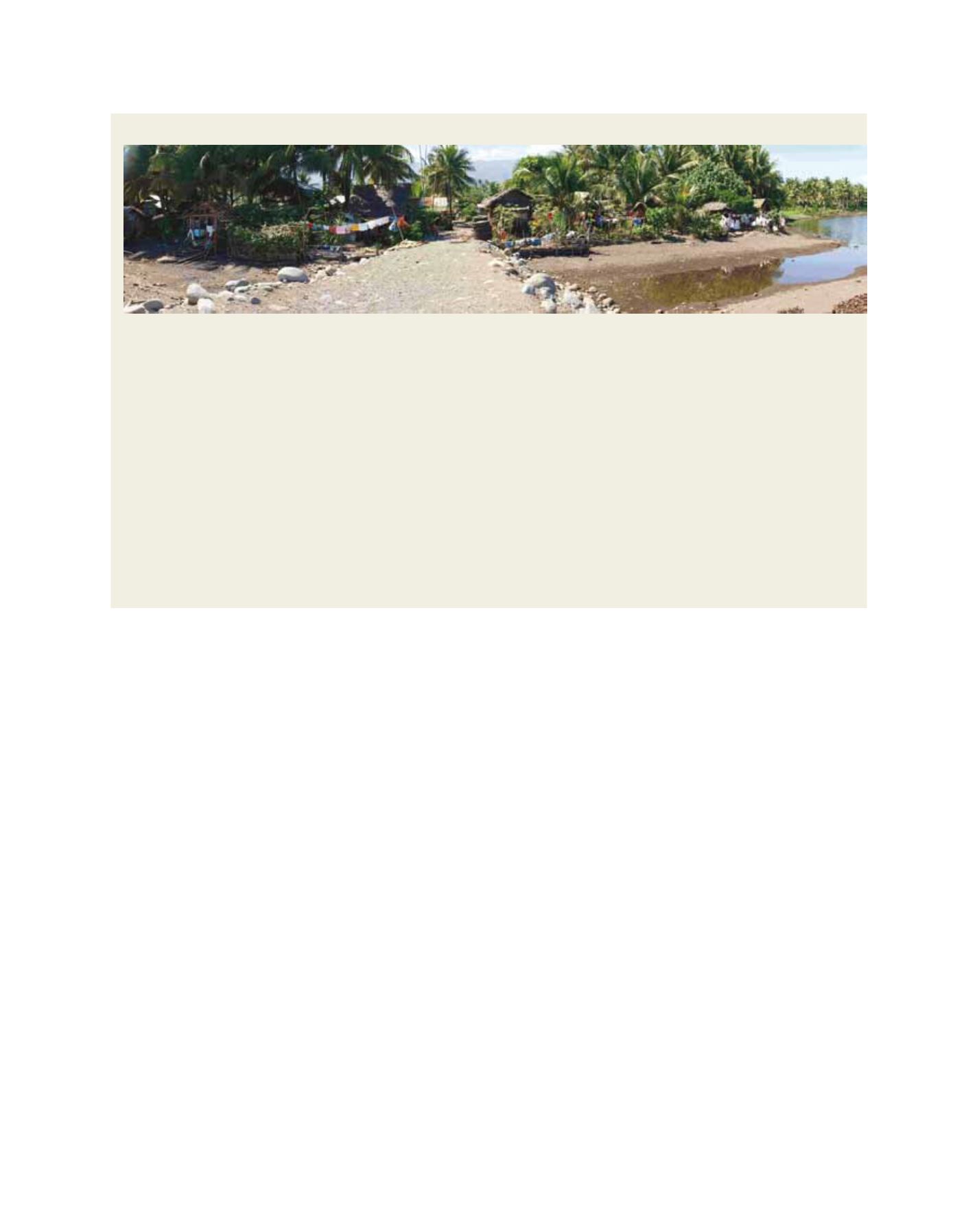
villagers to evacuate to higher ground. A two-metre high breakwater,
built during the CBDPRR programme as part of its structural defence,
prevented river waters from overflowing into the villages so that only 100
of the 600 households experienced a mere half-metre of flooding.
The resilience of these communities illustrates the effectiveness of
investment in adaptive DPRR activities, which put them in a better
psychological state to manage, overcome and recover from a disaster
with minimal physical and psychological trauma.