



 202 / 208

[
] 202
R
esilience
and
disaster
preparedness
lack of risk prevention and intervention caused several
major Japanese companies, Thailand’s largest foreign
investors, to consider diversifying investments inside
Thailand and to other countries. Foreign investors’
confidence waned, which will affect local economy and
livelihood opportunities.
Risk reduction and adaptation
Natural disasters are no longer seen as extreme events
created solely by forces of nature, but as manifestations
of unresolved development problems. In any vulner-
ability analysis there are no straightforward solutions.
Multidimensional approaches and innovative institu-
tional arrangements are required to reduce the risks
of future harm or loss and threats to planned devel-
opment. Hazard assessment must include economic,
physical, social and political risks.
Despite rapid economic growth and structural trans-
formation in Asia, poverty remains high and the poor
are the most vulnerable to natural disasters. In order to
ensure cost-effective, well-paced continuous develop-
ment, developing nations must create a peaceful, safe
and secure environment conducive to uninterrupted
growth. This is especially so for disaster-prone nations,
as the threat and extent of disasters are difficult to antic-
ipate. The process of managing disaster risk effectively
begins with risk identification and hazard mapping,
which comprise an understanding of the vulnerabili-
ties to determine potential impacts and devastation.
Vulnerabilities that threaten growth and development
must be adapted and mitigated, if not eliminated.
There is widespread emphasis on post-disaster relief
and support for economic recovery such as livelihood
regeneration, as governments curb risk mitigation
initiatives and divert funds towards reconstruction
and recovery efforts, which require extensive resources
and time. Given the increasing occurrences of natural
disasters, it is imperative that national strategists and
humanitarian implementers put in place critical proc-
esses and capacity-building strategies, driven by disaster
preparedness and risk reduction (DPRR) and adapta-
tion initiatives to prepare vulnerable communities for
future calamities.
DPRR can be defined as the concept and practice
of reducing disaster risks through systematic efforts
to analyse and manage the causal factors of disas-
ters, including reduced exposure to hazards, lessened
vulnerability of people and property, wise management
of land and the environment, and improved prepared-
ness for adverse events.
DPRR propagates a set of activities to minimize
vulnerabilities and disaster risks in society, and to avoid
and limit the adverse impact of hazards within the broad
context of sustainable development. It is imperative
that community-based DPRR (CBDPRR) interventions
build resilience among vulnerable and disadvantaged
communities in a sustainable manner that integrates
participation across different demographics within
targeted societies.
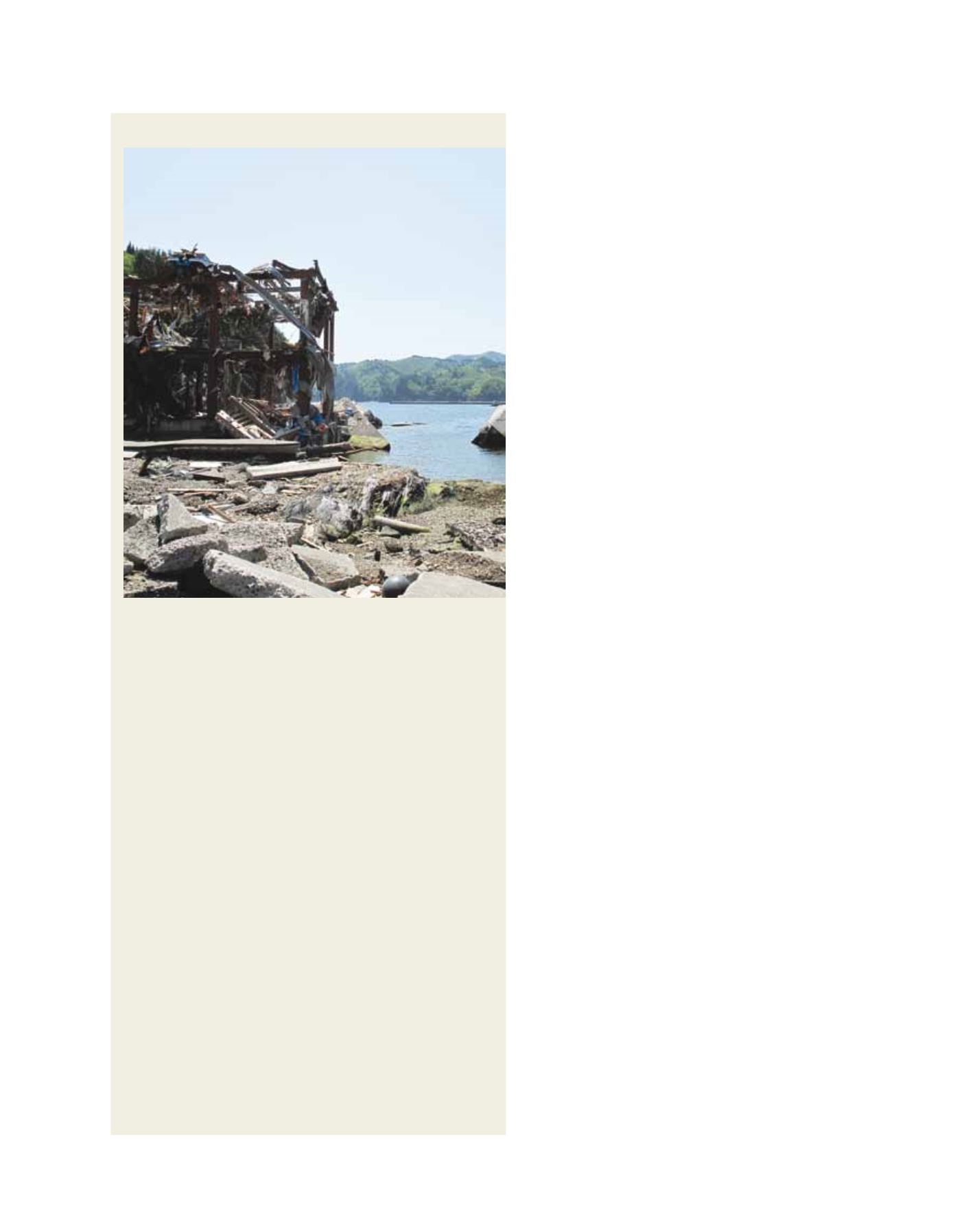
Case study 2: Japan earthquake and tsunami – Tohoku, Japan
Japan, the world’s most prepared nation against natural disasters, faced a
complex humanitarian crisis in March 2011. A 9.0 magnitude earthquake,
the most powerful to hit the country, caused widespread destruction and
triggered a tsunami of 9.3 metres, which damaged about 400 kilometres
of coastline including the Fukushima nuclear power plants, exposing the
world to a radiation threat.
A total of 15,845 people died, with 3,375 others missing and hundreds
of thousands displaced. Tsunami waves with a run-up height of up to
40.5 metres swept through the regions of north-eastern Japan, inundating
561 square kilometres of land and requiring an estimated US$300 billion
for reconstruction.
MR deployed its first response team within 24 hours of the international
appeal by the Japanese Government. Six other relief teams served in
the Miyagi and Iwate prefectures in the Tohoku region over four months,
addressing survival and wellness needs including food, water, fresh
vegetables, establishment of cold storage facilities and a children’s
nutrition programme. Hundreds of radiation protective suits were provided
to help local workers in their search-and-rescue efforts in and around
Fukushima.
Risk mitigation initiatives were well planned and implemented by the
Japanese authorities, including tsunami warning systems and solid
breakwaters along most of the Japanese coastline. Unfortunately, these
mechanisms were breached due to the speed and strength of the waves,
but the impact could have been much more extensive had there been
no structural protective measures in place. Over in Kamaishi, the locals
ignored the tsunami warning and chose not to flee, believing they were
protected by a world-record breakwater. The US$1.6 billion breakwater –
which took three decades of research and construction and was
2 kilometres long, 63 metres deep and 7 metres above water – gave way.
The major and costly failure of the Kamaishi breakwater and the indifference
of the Kamaishi community to the tsunami warning, highlight the need for an
immediate, unbiased and exhaustive assessment of Japan’s comprehensive
structural and non-structural DPRR initiatives, including the inadequacies
of earlier research and the design, planning and implementation of the risk
mitigation measures. Lessons learned from this and associated counter-
measures will greatly benefit Japan and other countries with similar
geographical conditions and challenges but fewer resources.