



 200 / 208

[
] 200
Mitigating vulnerability for
sustainable development
Hassan Ahmad, Kyaw Swa Soe, Nursyahida Othman, Mercy Relief, Singapore
D
eveloping nations, which are constantly besieged by
natural or man-made crises, commonly struggle to
develop beyond their prevailing economic and living
standards. The world’s largest continent with three-fifths of
the world’s population, Asia is rich in natural resources includ-
ing petroleum, forests, fish, water, rice, copper and silver.
It accounts for about half of global trade and is expected to
develop into a global economic powerhouse. While Asia has
seen a significant decline in man-made menaces over the past
decade, it faces the increasing occurrence of natural disasters
such as floods, droughts, earthquakes, cyclones, storm surges
and tsunamis. On average, 100,000 lives are lost each year, with
more than 200 million others affected by these hydro-meteoro-
logical and geological hazards.
Hazards become disasters in the absence of development and
adequate investment in risk reduction. More natural disasters
and extreme weather events are anticipated due to climate change
and communities must develop effective preventive and response
mechanisms, incorporating adaptation to reduce the impacts.
Reducing vulnerability means improving infrastruc-
ture, education, food source, security and other factors
that contribute to peace and stability for growth. More
investment is needed to reduce the gap between rapid
economic growth and disaster risk reduction, in order
to protect social and economic assets.
The impacts of natural disasters fall disproportion-
ately on developing communities in the region, causing
loss of lives and damage to the economy and envi-
ronment. This affects peace and stability and leads to
severe setbacks for social development. Impoverished
areas are the most susceptible to catastrophic damage
from natural disasters, due to a reduced capacity to
prevent damage before and during a disaster and to
recover afterwards. Asia remains the most vulnerable
continent, with US$243 billion of economic losses
due to natural disasters in 2011 alone. Such massive
losses hinder much-needed development in the region,
which has the world’s largest percentage of people
living in poverty.
R
esilience
and
disaster
preparedness
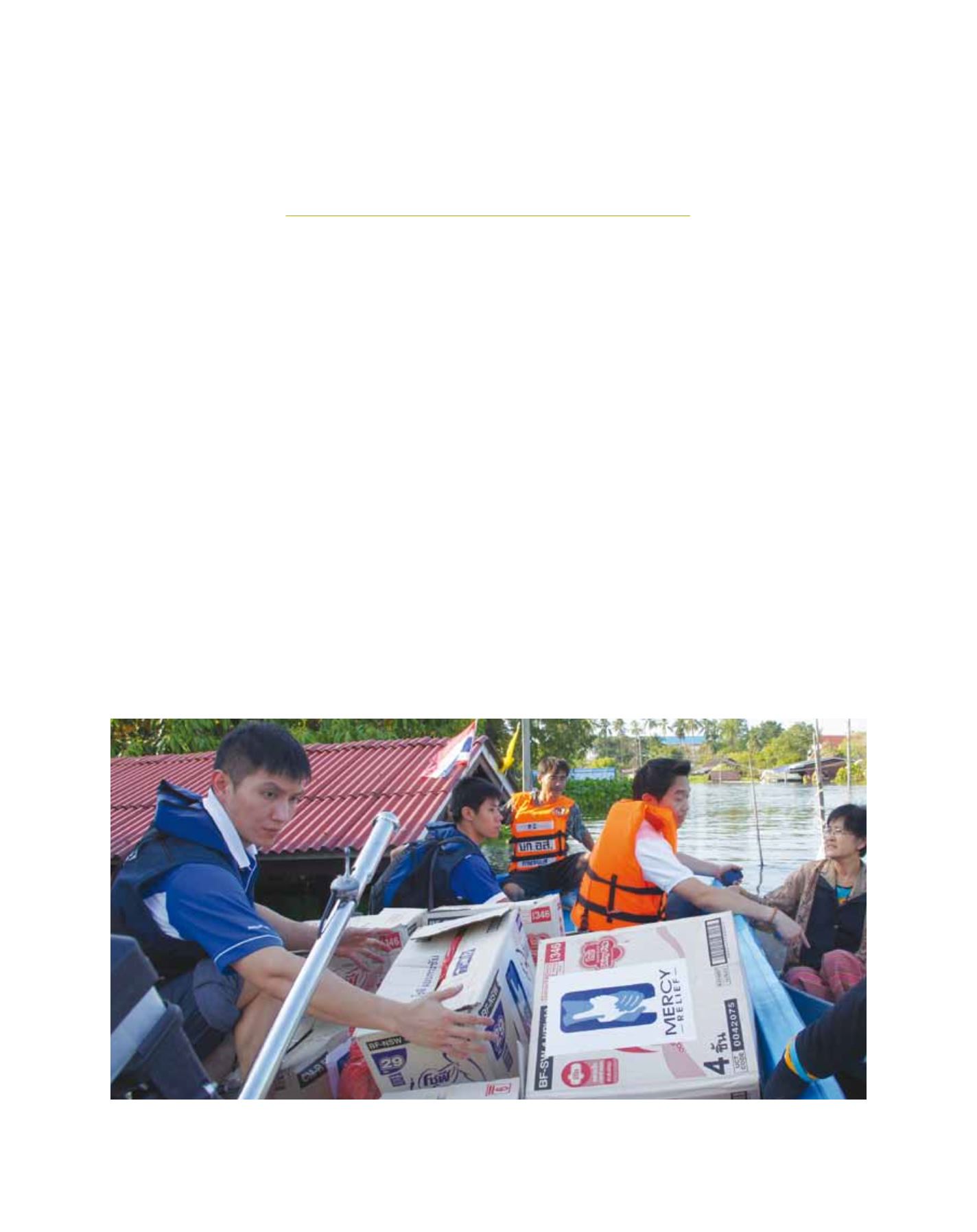
Mercy Relief’s response team distributing aid to the victims of the massive Thailand floods in 2011. The country’s lack of risk prevention and intervention
have affected foreign investors’ confidence
Image: Mercy Relief