



 199 / 208

[
] 199
S
ustainable
cities
ing in multiple vulnerabilities of the poor. As building work was not
controlled by adequate planning procedures, it often took place in areas
prone to flooding. The new Law:
• Brings multiple benefits in terms of more transparent and
efficient legalization procedures, instalment-based collection of
unpaid communal charges and – in accordance with the Vienna
Declaration – provision of alternative accommodation for owners
of informal settlements where these are their primary housing and
will have to be removed during the regularization process
• Means a wide societal consensus across all Montenegrin citizens is
necessary to ensure maximum efficiency in engaging all available
capacity with the main goals being to improve the quality of
environment, land and life conditions, infrastructure in areas
of existing informal settlements and, in an equitable manner,
to contribute to sustainability, static and security factors in the
housing sector.
Tackling the energy consumption of informal settlements is challenging
to implement. Assuming tens of thousands of existing informal objects
have a similar average energy consumption profile to regular houses, it
is estimated that the informal housing sector accounts for over a quarter
of Montenegro’s residential energy consumption and seven per cent of
the country’s energy-based greenhouse gas emissions. Informal housing
is further characterized by relatively high energy poverty and although
systematic data is scarce, some observations suggest that up to 40 per
cent of people living in informal housing do not have access to sufficient
energy services to ensure a healthy lifestyle for themselves and their
families. To resolve these issues, the planned strategy includes innova-
tive cutting-edge solutions and formalization to integrate
climate change mitigation and disaster risk reduction,
with an objective of scaling up to a full national territory.
The main solution relies on designing a programme that
uses energy efficiency and disaster risk reduction as incen-
tives for both households and government to address the
impacts of illegal construction. This will result in sustain-
able revenues for local and national government, better
living standards and purchasing power for households,
along with pollution and disaster risk reductions. Pilot
projects are expected to be implemented by 2015.
Rio+20 opportunity for action
Since 2002, Montenegro has been continuously working on
strengthening the internal mechanism for ensuring meas-
ures and principles in its sustainable development strategy
are fully respected and that economic progress and growth
are followed by equally high social and environmental
standards. An important part of those efforts focuses on
creating an adequate institutional framework that encour-
ages multi-stakeholder dialogue, intrasectoral cooperation
and integrative planning. In this context, Montenegro sees
the Rio+20 Summit as an important opportunity to further
reform its national structure and adapt to the new and
emerging challenges the world is facing. In defining national
solutions, Montenegro remains committed to regional and
international cooperation as core values and operational
principles needed to move to the future we want.
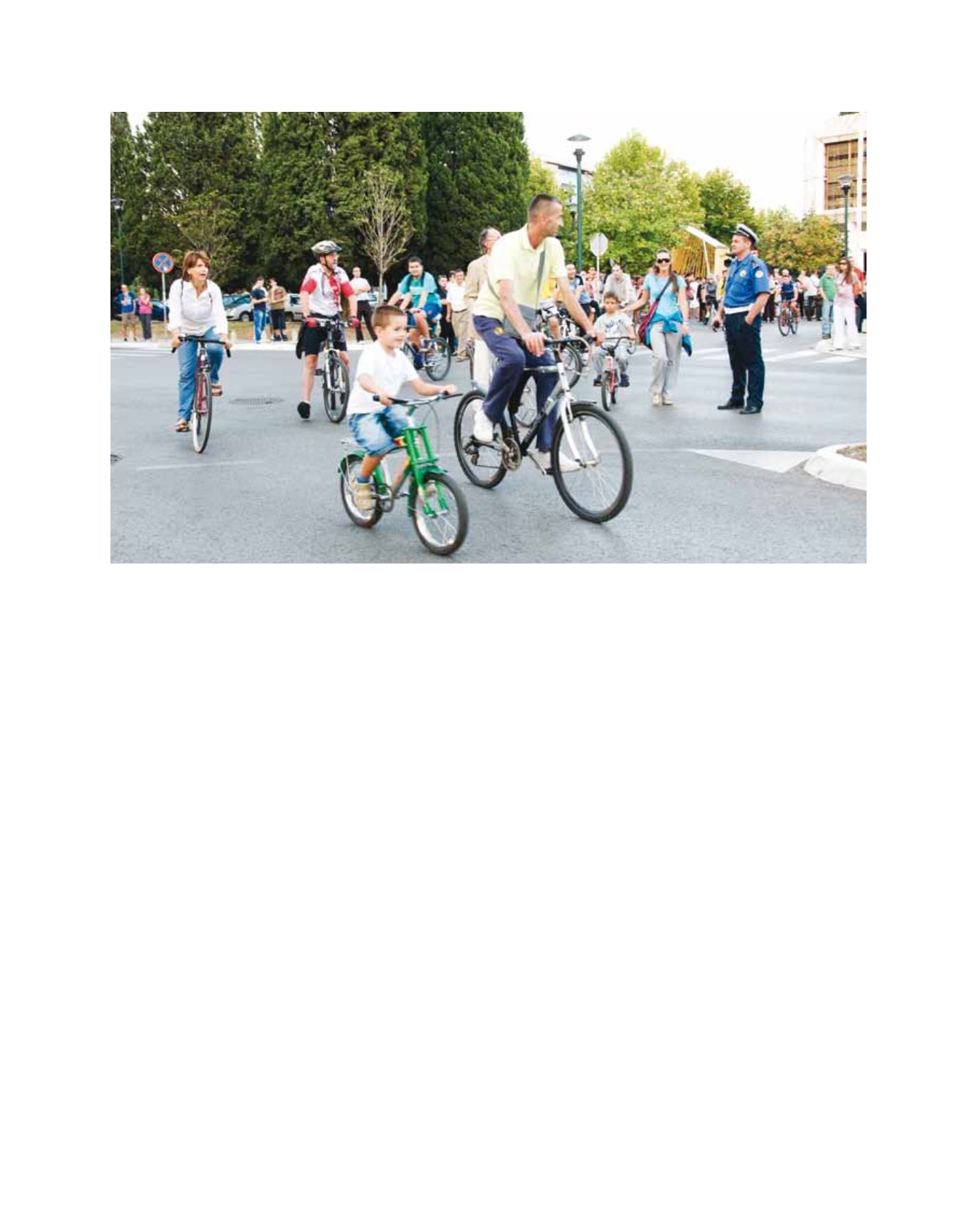
Secretariat of the National Council for Sustainable Development opening the first Solar Station for Electrical Bikes in Montenegro (wooden construction with solar
panels behind). Member of the Council joining all generations of citizens participating in the cycling ride organized to promote alternative transport and the use of
renewable energy sources
Image: NGO ADP ZID