



 194 / 208

[
] 194
New voluntary bottom-up urban planning and
forest conservation methods in Finland
Ville Niinistö, Minister of the Environment, Finland
A
s the pressure on the natural environment has intensi-
fied globally, it has become essential to find new ways to
secure the well-being of nature and its vital life-support-
ing functions. New, voluntary and locally driven bottom-up
methods have been tested in Finland during the past decade
and are now being widely applied. Most importantly, these
include the national urban parks – a concept that provides blue
and green areas in cities – as well as the Forest Biodiversity
Action Programme for Southern Finland 2008-2016 (METSO)
programme, which provides incentives to private forest owners
in the region to participate in conservation efforts. These two
models are described in detail below to provide inspiration
for the conservation of nature in a world where urbanization,
population growth and the rising demand for raw materials will
undoubtedly overshadow all progress achieved so far unless
further action is taken.
Blue-green spaces in the middle of the city
With continuing urbanization, it is important to
protect both biodiversity and cultural heritage as well
as to ensure blue and green spaces for city dwellers.
In Finland, this has been achieved by creating national
urban parks.
Green urban areas provide many benefits for city
dwellers, including the possibility of outdoor activities
and spending time in nature without having to leave the
city. In addition, green areas provide many beneficial
ecosystem services, such as noise reduction and purifi-
cation of the air. People living close to such areas have
also reported being less prone to allergies than those
without access to green areas.
There is a global trend to build more compact towns
and cities, leaving less room for green urban areas. In
S
ustainable
cities
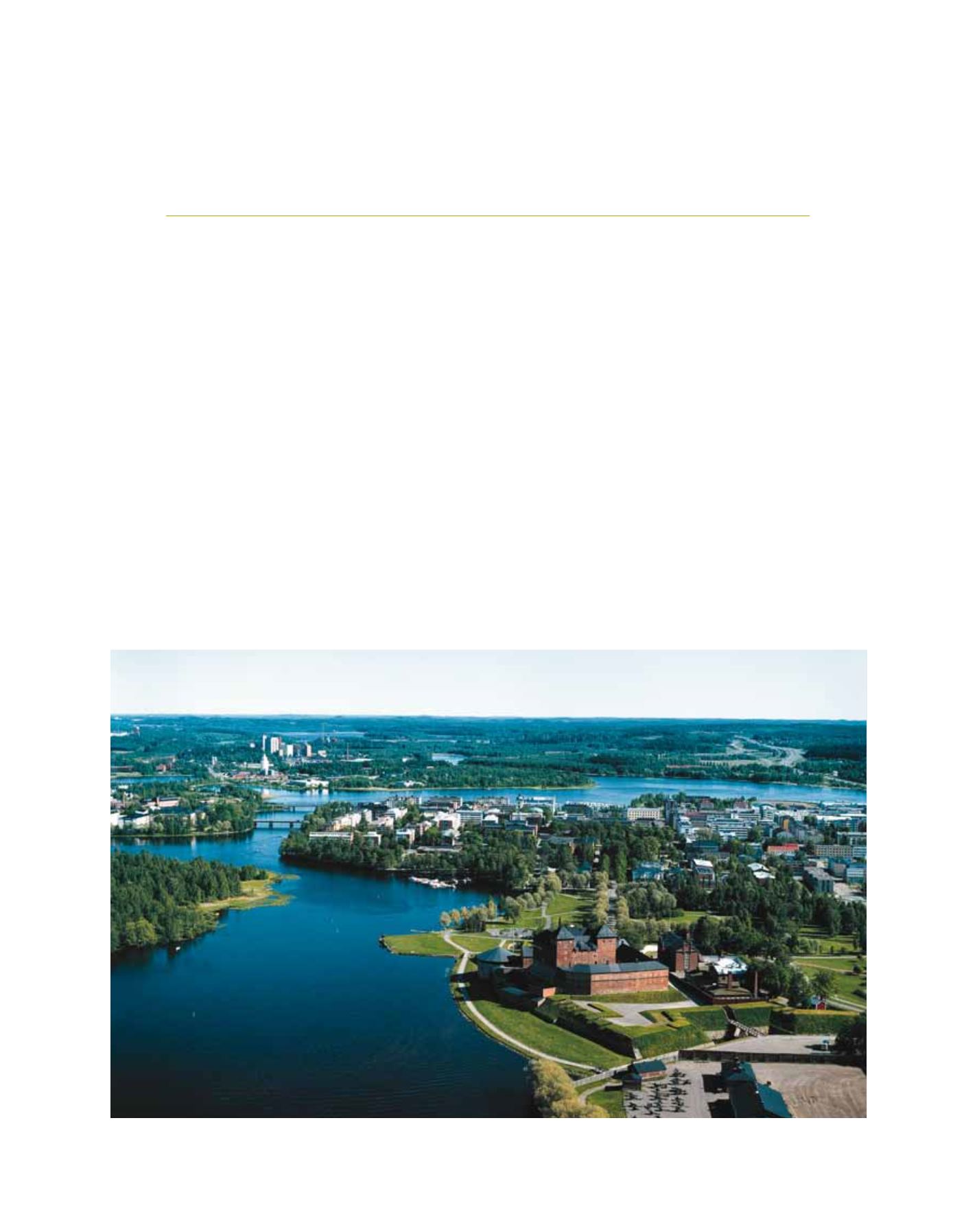
Hämeenlinna National Urban Park combines historical city blocks with lakes and forests
Image: Lentokuva Vallas Oy