


 139 / 168

[
] 139
Actions for disaster risk reduction
through climate change adaptation
in Asia and the Pacific
Dugkeun Park, Senior Analyst, National Emergency Management Agency, Republic of Korea
C
ommunities are increasingly exposed to natural hazards
in the Asia-Pacific countries and practical resolutions
are urgently required for this region, the most vulnerable
in the world to climate-induced disasters, including weather-
related crises.
From 25-28 October 2010, the National Emergency Management
Agency (NEMA) of the Republic of Korea hosted the 4th Asian
Ministerial Conference on Disaster Risk Reduction (AMCDRR) in
Incheon Metropolitan City with the support of the United Nations
International Strategy for Disaster Reduction (UNISDR) Secretariat,
the Global Facility for Disaster Reduction and Recovery (GFDRR)
of the World Bank and AusAid.
More than 900 people participated in the event, including the prime
ministers of Bhutan and the Republic of Korea, 53 ministers and high-
level officials from the Asia-Pacific nations, including Japan, China,
India, Maldives and Malaysia, and experts from UN agencies and non-
governmental organizations.
During the conference, the Incheon Declaration, Regional
Roadmap (REMAP) and action plan were deliberated, agreed and
adopted. These were the first regional agreements in the
world for disaster risk reduction (DRR) through climate
change adaptation (CCA).
The first AMCDRR was held in China, the second in
India and the third in Malaysia, with the fifth planned
for Indonesia. As the only biennial ministerial confer-
ence in the Asia-Pacific region, its purpose is to enhance
regional disaster management cooperation and imple-
mentation of the Hyogo Framework for Action (HFA)
adopted by 168 nations in 2005 for global DRR.
The main theme of the Korean conference, ‘DRR
through CCA’, was chosen to propose Asia’s initiatives
for climate change adaptation. There is an urgent need
to harness international cooperation targeting emerging
disasters worsened by possible climate change, not fighting
against nature, but adapting to the changing environment.
To share information and technologies for climate
change adaptation, it is necessary to establish tangi-
ble and practical strategies for DRR in our region. The
discussions in the 4th AMCDRR were conducted in
three sub-sessions under the main theme:
2015
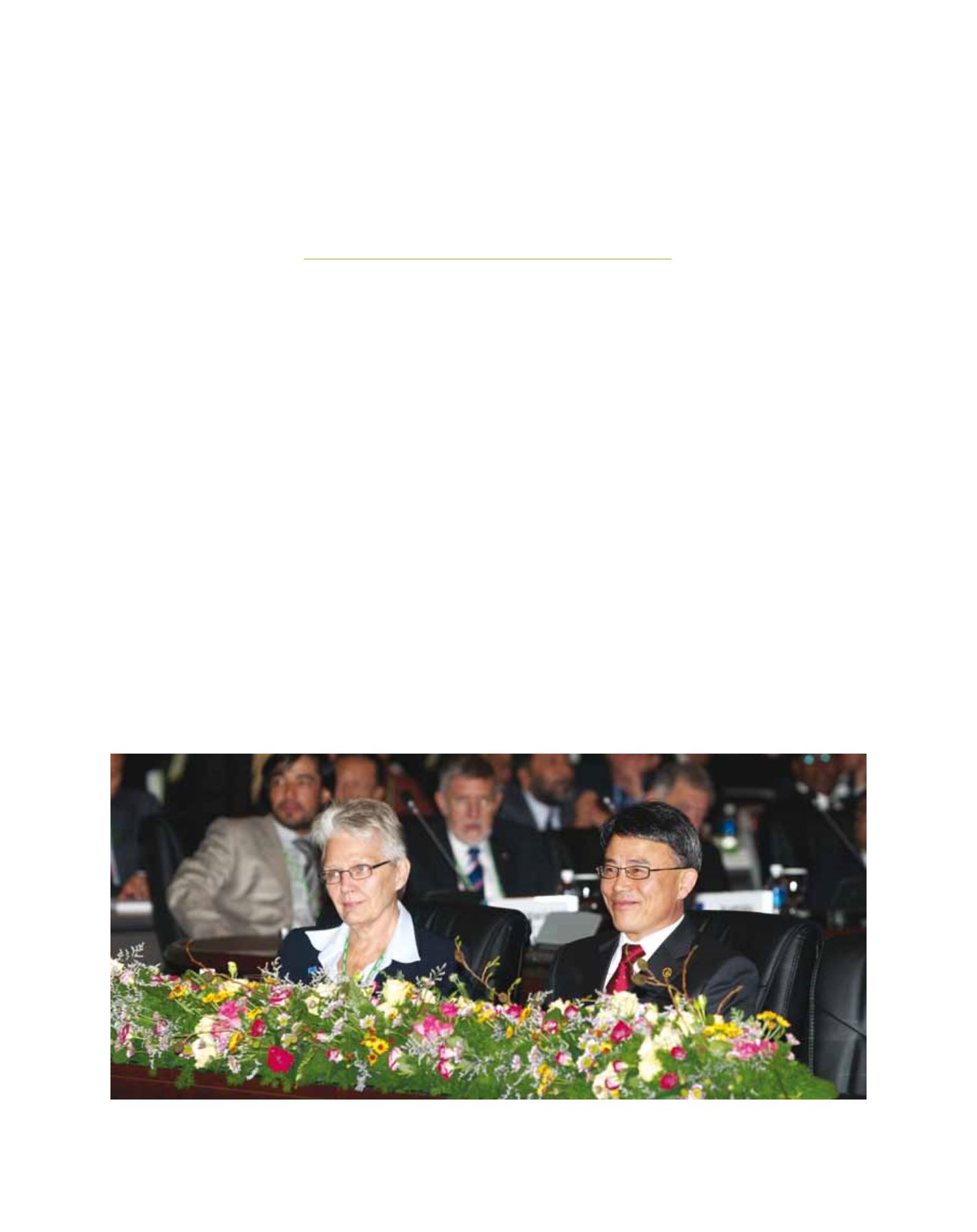
High-level conferences bring together experts in disaster management to consider the Asia-Pacific region’s preparedness for disaster (left: Ms Margareta
Wahlström, UN Special Representative for DRR, right: Dr Yeon-Soo Park, Chair of the 4th AMCDRR and Administrator of NEMA)
Image: NEMA