



 144 / 168

[
] 144
load. People affected by impairments owe their survival to close family
members and are excluded from the community’s social life. They will
be the first to be left behind during a disaster.
Addressing disaster inHumla with an inclusive approach is not an easy
task. The communities are too isolated to benefit from central support
and resources at district level are too far away – accessible only by long
days of hard walk – to be rapidly deployed. Disasters are numerous but
on too small a scale to attract the attention of the central government.
Each single village in Humla is at risk from natural hazards.
Building disaster-resilient communities in Humla could not be a
standalone approach. If we estimate the cost/benefit ratio of 3.5
for similar community-based DRR approaches in the lowlands of
Nepal (that is, for every Euro spent, there are EUR3.5 of economic
benefits), then the cost of deploying emergency equipment and
resources, setting up early warning systems, and even building miti-
gation work in mountain villages is unaffordable, because of the
absence of transportation facilities. In such conditions, the best way
identified by Mission East to address disaster in a sustainable and
financially acceptable way is through mainstreaming inclusive DRR
into local development practices and natural resources management.
Encouraging local authorities, civil society and communities to
integrate elements of disaster risk reduction in their construction
efforts, land-use approach and natural resources management, and
involving vulnerable groups such as women, stigmatized castes and
people with disabilities to take part in such action will ensure a
durable effect. Creating or strengthening local DRR knowledge and
capacities at community level should start by enhancing self-help
and solidarity mechanisms between villages, reducing stigma on the
most vulnerable and excluded groups, and tackling the
attitude of fatalism and despair.
Finally, improving communications between district and
community level, even if difficult to implement, is essential
to reduce the isolation of the population. Nevertheless, the
lack of government representation at local level and political
instability remain major obstacles to Humla engaging in a
sustainable process of increasing resilience.
However, after more than a year of efforts by Mission
East in that direction, some positive effects are already
visible. Local peoples’ fatalistic attitude in the face of
natural hazards has decreased and local authorities,
previously helpless to mitigate the adverse effects of
landslides and mudflows, now realize there are ways
to organize the community into groups for disas-
ter management. The role of women as key agents
in mitigating risk has started to be recognized by the
the male population. But one year is way too short to
demonstrate a durable effect in an environment with
an illiteracy rate of, in some parts, 70 per cent of the
population, and where immediate needs such as access
to food, water and health are not even met.
Long term, a community-based approach is essential
and the role of the central government, to allocate more
resources to the remote districts, is vital. Although
isolated, this region and its communities need to be part
of a national strategy for disaster management. Mission
East is also striving to bring attention at a central level
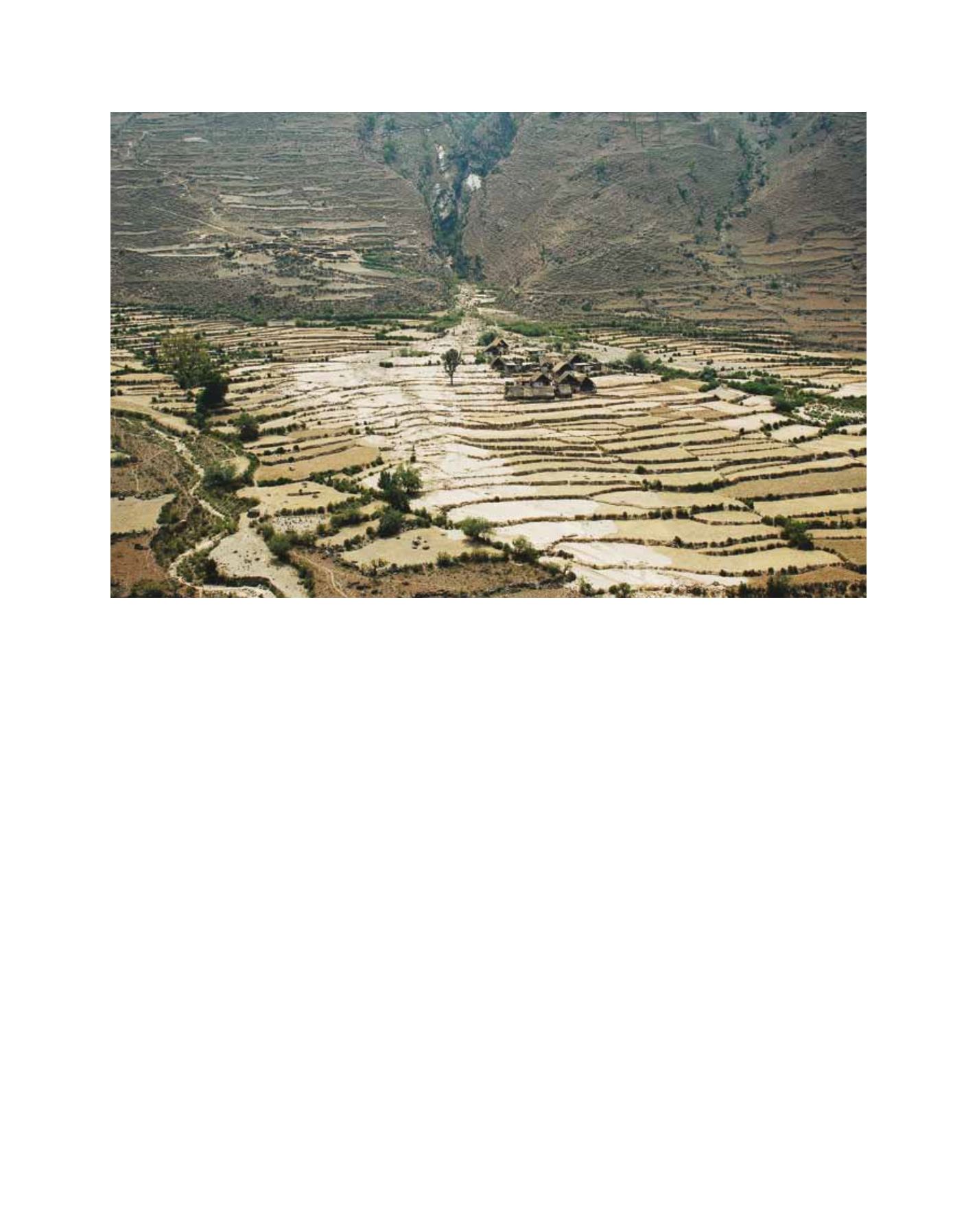
Disasters such as landslides and mudflows mostly affect assets such as land and livestock
Image: Christophe Belperron