


 143 / 168

[
] 143
insecurity. Although this has been stabilized, thanks to the
distribution of food by the government and World Food
Programme, this improvement could be jeopardized if the
adverse effects of natural disaster increase due to the effect
of climate change and its consequences (drought, food/
water scarcity, epidemic disease). Because living condi-
tions are extreme, each and every individual is expected
to contribute to help keep the community alive. Because of
migration, women carry an important share of this work-
the scale of damage is often limited and the district’s geographical
isolation is so important that affected people have no other choice but
to find themselves local resources to aid recovery. So we cannot call
the many events that strike the region a ‘disaster’, compared to larger
scale disasters that affect hundreds or thousands of people. However
when such events are so regular that the cumulative effect poses a
threat to the whole community’s development, can we not describe
them as a ‘disaster’? Because living conditions in Humla are extremely
hard, communities do not always inform the authorities, even when
cases of death or destruction have occurred. What is linked to a disas-
ter and what is not is thus hard to determine.
In this context, Mission East concluded that, in this inaccessible
part of the country, the population was confronted by a ‘hidden
disaster’. So the organization decided to implement a community-
based approach to disaster risk reduction.
Numerous hazards – such as landslides, avalanches, mudflows,
lethal epidemic diseases, and fires – occur every year but still
remain unrecorded. Disasters such as landslides and mudflows
mostly affect assets such as land and livestock, while humans (espe-
cially small children and infants with disabilities) are mainly affected
by epidemic diseases, due to poor hygiene conditions and limited
access to healthcare. Abnormal melting of the snow cap at high
altitude can cause an increase in seasonal flooding and destruction
of the meagre arable lands that high altitude communities possess.
Large-scale threats also exist. Droughts or earthquakes can create a
catastrophic situation due to the difficulty accessing the area.
Migration is an important coping mechanism in the region. Men
migrate to India to find seasonal work and relieve households from food
Community Development report
In 2008, in the community of Majhpatal (Humla district),
Mission East, with an important contribution from the
community, implemented an ambitious project aiming at
connecting water flow from at least eight different sources
along a nearly five kilometre long canal. Hundreds of people
reportedly showed up to work on the construction site. The
project came to fruition and water flowed for about a month
until a large landslide completely disrupted the flow. The
landslide proved a crushing blow to the community, which had
laboured intensively to get the system operating. Members
of the community complained that they had done too much
work with no impact – “pani chuinchha, janchha” (‘the water
leaks and goes away’). But this landslide did not affect life or
dwellings and it was not reported to District Headquarters.
From an evaluation report on “Community Development
leading to Sustainable Food Security in Humla district, Mid
West Nepal”, June 2009
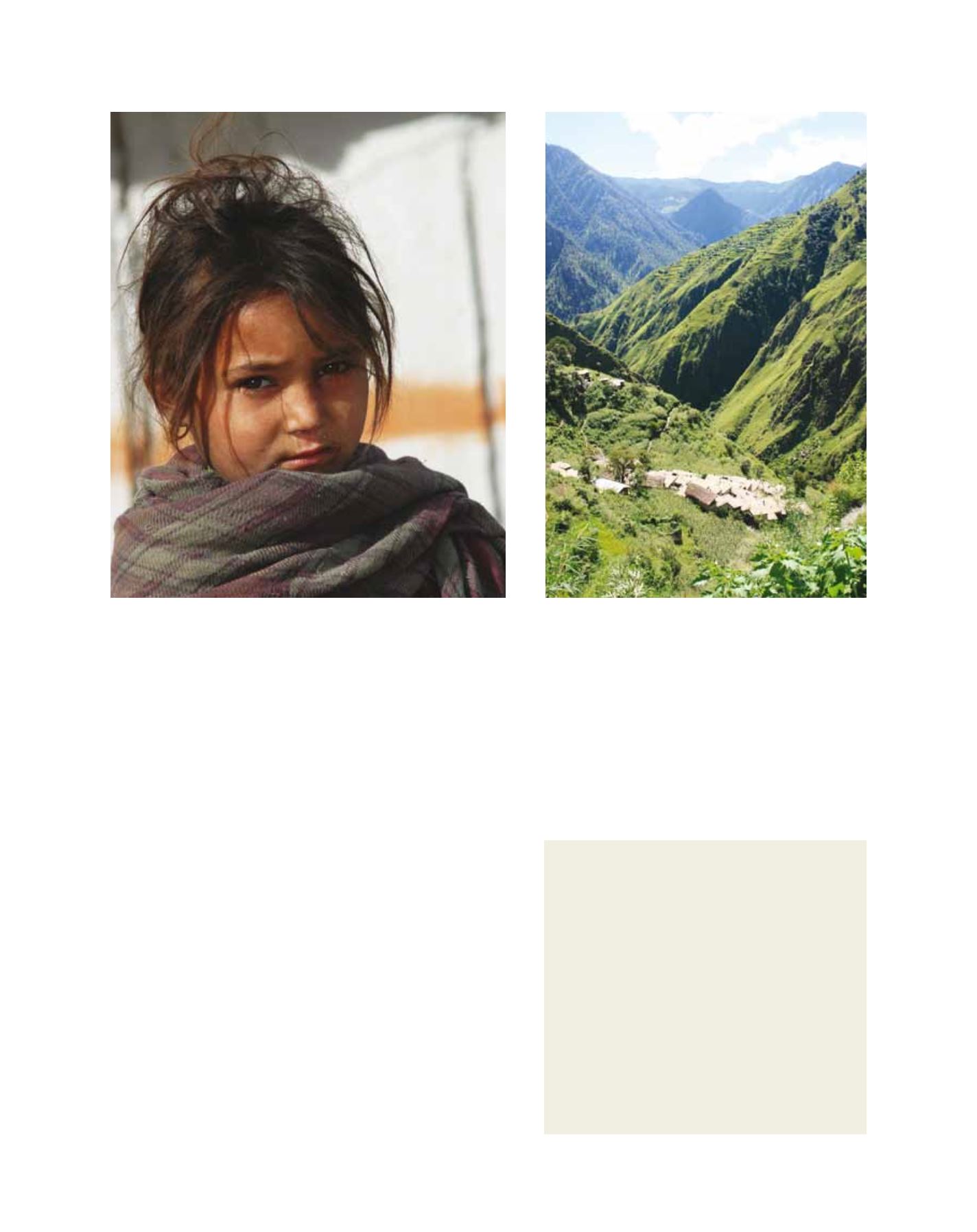
Living conditions in Humla are extremely hard
Gothi village, Humla district
Image: Christophe Belperron
Image: Christophe Belperron