


 148 / 168

[
] 148
people’s confidence in understanding the substance of disaster risk
in the eruption of Mount Kelud. The important changes in public
confidence in the face of such risk come from the certainty that
disaster is not just a fate, but a result of our inability to manage
threats and vulnerabilities. So, to reduce the risks that come from
a volcanic eruption, communities should change their behaviours
and practices.
The changes in behaviours and practices related to disaster risk
reduction came about both directly and indirectly. On the society
side, preparedness for disaster risk reduction in the shape of the
Village Standby Teams has already materialized, These teams have
joined together as ‘Anchors Kelud’, Redi Community Network
(Mountain) Kelud.
The community’s enthusiasm for rehearsal action has already
been showed. This enthusiasm can also be seen in the changes in
behaviour and practice of village officials and other actors who deal
directly or indirectly with disaster management. In the community
radio station, for example, changes in behaviour and practices have
meant that information on risk reduction has been incorporated into
radio broadcasts. These changes are for the long term and there is
some indication that their adoption will be widespread. From village
to district administration level, the behaviour changes are demon-
strated by their involvement in community dynamics.
Strong and significant changes have occurred in the community,
but on the other side, local government has not changed signifi-
cantly as yet, because the programme has not yet targeted those
institutions. In the future, we plan that district govern-
ment agencies will be the main target group.
The issue of human rights, particularly political
injustices that lead to gender issues and conflicts have
become part of cross-sectoral concern in the region
of Mount Kelud. Based on the ‘glasses’ of disaster risk
reduction, these phenomena play a real role in the
vulnerability of society. In fact, all forms of vulnerabil-
ity are closely related and can create new forms.
The substance of disaster risk analysis (the threats,
vulnerabilities and capacities) were explained in
any activities at district level workshops and train-
ing in the villages and schools in the disaster-prone
region (KRB) of Mount Kelud. Risk analysis can be
enlightening for the government and society, because
the analysis of disaster risks, such as poverty, social
injustice, political, gender and the environment always
appears as the main and basic cause of vulnerability, so
the risk analysis itself can be used as a tool for resolv-
ing the problem.
Strengthening the understanding of this risk reduc-
tion has a positive impact on other issues that occur
in the community, such as control and access issue to
land due to differences in political attitudes. There are
a few examples of this, such as the preparation of the
GIS-based disaster risk map.
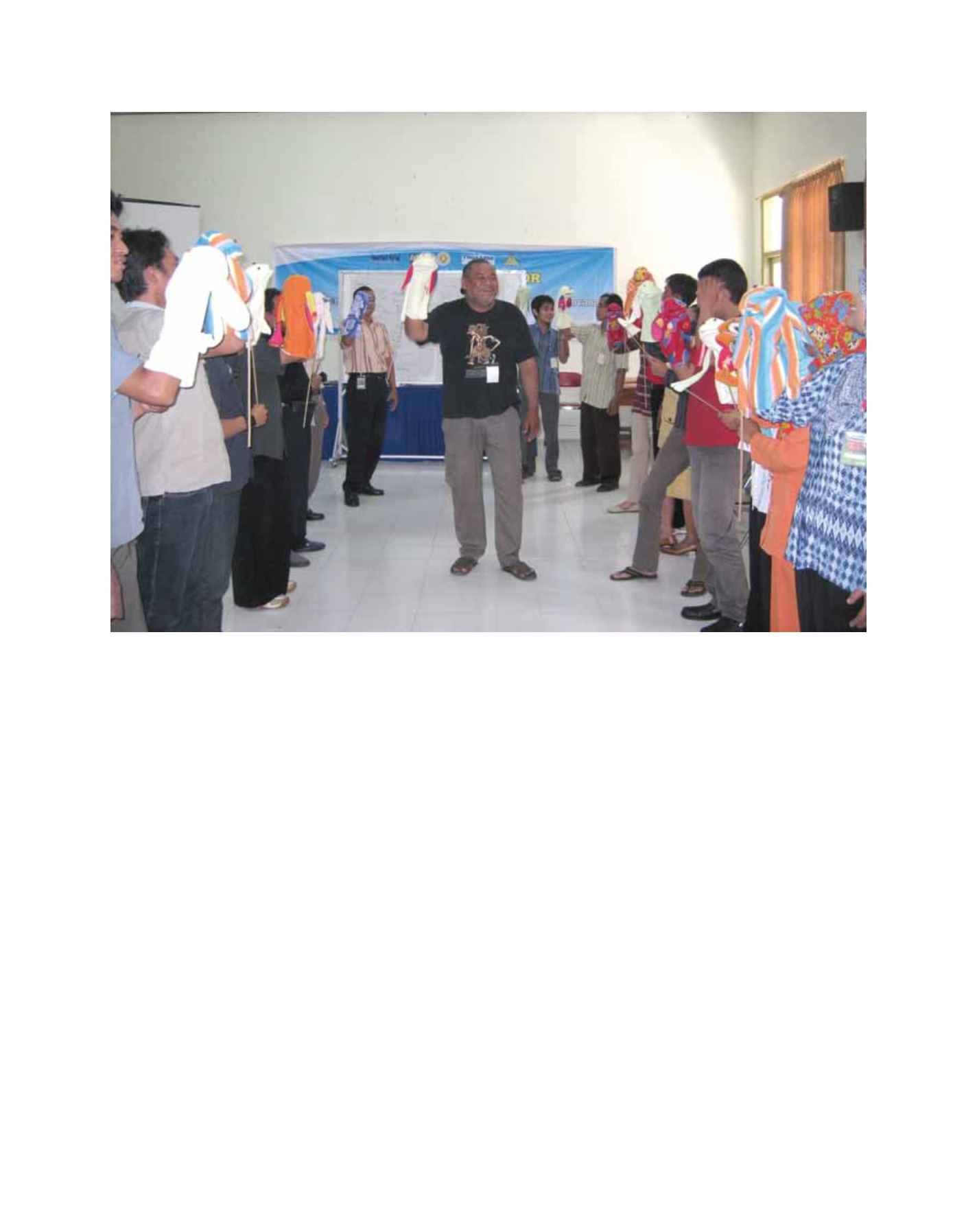
No string puppet show training for disaster risk reduction programme at school
Image: DREaM UPN