


 147 / 168

[
] 147
Lesson 3: Standby Village Teams
The establishment and strengthening of these Village
Standby Teams has been done through a series of
activities and closely related with the previous activ-
ity, PPGD and PRBBK village workshop training. The
process used to form these standby teams incorporates
standby team workshops, field rehearsal and simula-
tion. This activity has sharpened the knowledge of
Village Preparedness Teams about volcanology, and
strengthened their commitment to building awareness
of DRR in their villages.
The workshop was attended by the whole team of
12 villages and was held at the Observation Post of
Mount Kelud, Margomulyo hamlet, Sugihwaras village,
Ngancar sub-district, Kediri District. The rehearsals are
carried out order to establish a brotherhood between
the village standby teams around Mount Kelud, to
increase the capacity of the standby teams in PPGD by
holding exercises together, and to provide clear infor-
mation about the condition of Kelud.
The capacity of the 419 standby team members is
further enhanced by standby team workshops, field
rehearsal, and simulation. Until now, the standby team
has been able to coordinate a simulation in five villages
with the participants of every village in general, followed
by 125-200 local residents, including vulnerable groups,
both pregnant women, children, and elderly people.
Results
This programme has resulted in significant changes
in beliefs, attitudes, behaviours, practices, ideas and
tion system (GIS), we then carry out GIS training for disaster risk map
arranging. Community representatives from 12 villages, plus teachers’
representatives are involved in this training. The training then goes
into a further phase, which seeks to deepen the skills of participants
at regency level, in order to increase their ability at using GPS, decide
the element, mapping model, schedule and location of the activities,
and also the future needs. The activity starts with the group making
and choosing the location, and setting a time limit. The goals of this
activity are to combine the mapping result, share results in order to
find the other elements, and make corrections..
Lesson 2: Disseminating the knowledge of PRBBK
This is aimed at strengthening the capacity for disaster risk recovery
(known as PRB in Indonesia) in the community through activities
such as, firstly Training for Community Based on Disaster Risk
Management (PRBBK) and Emergency Care and Handling of the
Patients (PPGD) for the community and, secondly, training facili-
tators of PPGD. PRBBK and PPGD training was conducted in 12
villages with 419 participants.
Training the community in PPGD and PRBBK has strengthened
the disaster management capacity of the communities of the Mount
Kelud region. PPGD ability is an important skill that must be
known and studied continuously. On the other hand, in PPGD the
understanding between communities and medical principals must
be understandable. With this training, we expect the ability of the
medical community to be transmitted to others. Facilitator training
has produced 53 skilled local facilitators. Furthermore, the facilita-
tors have been able to disseminate their knowledge to 419 people
(77 women and 329 men), the participants in the PRBBK training.
All those who participated in the PRBBK training have now been
organized into Standby Village Teams.
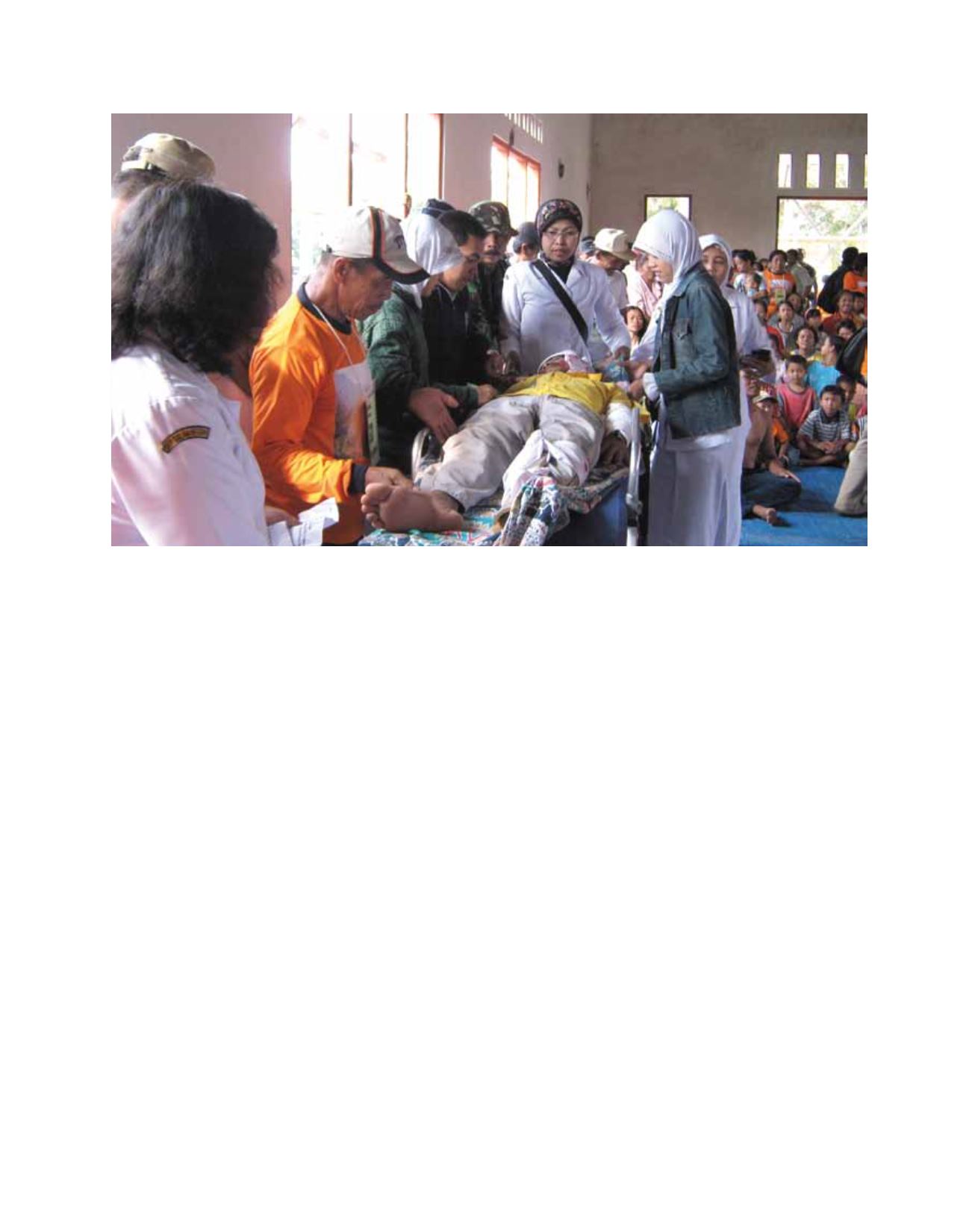
Student first aid training
Image: DREaM UPN