


 151 / 168

[
] 151
In order to build the capacities of the community to understand their
circumstances and negotiate the sudden influx of relief and rehabilita-
tion schemes in a manner that helped create environmentally sustainable
and culturally sensitive livelihood options, two key interventions were
undertaken by TISS. The first was to create a cadre of trained workers
and the secondwas to set up community-based island knowledge centres.
The overarching aim of these interventions was to help local commu-
nities access information on their terms and to develop a critical
understanding of their environment, culture, economy and livelihoods,
especially in the altered conditions brought about by the tsunami.
Framework of the training programme
Critical awareness
This implied developing a consciousness of community-based institu-
tions, societal power relations and forms of exclusion andmarginalization.
It involved relating to perceptions of ‘self’ and ‘others’ (outsiders, main-
landers, settlers etc.). This component facilitated personal and collective
reflections on social and political conditions and what was offered
through government post-tsunami rehabilitation programmes.
Indigenous knowledge base
Participants focused on environment and natural resources use
and management, existing skills and trades, exchange systems,
organization of the local economy, traditional social institutions
and leadership and modern political institutions. They considered
memories and experiences of adversity and coping mechanisms.
Information and Education Component
This part of the programme dealt with government, state and non-
state institutions, development schemes and welfare programmes,
financial aid and capacity building, and covered key
subjects such as health, education and law.
Knowledge and skill component
This component was primarily concerned with
sustainable development practice built on individuals’
own perspective of development, sustainable liveli-
hoods, welfare and rights. It built on process skills
(communication, community organizing, participa-
tory planning, natural resource mapping, etc.) and
organizational skills. All these enabled the develop-
ment of a more robust perspective on sustainable
livelihoods and development and also the critical
ability to decide and assert what was desirable from
communities’ own standpoint and to negotiate ideas
of development which might have been imposed from
above by the government.
The education programme showed the value of inter-
ventions that not only rebuild, but prepare communities
for future disasters while promoting sustainable devel-
opment. It is not only essential to mitigate the risk of
disasters, but to also find lasting ways of coping with
them. In disaster situations of both natural and human
origin, the impacts can be mitigated to a large extent by
appropriate planning and adequate preparedness. This
requires a coherent and strategic response, informed
by a longer-term approach to disaster risk reduction
and appropriate planning and management. Such an
approach would address the needs of specific vulner-
able categories such as tribal communities.
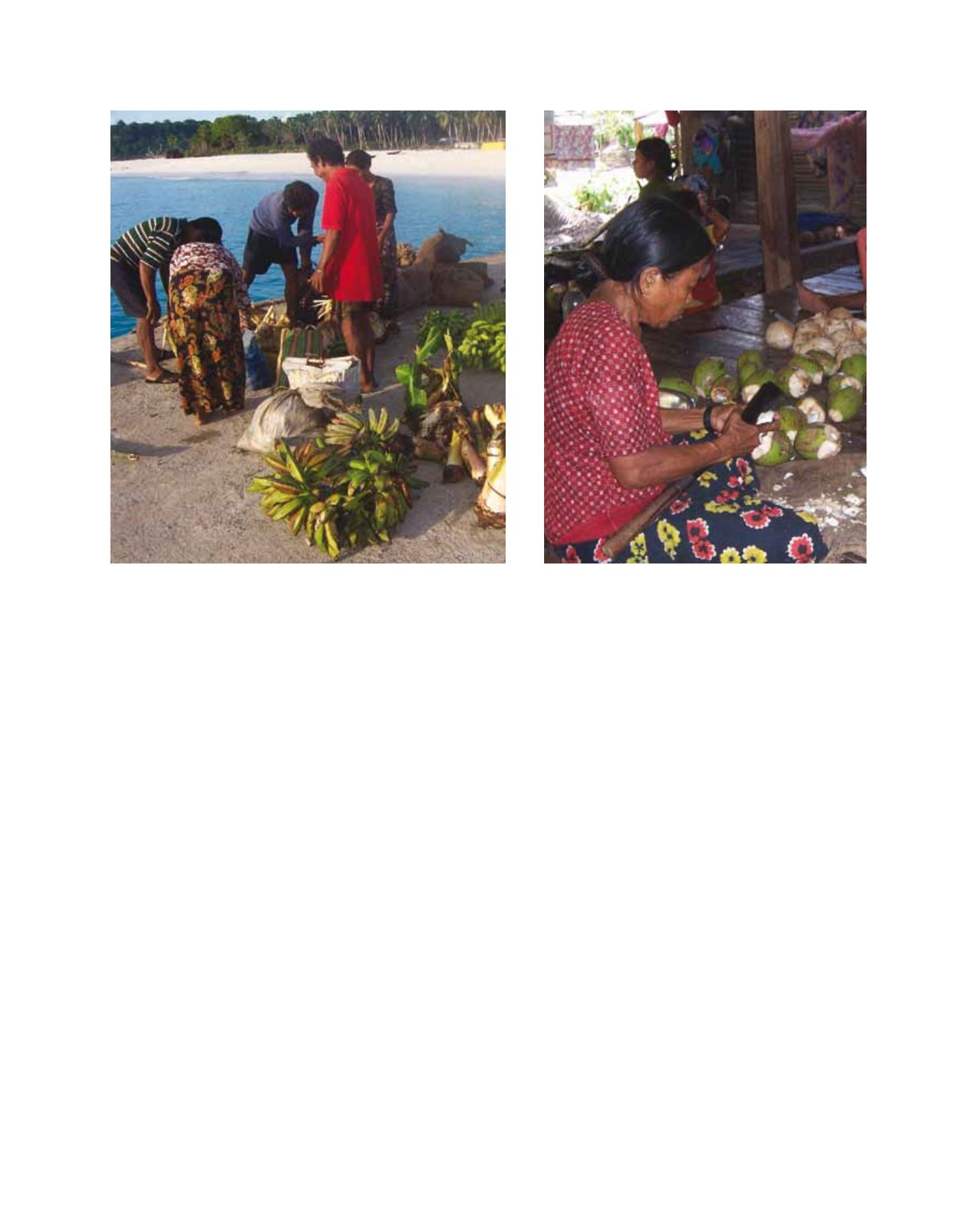
Nicobarese of Chowra Island rebuilding their livelihoods, including banana transportation and copra making
Image: JTCDM, TISS
Image: JTCDM, TISS