



 155 / 168

[
] 155
Reducing disaster risk through microinsurance:
new evidence from communities in South Asia
Mihir R. Bhatt, All India Disaster Mitigation Institute, and Lawrence Hall
R
educing disaster risk through the use of microinsur-
ance is not a new idea or a new initiative, but how does
it actually perform when operated at grassroots level?
Where is the evidence?
New and field survey-based evidence from the frontlines in South Asia.
There is broad and growing discussion on financial disaster safety
nets, such as those provided by microinsurance, and the role that
they can play as a resource for the poor in the aftermath of a disaster.
Recent research and experience has pointed to the importance of such
programmes in assisting the poor to avoid poverty traps and reduce
their vulnerability to hazards. Despite its theoretical potential, very
little is known about howmicroinsurance actually benefits households
and communities after disasters. Much of the current work on disaster
microinsurance has focused on supply-side issues, such as insurance
pricing and implementation questions, whereas the demand side and
potential benefits to the insured have gone largely unexamined.
This article attempts to address this and offers the first large cross-
country assessment, based on first-hand observation, of the impact
of disaster microinsurance in the South Asia region. Communities
across South Asia are vulnerable to disaster and include many
households both with and without disaster microinsurance, making
this a particularly useful area for rigorous comparative
analysis.
The overall aim of the study
Impact Assessment of
Disaster Microinsurance for Pro-Poor Risk Management:
Evidence from South Asia
is to advance the discussion of
disaster microinsurance from anecdotal knowledge to
specific evidence-based recommendations by assessing
and understanding the impacts of products on clients.
Key areas covered include:
• Client satisfaction in products and services
• Client awareness, understanding and perceptions of
risk, products, and needs
• Current disaster coping mechanisms and risk
management behaviour
• Delivery mechanisms tailored for this low-income
market
• The potential for vulnerability reduction, including
poverty and disaster risk reduction (DRR) as well as
enhancements in human welfare.
These areas have not previously been systematically
looked into.
The study was initiated as a part of the Regional Risk
Transfer Initiative, an effort led by the All India Disaster
Mitigation Institute (AIDMI) to expand and strengthen
microinsurance options for the poor in South Asia. It has
been supported through funding from the ProVention
Consortium and executed in partnership with the
International Institute for Applied Systems Analysis. The
study was led by Rakhi Bhavnani and Mehul Pandya, and
guided by Reinhard Mechler and Ian O’Donnell.
Methodology
To investigate the impact of disaster microinsurance,
an original dataset was generated across South Asia
through primary data collection, based on stratified
sampling of responses received from a control group
(or ‘non-clients’) as well as microinsurance clients of
the following five organizations offering disaster micro-
insurance products:
• Basix (India)
• Self-Employment Women’s Association (SEWA
India)
• AIDMI (India)
• Yasiru (Sri Lanka)
• Proshika (Bangladesh).
2033
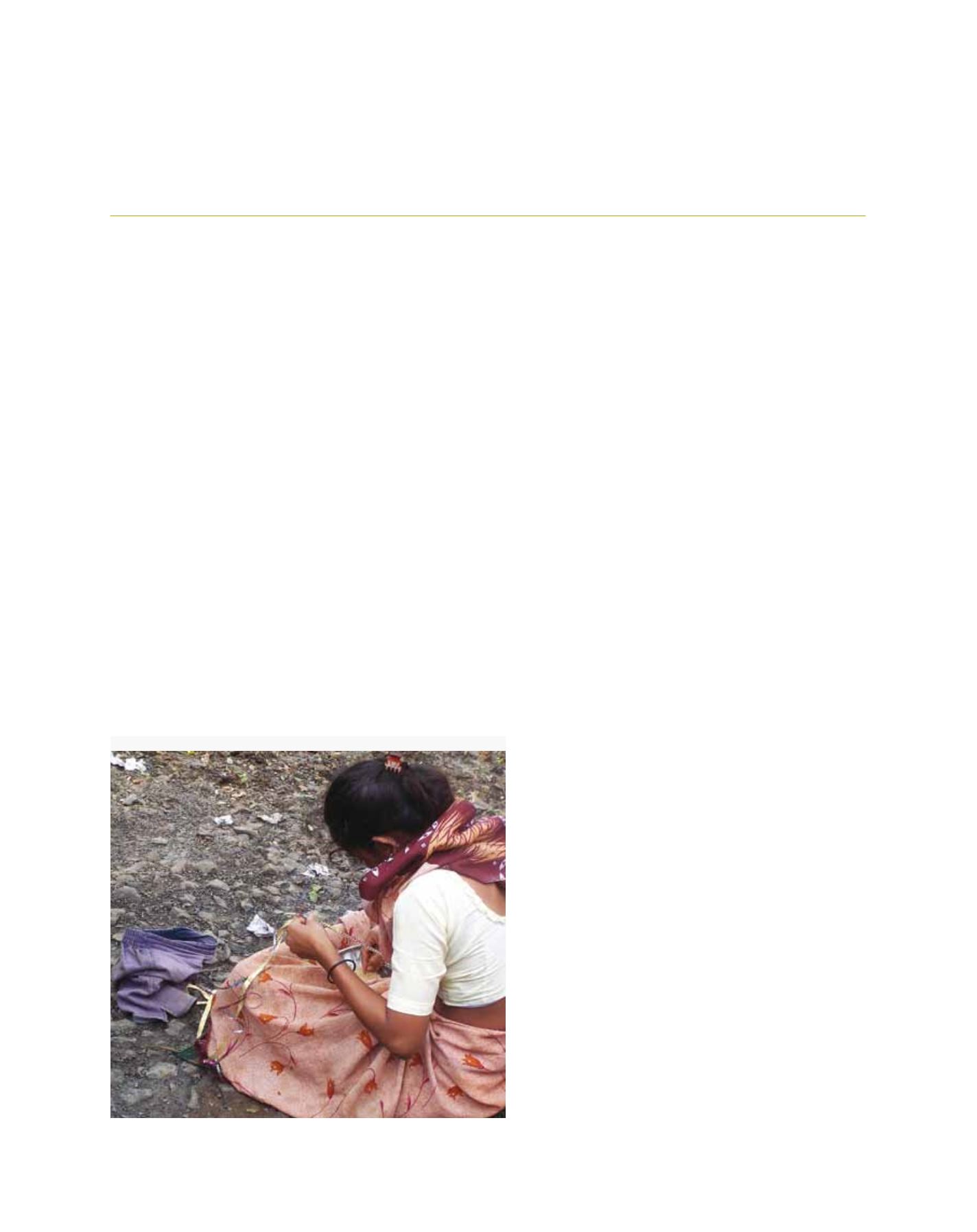
Women work long hours to pay for microinsurance instalments
Image: AIDMI