



 158 / 168

[
] 158
Community managed disaster risk
reduction programmes of Caritas India
Sunil T. Mammen, Caritas India
T
he concept of disaster risk reduction (DRR) has become an
important part of development efforts throughout India,
which is highly prone to all sorts of hazards. In the recent
past, the country has witnessed several disasters, including the 2004
tsunami. Recurring hazards like cyclones, floods, landslides and
tsunamis have prompted both Government and non-governmental
agencies to implement disaster risk reduction programmes in a
variety of ways to mitigate risks and vulnerabilities.
Emergency response has been a key strength of Caritas India, which
responds to various types of emergencies through its partners. Because
disasters disrupt development initiatives and use up available resources,
thus making communities more vulnerable, disaster preparedness is an
integral part of our wider strategy and of our community based disaster
preparedness (CBDP) programme launched in 2001. The realization that
preparedness is just one important component of the whole gamut of
DRR and that communities need to work towards finding solutions to
potential risks associated with their lives and assets prompted initiation
of the community managed disaster risk reduction (CMDRR) approach
taken by Caritas India.
Finding the connection
The CMDRR approach begins by acknowledging the rela-
tionship between hazards and development and offers
solutions at the outset. We believe that this approach is
essential to make our disaster response effective, accounta-
ble and able to cater to the vital needs of disaster victims in
a way that protects their right to life with dignity. Inspired
by the effectiveness of CBDP/CMDRR as amethodology for
motivating communities to take informed decisions and
timely actions for risk reduction in the context of natural
disasters, Caritas India launched its programme in West
Bengal and gradually broadened its work to include other
regions of India. Currently, 58 Caritas India partners are
implementing CMDRR programmes in 60 districts across
12 states and two Union Territories, covering 2,588 highly
vulnerable villages and serving 462,091families.
East Zone
West Bengal and Orissa states:
The DRR programme started
in 2001 in West Bengal state following the floods of
2041
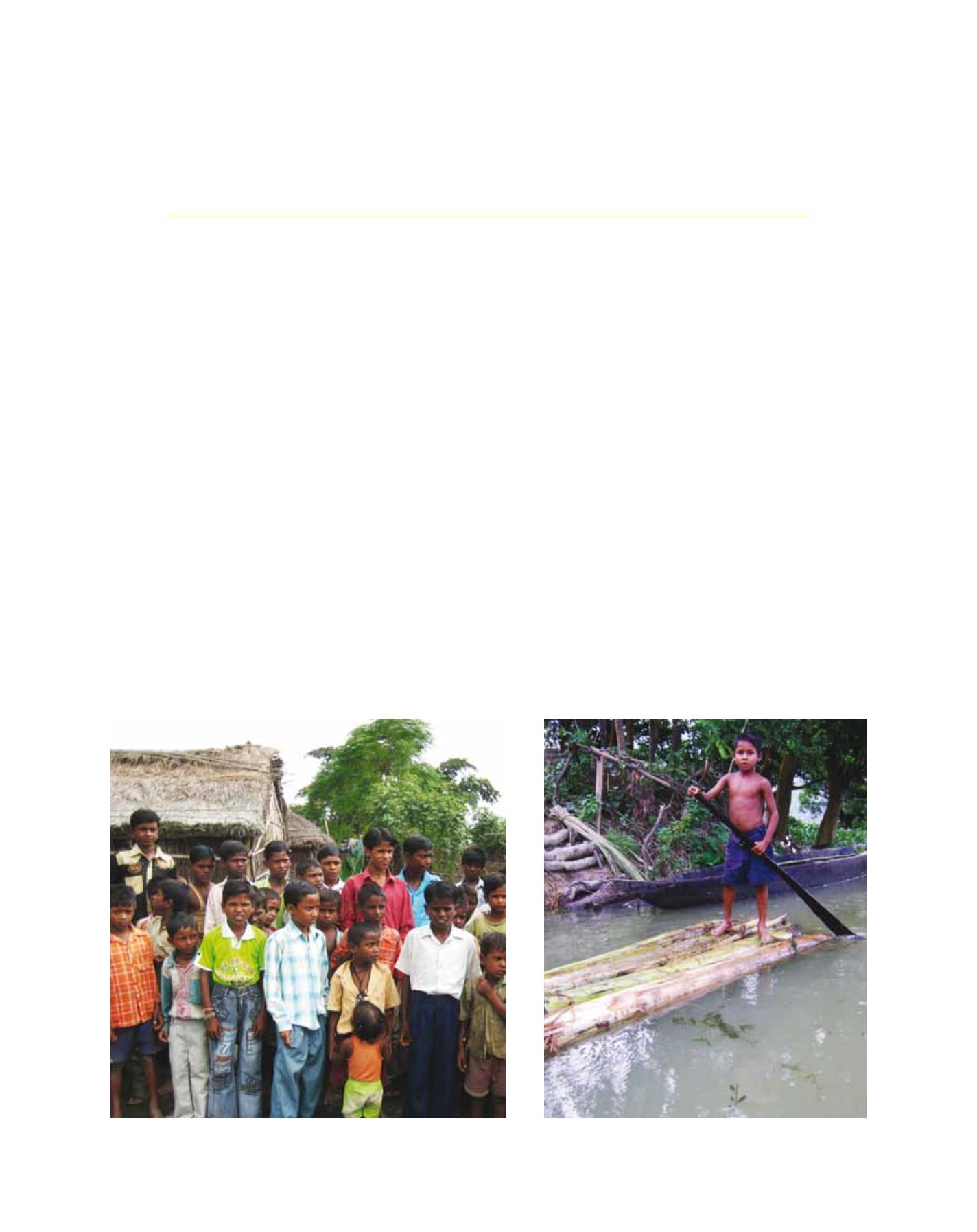
Banana rafts are used as transportation during floods
Children in Masandap understand community managed disaster risk reduction
Image: Caritas India
Image: Caritas India