



 163 / 168

[
] 163
Governing for risk reduction
In 2005, following the Indian Ocean tsunami and
Kashmir earthquake, the leaders of South Asian
countries met in Dhaka, Bangladesh and made a
commitment to better disaster preparedness. A year
later, in New Delhi, government officials and civil
society in the region debated collaborative risk
reduction. The resulting Delhi Declaration requires
governments to consider the links between disasters
and development and to prioritize preparedness and
the reduction of vulnerability.
However, the intrinsic connections between poverty
and disaster risk, and the emerging threat of climate
change, are yet to be fully understood. Planning for
poverty reduction, disaster risk reduction (DRR) and
climate change is handled by separate bodies. Other
problems include limited public sector resources
for governing risk reduction, no real harmonization
between national and local authorities, and minimal
potential for decentralization of planning.
South Asia needs overall risk reduction plans which
are incorporated into its periodic planning processes,
investments and infrastructure. Land use planning,
zoning and identification of specific risk zones, conser-
vation planning, insurance governance are all aspects of
the overall risk reduction.
Monitoring is vital to ensure delivery and compliance.
This cannot be carried out at the national level alone, as
the information required for planning, implementation
and monitoring requires local level involvement.
projects, especially large infrastructure initiatives such as river diver-
sions, expressways and dams, actually exacerbating disasters.
7
In the state of Orissa, eastern India, large-scale deforestation for
settlements and agriculture has led to silted rivers, downstream
flooding, eroded riverbanks and greater exposure to cyclones for
coastal people. In the Himalayan regions of Nepal, road construction
is commonly associated with slope destabilization and landslides.
Despite the risks, settlements spring up along roadways on unsta-
ble ground. Two expressways under construction in Sri Lanka have
exposed local communities to repeated flooding during monsoons.
Sometimes even structures that were meant to save people from
disaster increase vulnerability. In Bangladesh, sea walls created
to keep out storm surges acted as a barrier to storm water drain-
age during a cyclone, increasing flood levels during the storm. In
Pakistan, flood protection embankments have created a false sense
of security and encouraged poor settlement patterns in the Kaccha
area and abandonment of traditional flood preparedness strategies.
8
The lack of an interface between development and disaster
management leads to vicious circles of failed development and
increasing risk where even a low level hazard can play havoc with
vulnerable people, weak livelihoods and fragile structures.
9
The 2009 Global Assessment Report on Disaster Risk Reduction
(GAR)
10
reports underperformance of the priority for action (PFA) 4
of the Hyogo framework, aimed at reducing underlying vulnerabilities
while improving sustainable livelihood patterns, capacity and empow-
erment. In South Asia, this can be seen as an indicator of inadequate
commitment and slow progress towards sustainable development.
Poor people are excluded from risk reduction measures as a result
of ineffective state institutions, corruption, poor accountability and a
lack of political will.
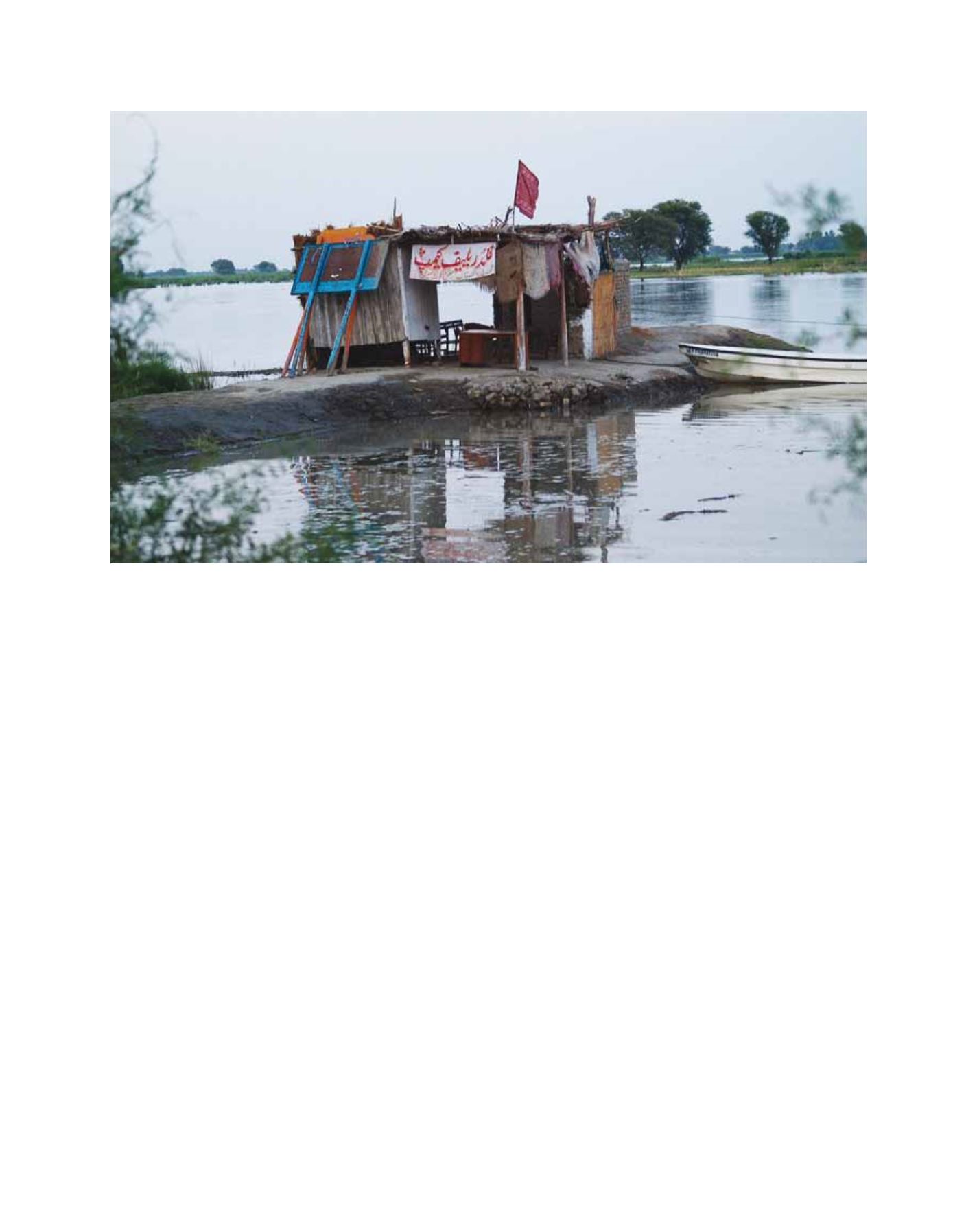
A flooded ‘flood relief camp’ installed by the local government. It shows the level of disaster response education of the government authorities
Image: RDPI