



 165 / 168

[
] 165
level (primarily local government) is a major barrier to developing
resilient communities.
DN has long advocated integrating DRR in local and regional
development planning. The Adaptive Livelihoods Framework devel-
oped through the experience of our member organizations places
risk governance at the core of building adaptive, resilient livelihood
assets for communities.
A decentralized disaster risk management (DDRM) approach
brings together community leadership and local authorities (both
devolved governance and decentralized government mechanisms).
Local government bodies may recognize the value of securing the
participation of local people, but often lack the political will and
the know-how to do so. Strengthening local level planning and
implementing processes allows for more practical consideration
of local priorities.
In an ideal scenario, local governments would play a key role in
gathering and analysing local data for effective planning, natural
resources management, development prioritizing through consulta-
tion, risk screening and risk reduction by encouraging proper land
use and livelihood choices, and mobilizing resources for sustainable
development. Local government could become the key repository
and disseminator of risk-related information generated by technical
agencies to the wider public.
Decentralization in South Asia started in the 1940s in India,
with other nations following suit, but there has been a lack of
political will for genuine decentralization, with resources avail-
able at the local level often ignored in favour of dependence
on central funds and resources. It is important to take stock
of resources within local government structures and other
stakeholders, through the use of DDRM as a planning and imple-
menting approach.
The inclusion of disaster risk and climate change in develop-
ment plans will make local development more effective in the
long run. The need for such integration has been clearly demon-
strated in grassroots-level risk reduction projects that have
achieved moderate success when implemented through civil
society partners, but tremendous impact when replicated through
local government channels.
Strong community institutions have an essential role in getting
local level vulnerabilities recognized within local and national
development. Such organizations represent diversity within
communities, ensuring marginalized and highly vulnerable
groups are represented.
17
There is also evidence from India that local community-
managed DRR initiatives work best where the local level
(village council) and district authorities are well governed in
terms of four criteria: accountability, participation, learning and
performance.
18
These examples show the benefits to South Asian countries
of moving towards overall risk reduction plans. Response
governance and road maps for DRR should be complemented
by risk governance, which involves macro- and micro-level
planning and active risk reduction measures and monitoring.
It is crucial that the macro planning processes, the projec-
tions of increasing disasters with the changing climate, is
enriched with communities’ coping strategies and knowledge
of their environments, thus helping to build adaptive capaci-
ties in macro-planning processes for climate-related disaster
management.
Community action to address risk
and protect livelihoods
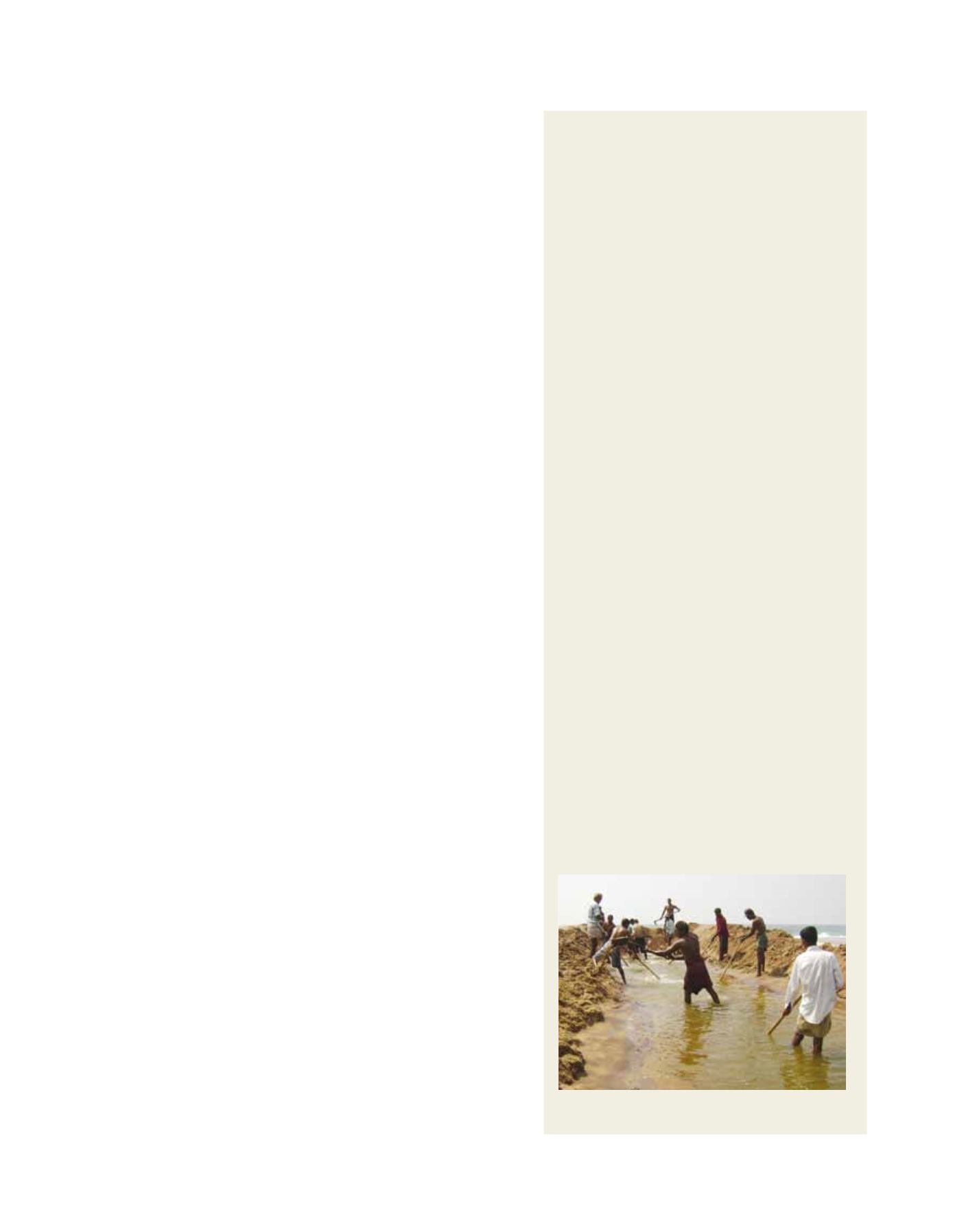
Recurrent flooding (12-20 times a year) occurs in and around
the coastal areas of Wanduruppa and Ambalantota in south Sri
Lanka due to a natural sand barrier across the river mouth. With
facilitation from a non-governmental organization
19
and the local
authority, the community devised and implemented a flood risk
management plan. Risk was assessed through both participatory
and scientific means. The community institution formed in the
process represented the community of ten villages affected by
the flooding. The flood mitigation mechanism agreed built on
traditional community practices of managing floods. A fund to
support this system was made available, operating under the
supervision of the local authority. In 2008, the community had to
clear the sand barrier 15 times to avoid floods and they drew on
the fund only twice. The Urban Development Authority continues
to work with the communities to develop disaster risk sensitive
land use plans.
20
On June 5, 2010, Cyclone Phet hit the coastal zone of
Sindh and Balochistan provinces of Pakistan. The District
Coordination Officer (DCO) set up a committee comprising
core members of the District Disaster Management
Authority. Early warnings of the cyclone were confirmed by
Pakistan Met Department and support was requested from
Indus Consortium (IC) for evacuation and establishment
of emergency camps. The DCO visited all areas at risk and
personally supervised the evacuation of the local population
from these areas. IC, in collaboration with the Thatta district
administration, established and managed ten emergency
camps for evacuees, involving staff, volunteers and children
and youth groups formed earlier under IC’s Child Centered
Disaster Risk Management Program. The Pakistan National
Volunteer Movement team also provided relief supplies.
Thanks to these measures, timely actions were taken
to safeguard the community prior to the cyclone making
a landfall in the district and no deaths resulted from the
disaster. The episode established a good example of
CSO-Government (at different tiers) close working and
coordination for reducing the disaster risk and response.
21
Reviving traditional risk management practices
In Kathirively in the eastern part of Sri Lanka, the
Thamaravillu tank (an artificially created lake) receives
water from Verugal Aru Main River via a canal. During the
rainy season, the water level of the river rises around six to
seven feet. The irrigation scheme was designed to handle
normal monsoon rains, severe floods and droughts. Decades
of neglect due to conflict had inflicted damage on this
sophisticated water management system. Prior to the recent
floods, villagers had begun participating in a project to
renovate the system. Although work was not completed, the
community of Kathirively withstood the flooding for a whole
week before being inundated. This allowed them to evacuate
the area with less damage than neighbouring villages.
Community clearing the sand barrier based on agreed timing
by farmers, fishermen, and the local authorities
Image: Practical Action