


 153 / 168

[
] 153
and prevention to grassroots communities in Bantul and
other affected areas. In total, 12,000 participants from
292 villages in the region received training in what is
now considered the top resource for building disaster-
resilient communities in Indonesia.
Disaster relief operations
In the event of major disasters, Maipark always takes
part in the national emergency response and is a partner
of the National Agency for Disaster Management
(BNPB) for disaster response activities, with a particular
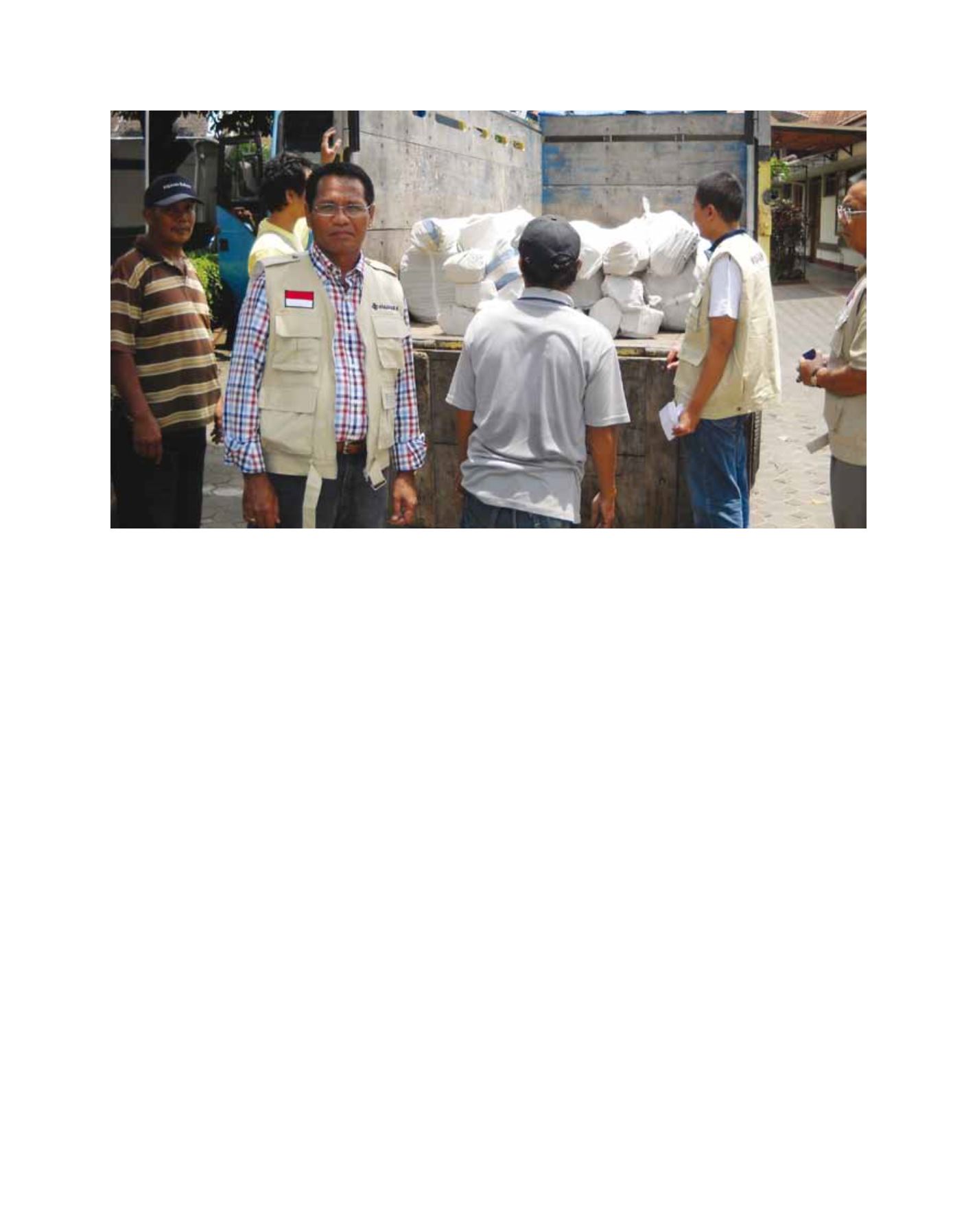
focus on earthquakes. After the West Java earthquake
of September 2009, the body worked in coordination
with BNPB to distribute aid for earthquake victims in
the form of food, clothing, medicines and large tents to
replace damaged school buildings so that educational
activities would not be interrupted.
Likewise, when Merapi volcano in Yogyakarta
erupted in October 2010, Maipark immediately sent
emergency response teams to distribute aid consisting
of items such as clothing, food, medicines, milk and
baby food. In addition to the main refugee camps, this
aid initiative reached remote camps like Muntilan,
Magelang, Borobudur and Klaten.
Surveys and research
The research and development division of Maipark
continually conducts geological surveys and research
in various part of Indonesia. Whenever an earthquake
occurs, a survey team is sent to appraise damage,
injuries and fatalities, as well as to study accompany-
Earthquake five-zone risk map and tariff reference
Maipark reviewed and introduced a five-zone risk map for
Indonesia along with a new earthquake insurance premium tariff
to replace the former three-zone risk map and tariff. In March
2010, this system was officially adopted by the Indonesian General
Insurance Association, which represents 87 member companies.
The Indonesian insurance industry’s initiatives to deal with earth-
quake risk so far have attracted the attention of the government,
international institutions and insurance industries at both regional
and international levels. The Indonesian government and the World
Bank are discussing plans to use Maipark’s Earthquake Model
to assist government in managing fiscal risk to the country’s state
budget through insurance or other mechanisms.
Maipark’s Cat-Model is being introduced in the wider insurance
and reinsurance market through collaboration with Catalytics who
provide catastrophe modelling software, thus providing opportunities
for insurance and reinsurance companies to assess, analyse and manage
their earthquake exposure in Indonesia at a relatively low cost.
Education and corporate social responsibility
To improve the competence of the insurance industry in dealing
with earthquakes and related risks, Maipark organizes regular
geological field excursions for insurance underwriters to explain
geological phenomena related to risk management. This activity
allows for the sharing of knowledge with insurance companies and
the promotion of prudent underwriting of disaster risk, particularly
for earthquakes and volcanic eruptions.
Following the Yogya earthquake of 2006, which claimed 5,716
lives and destroyed 156,662 houses, in 2008 Maipark (in coopera-
tion with the Gesellschaft für Technische Zusammenarbeit GmbH)
conducted disaster awareness training, promoting risk perception
Frans Y. Sahusilawane, CEO of MAIPARK, leads the emergency response team distributing large platoon tents for refugee camps and emergency schools after the
West Java Earthquake, September 2009
Image: MAIPARK