


 140 / 168

[
] 140
Ketsana and Parma in the Philippines, Vietnam, Lao
People’s Democratic Republic and Cambodia; the earth-
quake in Padang, Indonesia; the earthquake in Samoa
and Tonga and the subsequent tsunami disaster in the
Pacific; tropical cyclones Mick and Thomas in Fiji; tropi-
cal cyclone Pat in the Cook Islands; the Gaua volcanic
eruption in Vanuatu; the heat waves and rampant wild-
fires in Australia and the Russian Federation; the ‘dzud’
(extremely severe winter) in Mongolia; the earthquake
in Qinghai Province in China; the floods and landslides
in Pakistan, China, India and Bhutan; the cloudburst
in India and glacial lake outburst floods in Nepal and
Bhutan; the earthquake in Christchurch, New Zealand;
and the earthquake and tsunami in Mentawai, Indonesia.
To raise awareness and build capacity for DRR
and CCA, the Incheon Declaration called on various
DRR stakeholders to improve understanding of DRR
as delivering evidence-based adaptation actions and
strengthening knowledge of climate hazards, vulner-
abilities and risks in key socio-ecological systems.
On developing and sharing information, technology,
sound practices and lessons learned in climate and disas-
ter risk management, a decision was taken to collect sound
practices and lessons learned and to conduct harmonized
regional and sub-regional high level meetings to share
experiences and promote integration of DRR and CCA.
To promote integration of DRR and CCA into devel-
opment for green growth, the Declaration also called
on various DRR stakeholders to promote the adoption
of standard hazard profiles for use by all national and
regional stakeholders in development planning proc-
esses and to enhance linkages between DRR and CCA
institutions at the national level.
All actors were urged to devote the remaining five
years of the HFA to implementing its principles in line
• Raising awareness and building capacity for DRR and CCA
• Developing and sharing information, technology and lessons
learned in climate and disaster risk management
• Promoting integration of DRR and CCA into development for
green growth.
Through the Declaration, all participants fully realized the necessity
for simultaneous commitment to DRR, CCA and poverty reduction,
as stated by the UN Secretary General at the 2009 Global Platform.
In promoting development policies, the participating nations and
ministers also promised their best efforts for full consideration of
DRR and CCA, as well as implementation of HFA.
For this reason, the decision was taken to promote six major key
points to improve safety in the Asia-Pacific region with DRR through
CCA. As well as the three sub-topics, three additional items were
included in the Declaration: promoting implementation of the HFA
until 2015, encouraging investment in DRR and CCA, and making
every effort to promote resilient cities.
The 4th AMCDRR ensured the continuity of the conference
by developing the REMAP and action plan for the implementa-
tion of the Declaration. Eighty specific actions were proposed and
compiled for the action plan in the REMAP and for the implemen-
tation of the Incheon Declaration, and dozens of projects are being
formulated, inviting the participation of leading countries/agencies
and potential donors.
Some of the actions proposed include strengthening education
and training programmes, building a platform for sharing informa-
tion and technology focusing on DRR and CCA, and making policy
guidelines for development, integrating DRR and CCA.
Declaration, Regional Roadmap and action plans
The Incheon Declaration on DRR in Asia and the Pacific 2010 recog-
nized the increasing impact of disasters in the region in the past two
years. These include cyclone Aila in Bangladesh, Bhutan and India;
typhoonMorakot in Taiwan Province of China; back-to-back typhoons
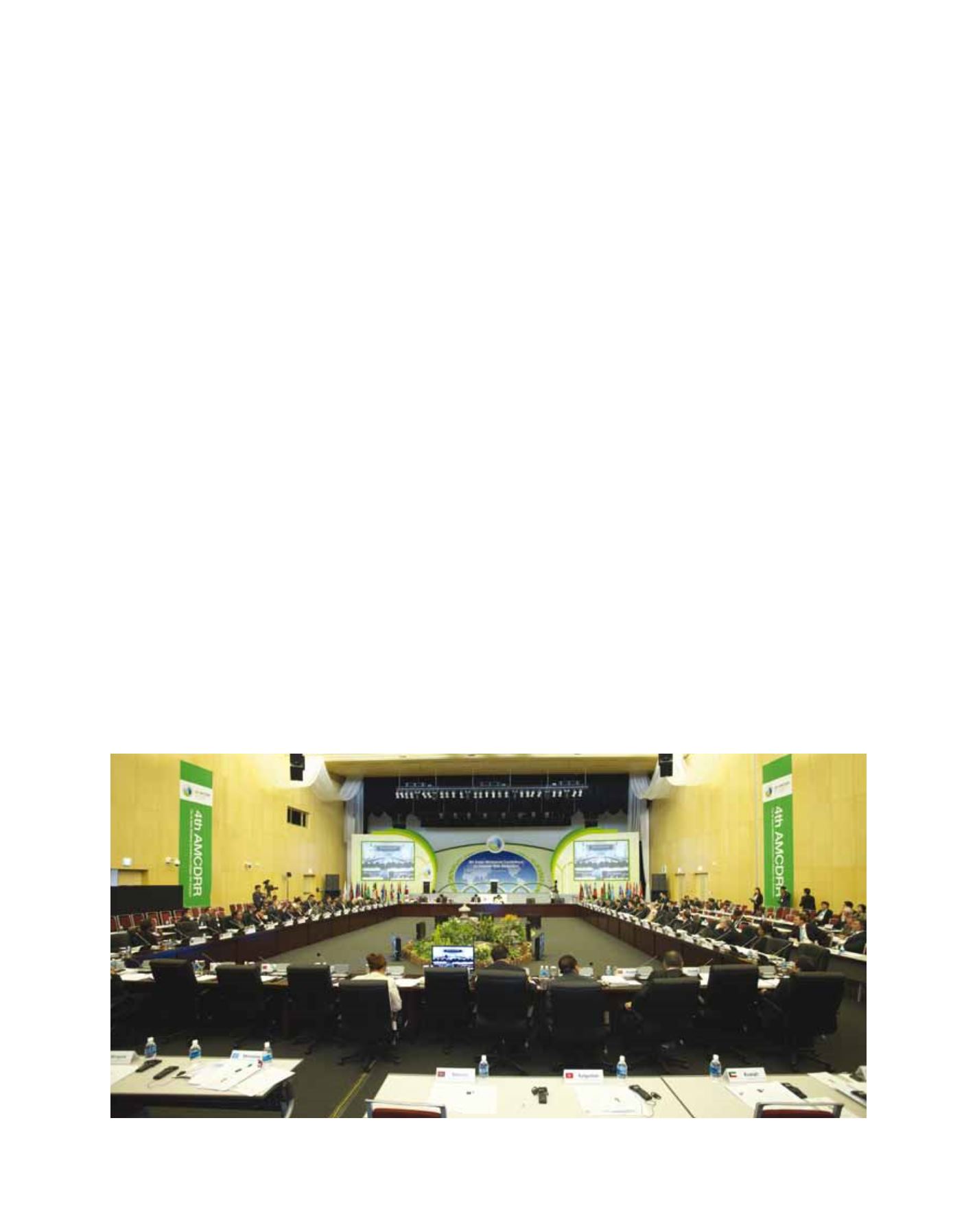
Participants in the 4th Asian Ministerial Conference on Disaster Risk Reduction (AMCDRR) in Incheon Metropolitan City, October 2010
Image: NEMA