


 10 / 85

[
] 10
have actively engaged with the private sector on planning assump-
tions, responsibilities and expectations, or provided practical support
for their application and followed up on implementation.
So far, cross-border pandemic preparedness has not been addressed
sufficiently. As a pandemic will have cross-border impacts,
transparent and collaborative cross-border preparation is needed to
achieve interoperability during a pandemic. Border closures and
travel restrictions could also have wider-reaching socio-economic
impacts. There is also little evidence that national planning efforts are
addressing the rights and interests of economically and socially disad-
vantaged groups, despite the likelihood that these groups will be
disproportionately affected in a pandemic. Strategies to assess and
cope with the impact on ethnic minorities, refugees and displaced
persons are absent in most plans.
But planning itself is not sufficient. The preparedness required goes
beyond sharing ideas, or even joint planning; it calls for the testing
of assumptions, interdependencies and systems for directing and
managing actions when undertaken by a range of different authori-
ties. This can only be achieved by conducting simulations and
reviewing the results to identify areas where there are overlaps, gaps
or difficulties. In the most recent UNSIC-World Bank Progress Report,
which gathered input from 148 countries, 53 per cent of national
authorities reported that their plans had been tested during the past
12 months, but only 25 per cent reported having done this both at the
national and local level; and only 38 per cent reported having incor-
porated lessons learned into plan revisions.
2
Indeed, evidence
available to the UN indicates that the majority of national pandemic
plans are still neither truly institutionalized nor operationalized – in
that policies and laws have not been instituted, and that crisis
response plans and procedures have not been rigorously
tested.
To date, nearly US$3 billion has been pledged towards
efforts to control the spread of highly pathogenic avian
influenza (HPAI) and to address the pandemic threat.
But the gap between the amount of external assistance
required for those activities and the amount pledged
each year by bilateral donors and multilateral develop-
ment banks has increased since 2005. This means that
the funds available are well below the amount needed.
Although there has been continued support from major
donor nations, the number of pledging donors has
declined. There is a risk that this decline in resources
pledged, especially for countries with the greatest
remaining needs, could undermine the sustainability of
the investments made thus far. In order to build on the
initial response and successes achieved to date – both
in responding to outbreaks in infected countries and in
building capacity in all countries – there is a need to
meet the longer-term funding needs and gaps.
What the UN system is doing to prepare
The UN system as a whole has invested substantially in
getting ready for an influenza pandemic. It takes this
threat very seriously, especially given that the UN must
stand ready to sustain its existing life-saving operations
regardless of circumstances. Doing so may prove extra-
ordinarily difficult under pandemic conditions, as we
expect even our normal operations to be drastically
complicated by factors such as access to vulnerable
populations, absenteeism, potential spikes in fuel and
food prices, unpredictable financial circumstances, and
other constraints.
The UN system has dealt with the threat in a coordi-
nated fashion, devising a Consolidated Action Plan
3
to
not only help limit the spread of H5N1 but also ensure
that, collectively, we are able to mitigate the impacts of
a severe influenza pandemic – and indeed other major
disasters with profound social and economic conse-
quences. The UN’s approach to pandemic preparedness
is built upon three pillars: ensuring staff health and
safety; maintaining operational continuity of life-saving
programmes; and supporting host governments’
preparedness and response efforts. One of the strengths
of the UN’s approach is its operational bent: there is wide-
spread preparedness practice within UN Country Teams,
peacekeeping operations, and other parts of the system
– working with local and central government, disaster
responders, humanitarian groups, and with other parts
of civil society and the private sector, as well as with all
inter-governmental bodies represented at country level.
We have also seen the useful development of a joint
Concept of Operations that shows how the different parts
of the UN system are going to work together in a
pandemic. UN agencies such as the World Food
Programme have organized training and simulation exer-
cises to prepare logistics personnel for the delivery of
humanitarian services in a pandemic. The World Health
Organization (WHO), as the UN technical agency
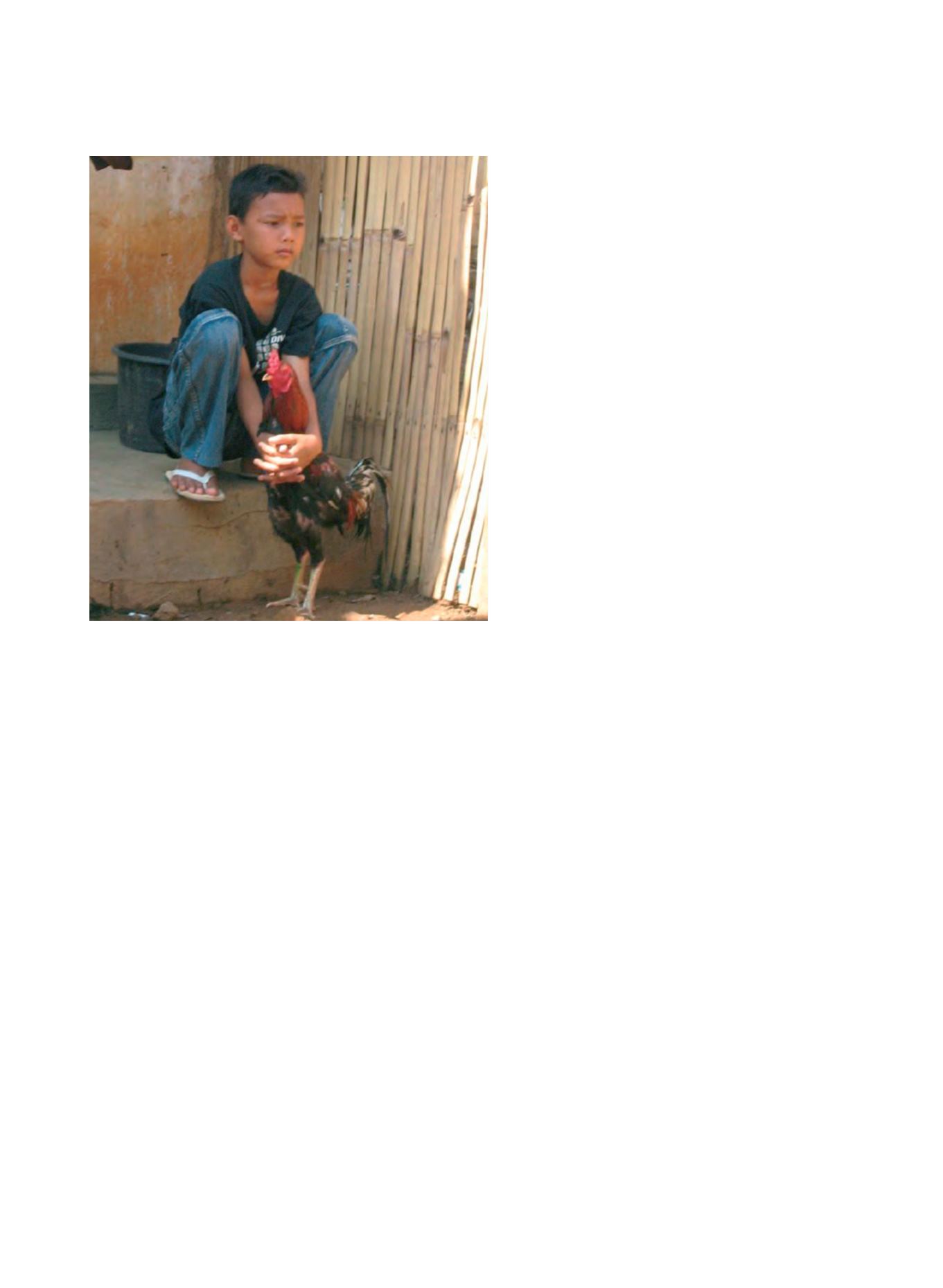
Discouraging children from treating poultry as pets is a difficult task
Image: UNSIC