


 9 / 85

[
]9
implementation of effective surveillance, prompt detec-
tion and rapid responses.
The H5N1 virus has not, so far, changed in a way that
permits continued human-to-human transmission and
an influenza pandemic. Intensive efforts to date have
without doubt led to a reduction in the likelihood of the
next influenza pandemic being caused by the H5N1
virus. However, the risk of a pandemic from a change
in H5N1 or other influenza A viruses remains. The
global picture is one of an H5N1 virus that – despite all
our collective efforts – is not yet fully under control and
is likely to continue to cause both avian influenza in
poultry and sporadic human cases in countries through-
out the world. Much more remains to be done to contain
H5N1 and to prevent the emergence of other animal
diseases that endanger the health of humans. The world’s
people rely on local, national and international organi-
zations to maintain continuous vigilance to detect and
assist countries in responding to such threats.
Ideally, an emerging pandemic could be aborted
through early containment by public health services. In
case this is only partially successful however, national
authorities need to be ready to limit human, social and
economic consequences of a pandemic. But while there
has been worldwide progress with development of
pandemic preparedness plans, there are also great dispar-
ities in preparedness between countries. Whereas
wealthier, industrialized countries have developed and
deepened their pandemic preparations in sectors beyond
health, many middle-income countries have yet to
prepare for the continuity of essential services.
Unfortunately, many low-income countries have not,
during the past year, had the resources needed to
advance their level of pandemic preparedness.
There are many components of pandemic prepared-
ness, some of which will not be feasible to implement in
all countries due to competing priorities and challenges,
though more limited programmes can still be highly
effective in mitigation of morbidity and mortality.
Of course, the health sector must be prepared to
handle the consequences of any pandemic of infectious
disease; but other sectors must be engaged as well given
the necessary depth and breadth of the response. This
requires a focus on all-of-government – indeed all-of-
society – preparedness. In particular, national
authorities should ensure that essential services critical
for society will be able to continue to function under
the stress of pandemic conditions.
United Nations assessments reveal an overall increase
in planning for the continuity of vital infrastructure in
2008 compared to 2007. But while some individual
countries have made concrete progress, this area of plan-
ning is still very limited in most countries, and correlates
clearly with countries’ income levels. The engagement of
civil society and the private sector is still relatively
minor, despite their importance for sustainable multi-
sectoral planning. And although some governments
have provided guidance and tools to assist businesses
with pandemic and business continuity planning, few
can reduce the impact of this pandemic on people, livelihoods and
society.
What member states are doing to strengthen their capacity to
withstand the next pandemic
Previous influenza pandemics have been caused by novel viruses
that are the result of change in the genetic material – either through
mutation or reassortment – of viruses that circulate and cause disease
within animals. One highly pathogenic influenza virus that has
caused widespread concern is the influenza A virus H5N1. Since
2004, hundreds of thousands of people throughout the world have
been working hard to contain the spread of this virus in poultry and
to reduce the number of humans infected with the virus. Led by their
national governments, and following strategies developed by the
Food and Agriculture Organization (FAO) and the World
Organization for Animal Health (OIE) they have initiated changes in
farming practices so as to upgrade hygiene in livestock production
and markets, improve veterinary services and disease surveillance,
immunize poultry with billions of doses of vaccine, limit infection
rates through restricting movement of birds and cull those in the
immediate area of outbreaks, and compensate persons whose birds
or property were destroyed as part of the control effort. Progress has
also been made in sensitizing the media and educating the public of
the threat posed by H5N1, and in promoting behaviours that improve
hygiene and bio-security so as to protect birds and humans from the
virus. Many more countries have increased the speed and effective-
ness with which they can respond to H5N1 outbreaks with
improvements in surveillance and diagnostic systems. Indeed, several
countries that detected HPAI infections or re-infections in 2007 and
2008 have now succeeded in eliminating infection thanks to the
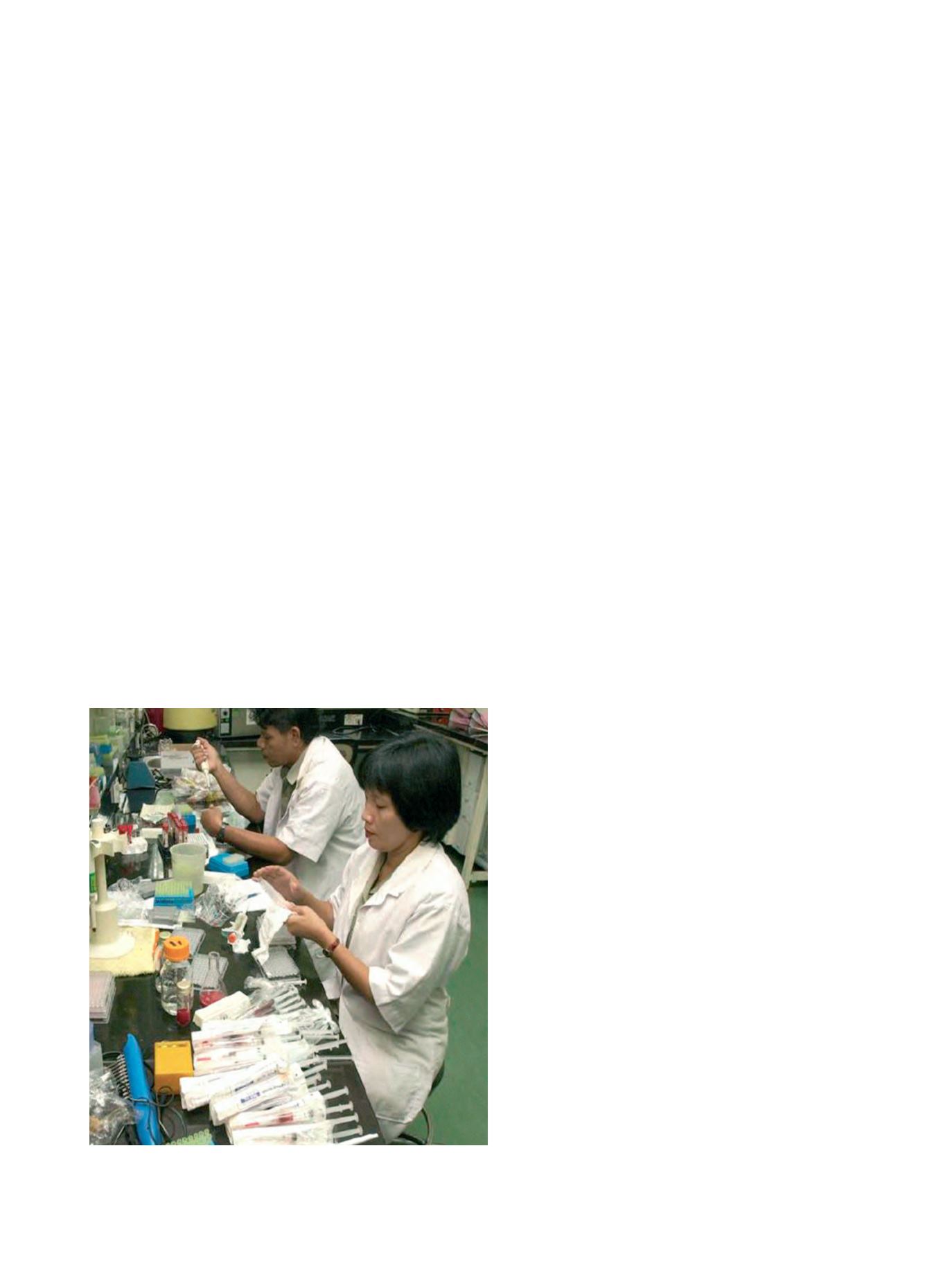
Laboratory tests provide support to rapid containment and response to
public health emergencies
Image: UNSIC