


 13 / 85

[
] 13
and volunteers, and have extensive experience and
knowledge in disaster planning and public health, and
in responding to disasters and infectious disease
outbreaks with life-saving goods and services.
Through those branches and community volunteers,
Red Cross and Red Crescent National Societies will
develop detailed plans for responding to a pandemic and
disseminate simple but effective prevention and mitiga-
tion messages for households and communities. These
include promotion of non-pharmaceutical interventions
such as proper hand-washing, sneezing or coughing
practices, avoiding gatherings and social distancing
among children and adults, and voluntary isolation of ill
household members.
National Societies can also augment the human
resource needs of communities in the delivery of health
and other services. Experience in community health
programming will allow National Societies to provide
home and community care to people who have influenza
and other illnesses, and to refer ill community members
to health facilities. Volunteers may also be enlisted to
support the distribution of food and non-food items,
management of dead bodies, provision of psychosocial
support, or collection and reporting of information
received from the community.
At the same time, because the actual occurrence of a
pandemic remains a big uncertainty, over-preparing
community volunteers now who are already heavily
involved in the implementation of existing public
tively by working on the ground within communities,” stresses
Kaufman. “Volunteers and community leaders must first be well-
trained – and we’re doing this now – and then we need to be ready
to implement specific, well-planned community-based interventions
when a pandemic surfaces.”
Considering that nearly everyone in a given community will be
affected in an influenza pandemic, communities need to anticipate
that there may be no outside help even though material resources
for response may be available. As a result of severe illness due to
influenza and other causes, health facilities may be overwhelmed,
there may be shocks to livelihood and businesses due to high absen-
teeism, and lifelines may collapse. Communities may be left to
respond on their own.
In an effort to survive a pandemic influenza wave, communities
need to develop plans that involve all sectors to ensure that influenza
infection is controlled, and that the delivery of essential services is
continued to maintain basic functions of society – namely health,
food, water and sanitation, energy, public security and order, finance,
telecommunications and transportation.
The Red Cross and Red Crescent approach to community
pandemic influenza preparedness
Red Cross and Red Crescent National Societies based in 37 nations
throughout Asia and the Pacific, and 186 nations worldwide, are
ideally positioned to support community preparedness for pandemic
influenza. They have independent status and formal auxiliary rela-
tionships with national authorities and government ministries,
coupled with expertize and capacity to reach the most vulnerable in
the community. These societies have massive networks of branches
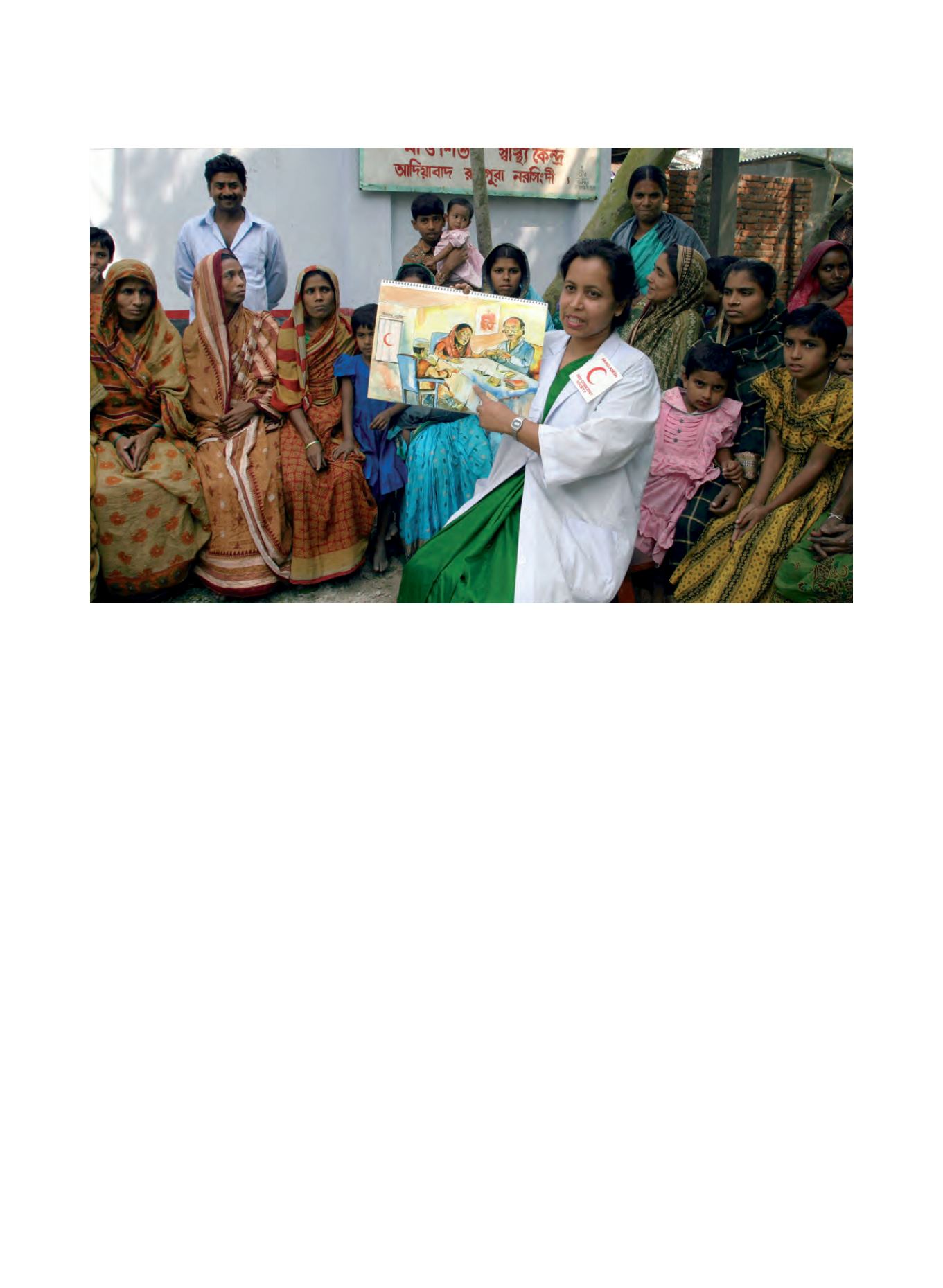
Red Cross and Red Crescent H2P projects are developing trainings and materials that enable volunteers, like these in Bangladesh, to share simple messages that
prevent or mitigate the transmission of influenza in households and communities
Image: IFRC