


 14 / 85

[
] 14
health and other programmes would be inappropriate. While generic
infectious disease messages and guidelines can be distributed at any
time, it is believed that pandemic influenza-specific tools and mate-
rials can be given to volunteers at the ideal moment through
‘just-in-time’ trainings.
What is thought to be appropriate in the current circumstance is
the preparation of simple, easy-to-use tools, guidelines and materi-
als for community leaders and volunteers, and their pre-positioning
close to communities. These may include culturally-sensitive and
acceptable Information, Education, and Communication (IEC) mate-
rials for print and broadcast distribution that contain prevention and
mitigation messages. Guidelines for volunteers identified to distrib-
ute food and non-food items can be put in place, and masks, gloves,
aprons and other protective materials can be distributed for volun-
teers who may be caring for sick individuals.
To ensure that these tools, guidelines and materials are delivered to
community volunteers when risk has increased – such as when WHO
declares that human-to-human transmission has occurred – a cadre of
trained district officials from National Societies and partners will be
prepared to deliver those tools and materials to communities. A coun-
trywide rollout plan will outline trigger mechanisms for national
society response and coordination arrangements for working with
partners during pandemic will be made clear. Simulation exercises will
be conducted to test the effectiveness and completeness of these plans.
National Societies have recognized the fact that, despite their expe-
rience and knowledge in disaster management and public health
emergencies and their extensive networks of chapters and branches,
they must work with partners. Due to anticipated absenteeism during
a pandemic wave, preparing township or district officials from
various organizations will be important in the rollout of tools and
guidelines. Working with partners will also maximize geographical
coverage and ensure that as many communities as possible receive
essential support.
Next steps for the IFRC
With the aim of contributing to increased household and
community level response and preparedness to limit the
impact of pandemic influenza, the IFRC has embarked on
a three-year Humanitarian Pandemic Preparedness (H2P)
programme to achieve the above-mentioned outputs in at
least 25 countries. Host National Societies will play the
primary role in implementation of this programme. In Asia
Pacific, the Nepal Red Cross began implementing a 20-
month community pandemic preparedness project late
last year, while the Red Cross Societies of India, Indonesia,
Laos, Philippines and Viet Nam will implement similar
projects beginning in the first half of 2009.
These projects are being carried out through the
support of the US Agency for International Development
(USAID), which leads and funds the H2P Initiative. The
Initiative also consists of partners that have established
competencies relevant to pandemic preparedness:
UN agencies
such as WHO, WFP, UNHCR,
UNSIC/OCHA and IOM, constitute the normative group
through the development of relevant global guidelines,
and are supporting governments in the preparation of
national pandemic preparedness and response plans.
The CORE Group
, which leads the public health
working group, is responsible for the development and
design of guidelines and materials related to care for the
ill, reduction of transmission and lowering of excess
mortality from common non-influenza illnesses in a
pandemic. It also seeks opportunities to stimulate
country-level coordination of NGOs.
AI.COMM
, managed by the Academy for Educational
Development (AED), is the principal partner in behav-
ioural change and communication. In addition to the
development of communication materials, it leads forma-
tive research.
InterAction
will take responsibility for communication
with the private voluntary organizations (PVO) sector.
It will also map out international non-governmental
organizations (INGOs) and their partners’ programmatic
capacities at national levels that may be mobilized for
response. InterAction will also coordinate three major
regional meetings aimed at introducing the Initiative on
a larger scale in Africa, Asia and Latin America.
The IFRC serves as the coordinating agency for the initia-
tive. It also provides technical and financial support to Red
Cross and Red Crescent National Societies to implement
pandemic preparedness activities. It will hire or oversee
experts, consultants and technical working groups tasked
to develop appropriate tools and protocols in public health,
food security and livelihoods. The IFRC will also facilitate
coordination between partners in keeping the wider Red
Cross Red Crescent Movement informed on H2P progress.
Experience and credibility in pandemic
preparedness and response
Pandemic influenza is not new to the Red Cross and
Red Crescent. During the 1918-1919 Spanish flu, Red
Cross and Red Crescent National Societies were
requested by governments to provide volunteers to care
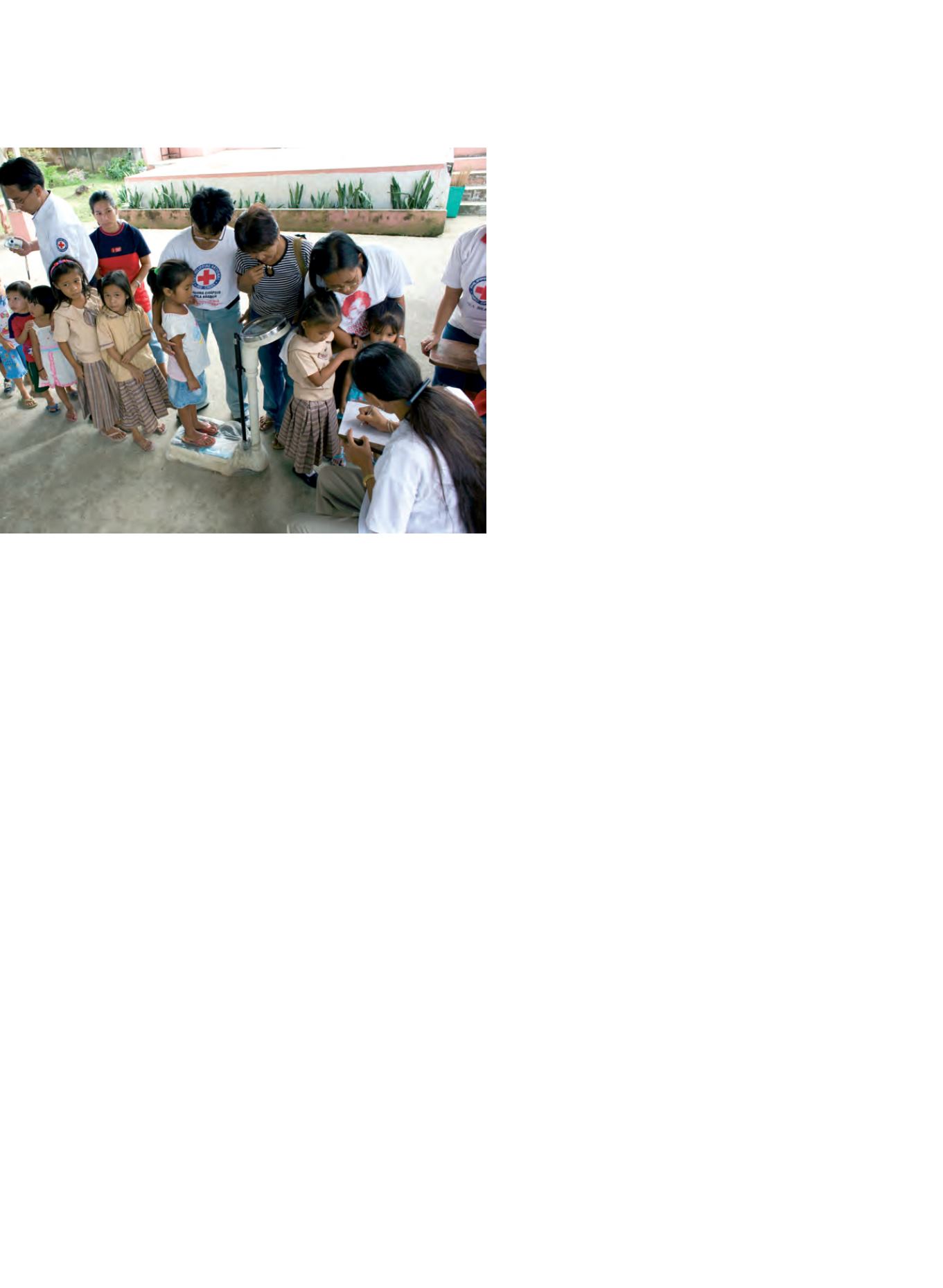
Throughout Asia, volunteers are engaged every day in promoting healthy habits.
These Philippines National Red Cross volunteers may one day play a vital role in
responding to a pandemic
Image: Rob Few/IFRC