


 19 / 85

[
] 19
Preparing for the next influenza pandemic
Stephen C. Redd, US Centers for Disease Control and Prevention
A
severe influenza pandemic has the potential to be one of
the most catastrophic health events in history. This future
pandemic will happen when an influenza A virus circu-
lating in birds or other animals undergoes a genetic change that
allows it to be transmitted efficiently from person to person.
This genetic change can occur through a series of mutations or
through a process called reassortment, which occurs when a
person or animal is infected simultaneously with an animal
influenza virus and a virus that already has the capability to be
readily transmitted among people – some subsequent descen-
dent viruses could have genetic material from both viruses.
Should such a new virus emerge that can be readily transmitted
from person to person, the world would be on the verge of a
pandemic. Susceptibility to such a virus would be universal, the
illness it would produce could be severe, and without effective
control measures, transmission would be widespread. With
increasing global interconnectedness, an infection with the char-
acteristics of influenza – respiratory spread, initial non-specific
clinical manifestations, and a short incubation period – has the
potential to spread around the world in short order.
Unmitigated, a severe pandemic could cause tens of millions of
deaths worldwide, disrupt civil society, and lead to trillions of
dollars of economic losses over a period of months.
In late 2004 and through 2005 and 2006, the world
braced for an influenza pandemic caused by the H5N1
influenza virus. This virus had spread in poultry and wild
birds over the course of months through Asia and into
Europe and Africa, and although H5N1 was not readily
transmissible from person to person, there was wide-
spread concern regarding increasing chances that a series
of random mutations of the virus in an infected bird, or
genetic reassortment with an influenza virus better
adapted to human transmission, would ignite a pandemic.
In the face of these dire possibilities, modern science and
public health have expanded the repertoire of tools avail-
able to reduce the impact of an influenza pandemic since
the last influenza pandemic in 1968. These tools include
the capability to diagnose novel influenza virus infections
specifically and quickly, availability of anti-influenza drugs,
the technology to produce large quantities of vaccine well
matched against a pandemic influenza virus, and, although
not new, traditional public healthmeasures to reduce expo-
sure of susceptible persons to infectious persons. The global
challenge is to marshal these interventions into a rapid,
seamless, worldwide response for an inevitable event, but
one where the timing and severity are unpredictable.
The United States is working in partnership with other
national governments, numerous international organi-
zations, and internally, to prevent and prepare for the
next pandemic. In short, this work translates to plan-
ning and training to use the full range of interventions
available. Because the next pandemic will almost
certainly arise from an existing animal influenza virus,
monitoring such viruses and attempting to control or
eliminate them from animals is the first line of defence.
In the years since 2004, largely as a response to the
H5N1 threat, individual countries and the global
community have achieved a substantial level of
pandemic preparedness. Sustaining and improving
preparedness is now at risk because of complacency with
the H5N1 situation – the virus has not become more
transmissible from person to person – and because the
global economic climate favours dealing with current
problems rather than preparing for future ones.
Nevertheless, the current H5N1 threat is undiminished,
and the risk of a novel influenza virus, whether H5 or
another type, spawning a global pandemic is ever
present. Preparing for an influenza pandemic is an
ongoing effort, and the global community must be ever
vigilant to reduce the risk and prepare to mitigate the
consequences of the next influenza pandemic.
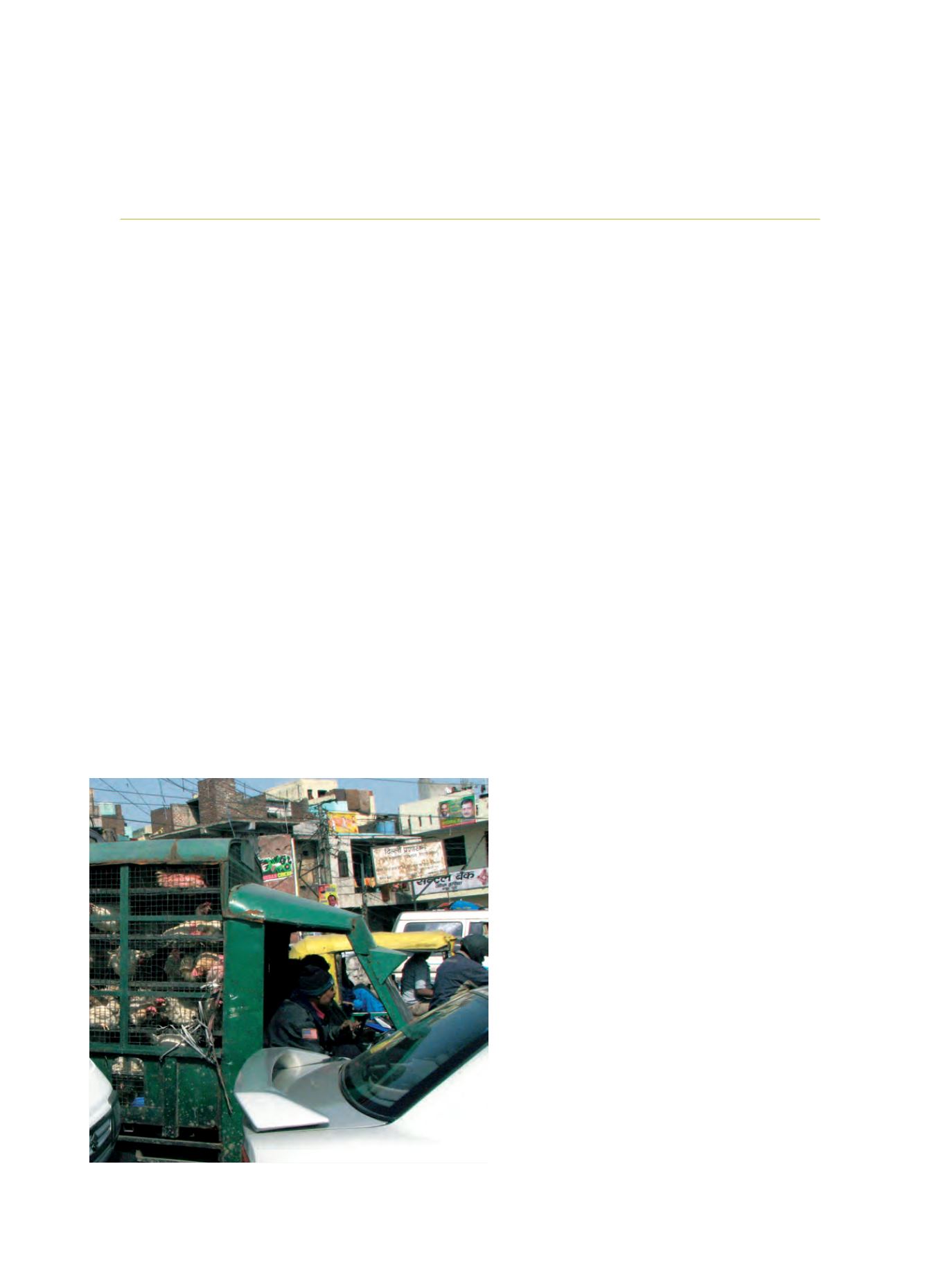
The H5N1 influenza virus spread rapidly in poultry and wild birds during 2004-2006
Image: US CDC