



 24 / 85

[
] 24
mined, if the protection induced by a vaccine is clade or
subclade-specific. Ideally, an H5N1 vaccine would protect
not only against the virus strain used for vaccine manu-
facture but also against viruses, which have undergone
antigenic drift. However, traditional inactivated split and
sub-unit H1N1 and H3N2 influenza vaccines induce rela-
tively strain-specific serum antibody and are ineffective
against antigenically drifted viruses. In contrast, studies
with the Vero cell culture derived whole virus H5N1
vaccine have demonstrated that it is capable of inducing
broadly cross-reactive neutralizing antibodies against a
range of H5N1 clades and subclades.
5
Immunization
studies in guinea pigs have demonstrated that two immu-
nizations with a clade 1 A/Vietnam/1203/2004 strain
vaccine resulted in induction of high titre neutralizing
antibody responses to a clade 0 (A/Hongkong/156/1997),
a variety of clade 1 (A/Vietnam/1203/2004, A/Vietnam/
1194/2004, A/Thailand/83/2004), clade 2.1 (A/Indonesia
/05/2005), clade 2.2 (A/turkey/Turkey/1/2005, A/chicken
/Egypt/03/2006) and clade 2.3 (A/Anhui/1/2005) strains.
Although whole virus vaccines are reported to be
more immunogenic in immunologically naïve individ-
uals than split or sub-unit vaccines, they are considered
to be associated with enhanced reactogenicity, partic-
this derivation of new reassortants requires several weeks, resulting
in significant delay in the delivery of a new pandemic vaccine. In
addition, the vaccine may provide an optimal antigenic fit with the
WT circulating virus only with respect to the HA and NA genes and
not with respect to the rest of the genes including the nucleoprotein
and the matrix genes which are derived from the A/PR/8/34 virus.
A novel strategy was developed to avoid the delay and potential
antigenic mismatch associated with vaccine production using egg-
adapted, reverse genetics-derived reassortant virus. This involves use
of wild-type virus to produce vaccine antigen in Vero cell culture,
one of the most advanced cell culture systems for production of
influenza viruses. For vaccine production, the virus harvest is inac-
tivated using a highly stringent procedure involving two separate
steps, formalin and UV treatment. Formalin alone was sufficient to
achieve total inactivation with a large safety margin, as confirmed
by safety (passage) assays of the bulk vaccine in two highly suscep-
tible cell systems, that is Vero and chicken embryo cells. Double
inactivation was chosen to enhance the safety margin. The inacti-
vated virus is then purified by continuous sucrose gradient
centrifugation followed by ultra/dialfiltration steps prior to formu-
lation. Re-sequencing of the HA gene of both strains at the
production level confirmed that virus grown in Vero cells did not
result in the selection of antigenic variants.
4
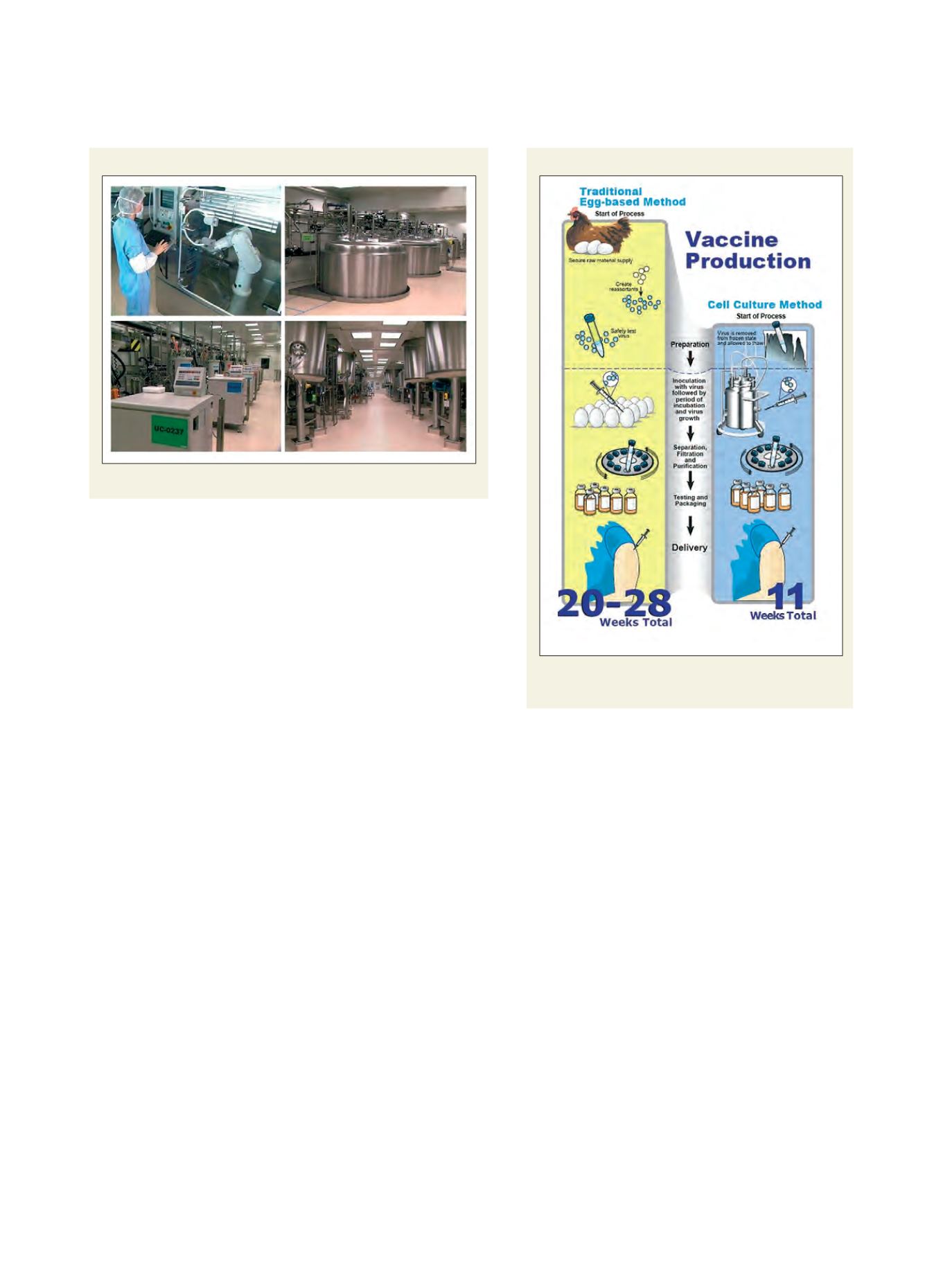
This process can result in the first batches of vaccine being avail-
able approximately 11 weeks after receipt of the pandemic vaccine
strain. This contrasts with a lag time of 20-28 weeks, which is
required for production of vaccine based on RG-derived attenuated
virus in embryonated eggs.
Safety and immunogenicity of Vero cell derived whole virus
H5N1 vaccines
In addition to vaccine supply, the other critical issues in the event of
a pandemic are vaccine efficacy and safety. The H5N1 virus has
diverged into three distinct lineages or clades (0, 1, 2) and multiple
subclades within clade 2. Therefore production of pandemic vaccine
can possibly only be initiated once the exact candidate strain is deter-
Cell culture (Vero) facility
Used for manufacture of H5N1 vaccine in Bohumil, Czech Republic
Source: Baxter Bioscience
Vero cell culture comparison
Source: Baxter Bioscience
Comparison of Vero cell culture with embryonated eggs with
respect to process and timelines