


 27 / 85

[
] 27
national level; prevention and control of the epidemic in
animals; and surveillance, investigation and management
of the disease in humans.
AusAID funding enables Australia’s national science
agency, the CSIRO, to employ two veterinary epidemi-
ologists within the FAO programme to help expand the
country’s Participatory Disease Surveillance and
Response Program to South and West Sulawesi. One
veterinarian, Emma Watkins, is based in the South
Sulawesi port city of Makassar which serves the whole
of eastern Indonesia. “Large numbers of chickens or
chicken products sent to Maluku or Papua or other parts
of Sulawesi come through Makassar,” says Watkins. “It
is also a big centre for commercial chicken production.”
Watkins helps to train veterinary officers and animal
health staff to help villagers identify and report diseases
in poultry. “Many chickens here die from diseases other
than avian influenza and the deaths are not reported.
Our aim is to make sure that all diseases are reported
and the information sent to Jakarta to give officials a
national picture of what is happening.”
The animal health workers make routine visits to
villages where, through village heads or groups such as
women’s organizations, they work with local people to
control and prevent the spread of avian influenza.
This is building the capacity of Pacific island states to deal with
the potential threat of an influenza pandemic and other emerging
diseases in line with regional and international guidelines.
Bilateral programmes
The largest bilateral programme on emerging infectious diseases
funded through Australian aid is in Indonesia. We also assist Papua
New Guinea with surveillance, reporting and rapid response, and
East Timor with bio-security strengthening. In the Philippines we
are helping build government health networks while in Burma we are
supporting WHO and FAO programs to combat avian influenza. We
have a strong presence in other countries of the Mekong as well.
Indonesia
Australia was one of the first countries to respond to Indonesia’s avian
influenza challenge, committing over AU$30 million in three phases
since early 2004. The first phase provided emergency funds to WHO
to assist in detecting and managing human cases and reducing the
risk of a pandemic. By 2005 it was apparent that the disease had
become entrenched in poultry, and further funding was provided to
assist in diagnosing the virus and preventing and controlling the
disease in birds. The third phase began in 2007 and will finish in
2010. This phase continues earlier activities, with additional funding
for a broader Animal Health Support project for South and West
Sulawesi. Our support targets three priority areas: coordination at the
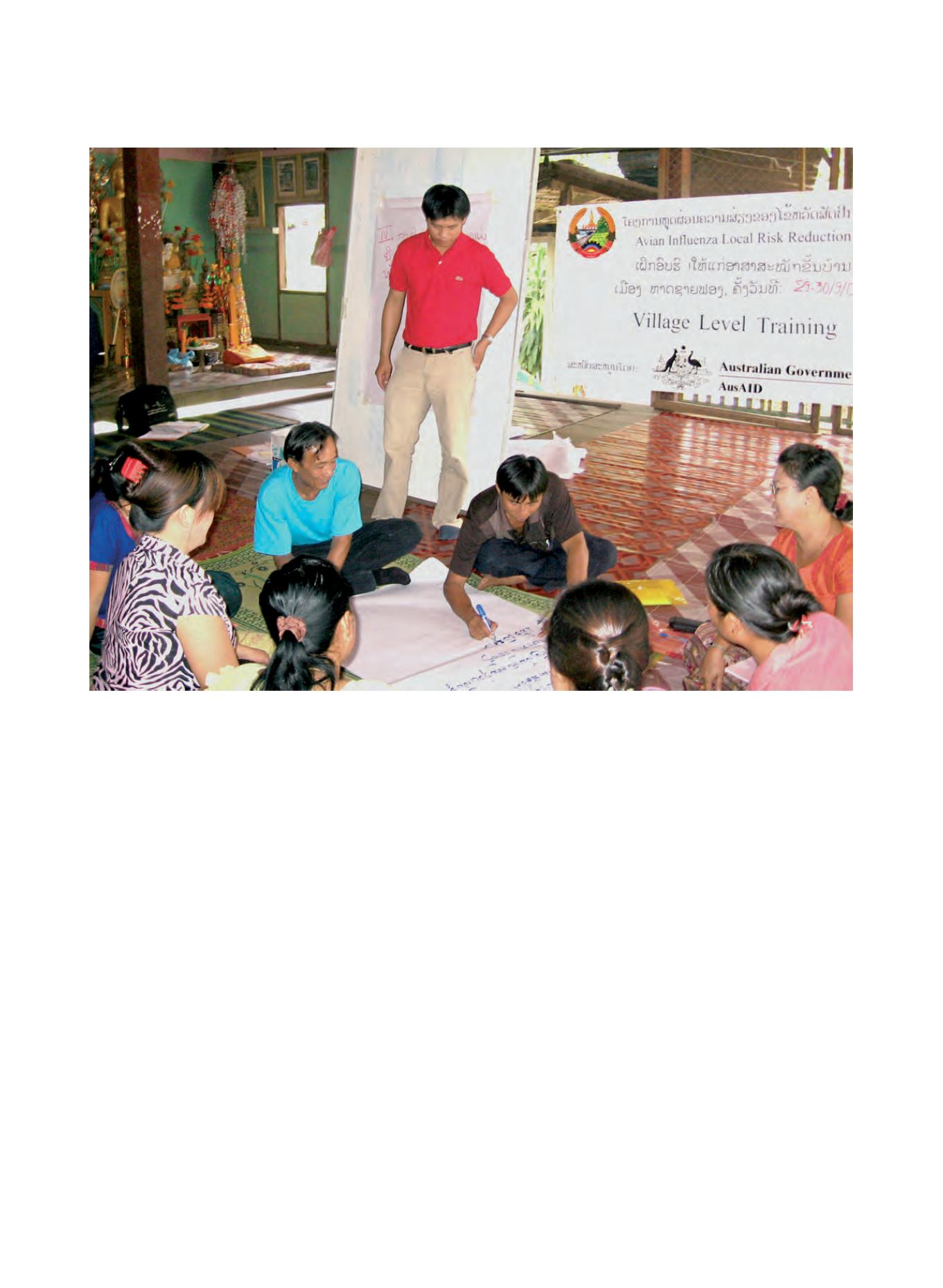
Village-level training on avian influenza in Vientiane, Lao PDR
Image: CARE Laos