


 28 / 85

[
] 28
However, as Watkins acknowledges, there are no short-term fixes. “We
could simply go to villages and tell people that viruses spread in partic-
ular ways. But people often have their own ideas about how diseases
spread. Long-term change is likely to be more effective if communi-
ties find their own solutions to the problem. Many people here own
chickens – they get their protein and make extra cash from them –
so if they can stop their poultry from becoming sick they stand to gain
a lot.”
AusAID funding is also at work in Indonesia helping WHO and
the Indonesian Ministry of Health (MOH) to track and monitor
trends of human cases of avian influenza. WHO field epidemiolo-
gist Gina Samaan accompanies the MOH from the most densely
populated centres to remote locations around the country to inves-
tigate cases. She and the MOH team establish the circumstances that
led to an infection and try to determine the cause. “We try to find out
whether human infection was caused by a sick bird, a dead chicken
or even possibly fertiliser,” says Samaan. “We also want to know
whether a death has been caused by late access to treatment and
whether the virus has acquired the ability to transmit between
humans. Unfortunately there is a stigma attached to having avian
influenza in the same way there was with HIV/Aids in the 1980s,
which means people can be reluctant to report an illness or seek
help.”
Samaan and the MOH team feed their findings into a national
tracking system to help build an overall picture of trends and clus-
ters and to see under what circumstances the virus passes from
human to human. “At present infections are directly from infected
birds to humans,” says Samaan. “The MOH tries to make sure that
family members living in close proximity to human
cases remain healthy, since they are the ones with closest
contact to a case and they may share a common genetic
susceptibility to the virus.”
The ability to conduct investigations will be stronger
now that the Field Epidemiology Training Program is
being revitalized. A group of 20 students has been
selected to do Master’s degrees by fieldwork in Applied
Epidemiology. They will be trained to conduct inde-
pendent investigations of avian influenza and other
outbreaks of emerging diseases to an expert level.
The Mekong
The countries of the Mekong region remain high-risk
areas for avian influenza outbreaks. The human, tech-
nical and health system capacities of these countries
to address disease outbreaks, particularly at the village
and district levels, are weak. The shared porous borders
allow unmonitored movement of people and animals,
which increases the risk of an avian influenza
pandemic.
AusAID funds the non-government organization
CARE Australia to establish a community-based Avian
Influenza Risk Reduction Program in high-risk commu-
nities and districts across Lao PDR, Myanmar, Vietnam
and Cambodia. The programme has piloted approaches
to teach people to recognize, report, control and prevent
the spread of emerging infectious diseases.
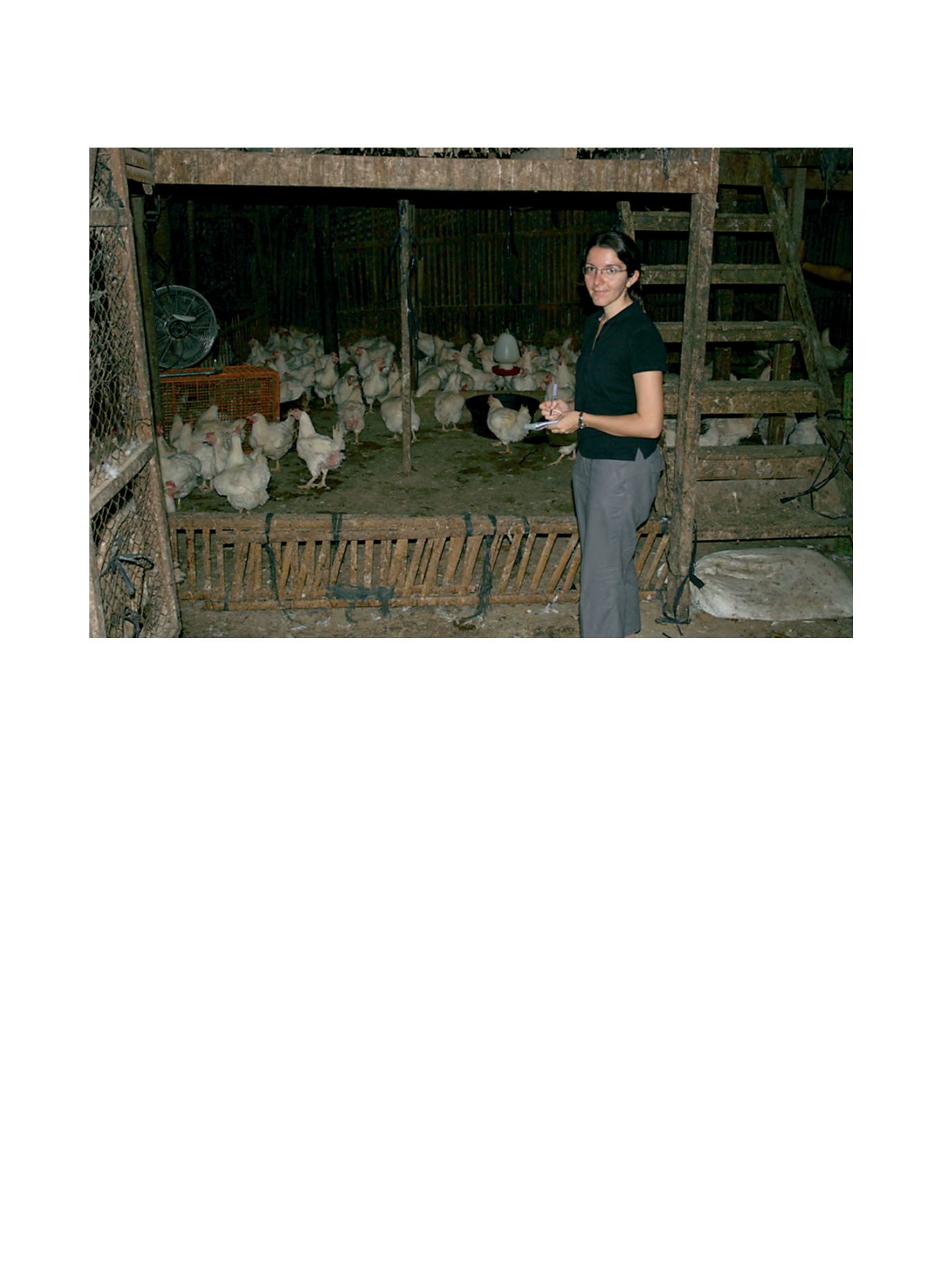
Epidemiologist Gina Samaan monitoring poultry in East Java, Indonesia
Image: Garry Smythe/WHO