


 34 / 85

Medical personnel were also faced with a space dilemma. The need
to quarantine patients with infectious diseases at the field hospital
required additional space in an already congested setting, which may
otherwise have been used to cater for additional beds for patients
with other conditions.
Case Study III: Armed Conflict – Afghanistan, 2002
MR worked alongside several other foreign NGOs at a medical centre
in Spin Boldak, South Afghanistan. The main objective was to treat
patients for common ailments and wounds. However, relief agencies
seeking to extend medical aid in Afghanistan also had to combat tuber-
culosis (TB), which was already an endemic disease that pervaded in
the war-torn country before the peak of its devastation.
There were many challenges in controlling the spread of TB and
its subsequent treatment, which takes around six to nine months. If
treatment falls short of the standard protocol, there is a risk of devel-
oping resistant strains of the bacteria. Thus, there is the continued
risk of TB becoming a potential pandemic caused by bacteria. Apart
from the mandatory three-weeks quarantine period imposed on the
patient, there is the problem of providing the complete course of
three drugs needed to treat the disease. If treatment is not done prop-
erly, patients may develop resistance and without proper X-ray
facilities, the doctors can only clinically diagnose patients. Given the
lack of resources, the doctors faced the dilemma of
whether or not to treat the patients. Patients need to be
educated extensively on the recovery process. While
they may feel better after two weeks, they still need to
be on medication for an extended period of three to four
months under direct observation. Treatment of TB is a
tedious process; therefore prevention of an outbreak
would save valuable resources.
Working with the local government health office, MR
embarked on a health education programme by first
targeting children, primarily infants – the most vulner-
able group to infectious diseases. Medical researchers
have typically acknowledged the hypothesis that infants
who are not breastfed are more vulnerable to infection
and diarrhoea. In order to build up the infants’ immu-
nity levels, MR executed the programme with a
conscientious aim to create a conducive and sustain-
able environment that encourages frequent
breastfeeding for children.
Driven by the misconception that milk powder has
superior nutritional value to breast milk, Afghani
mothers became persistent in asking for milk powder.
This had a reverse effect on relief agencies’ efforts to
[
] 34
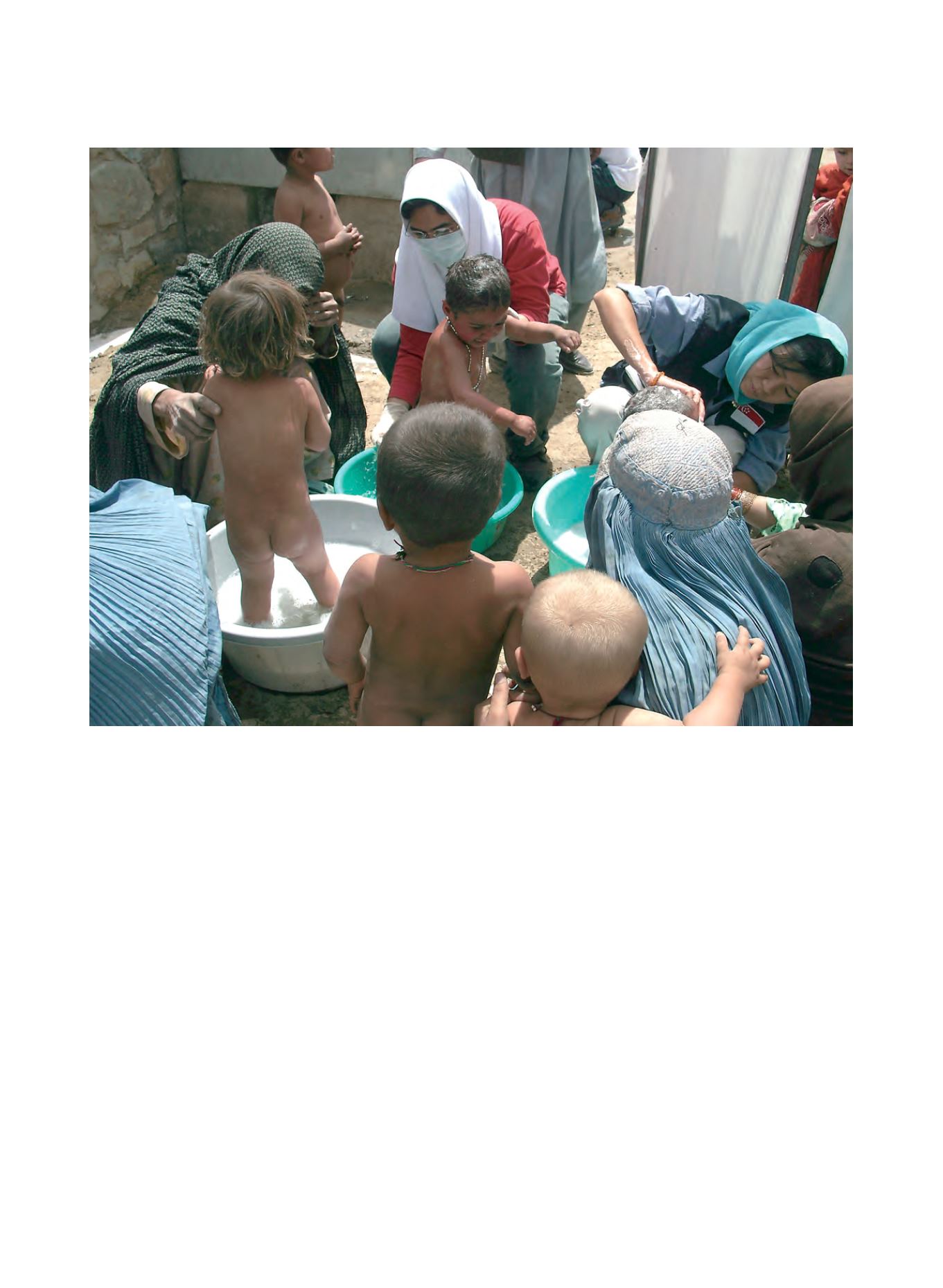
In Afghanistan Mercy Relief’s medical personnel mass-wash children with antiseptic soaps as part of its personal hygiene programme
Image: Tay Mia Hiang/ Mercy Relief