


 20 / 85

[
] 20
countries of Asia or Europe were unaffected, and several
countries in Africa had identified outbreaks. Although
transmission from wild birds to domestic birds has prob-
ably occurred, it seems likely that the trade in poultry,
sometimes illegal, was the more important pathway for
expansion.
Since 2006, the epizoology of H5N1 has changed with
the end of the rapid geographic expansion, and the devel-
opment of endemic foci in the Nile delta, Indonesia,
Southeast Asia, and possibly other locations. Backyard,
small-scale holdings with limited biosecurity initially
appeared to pose the greatest risk. In several countries,
H5N1 appears to have infiltrated commercial poultry
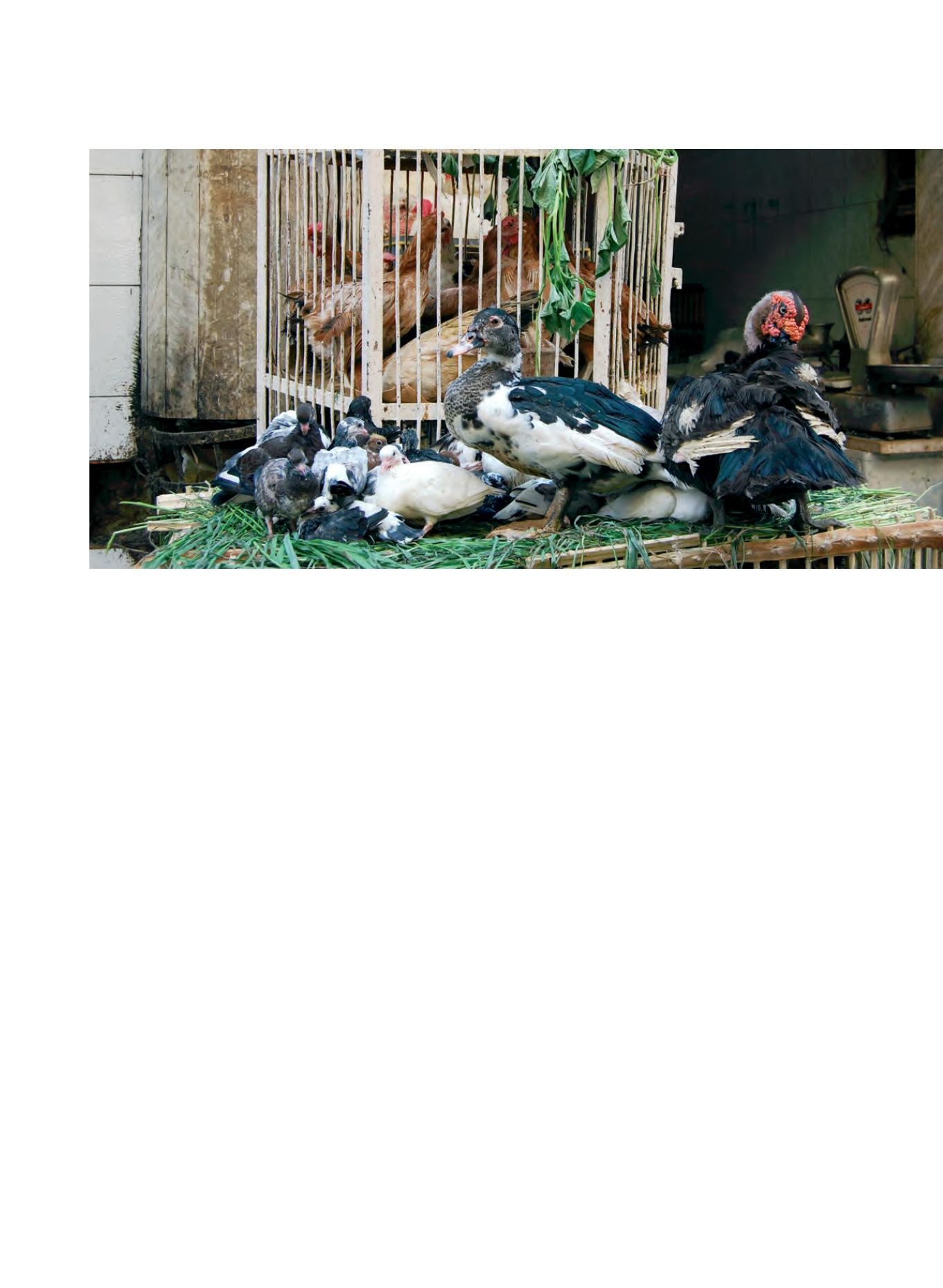
operations – including wet markets where live birds are
sold and slaughtered – increasing the economic impact
of avian influenza, but theoretically making control easier
to implement as concentration of ownership could make
centralized control efforts more effective.
Countries such as Viet Nam and Thailand and regions
such as Hong Kong have effectively controlled avian
influenza through programmes including aggressive
culling, vaccination, and tight surveillance for possible
reintroduction of the virus. Although these measures have
been successful, they require intense, ongoing vigilance
to identify and control reintroduction. For example, Viet
Nam had no avian outbreaks or human cases during
2006, but experienced both in 2007, 2008, and 2009.
Avian influenza in humans and pandemic risk
Every case of avian or other novel influenza A infection
in a human is potentially the start of the next pandemic.
Virology
Because of its widespread distribution and somewhat greater capa-
bility to infect and cause serious disease in a variety of mammals
compared with other avian viruses, the H5N1 influenza A virus has
to be considered the greatest current threat for the next influenza
pandemic. This virus has occasionally infected humans and contin-
ues to have a mortality rate above 60 per cent. In rare instances
limited person-to-person transmission has likely occurred, but these
events have not been accompanied by changes in the make-up of the
virus that signal a greater capacity for person-to-person transmis-
sion. One aspect of pandemic risk assessment involves detailed
molecular examination of each novel influenza virus isolated from
a human case, to determine whether it has changed so as to make
person-to-person transmission more likely. This virologic risk assess-
ment remains a critical component of preparedness.
Although H5N1 is considered the greatest threat, other novel
influenza viruses also pose risk. The three pandemics of the 20th
century all occurred as a result of mutation of a low pathogenic avian
virus or mixing of a low pathogenic virus with different influenza
viruses with genetic components better adapted to human trans-
mission. H2, H5N2, H6, H7, H9, and, possibly, swine H1 viruses all
have the potential to cause the next pandemic. As a consequence,
virus tracking cannot be limited to H5N1.
Influenza in animals and pandemic risk
Controlling influenza in animals is the only way to truly prevent an
influenza pandemic, but because influenza viruses are natural
pathogens of migratory waterfowl and shorebirds, these interventions
cannot be 100 per cent effective. Following H5N1’s emergence as a
major pathogen of poultry in 2004, outreaks in poultry or wild birds
spread southward and westward through 2005 and 2006 until few
Although influenza viruses are natural pathogens of migratory waterfowl and shorebirds, exposure to infected poultry appears to be more
important in human cases of H5N1
Image: US CDC