


 15 / 85

[
] 15
for the sick and dying. The word influenza was also mentioned
prominently in the written history of the IFRC, which was founded
in May 1919 within a few months of the peak death rate of the
Spanish flu.
Since then, the IFRC and its member National Societies have been
in the forefront of delivering effective response to disasters and public
health emergencies through health and care services, enhancing
resilience and coping mechanisms, and reinforcing and complement-
ing weak national health care systems. During the Severe Acute
Respiratory Syndrome (SARS) outbreak in 2003, national societies in
Southeast and East Asia made it possible for volunteers and members
to reach out to a large number of people with preventive measures,
such as information and education materials, hygiene kits and other
supplies, community-based health workshops, advocacy and volun-
teer training.
When the first highly-pathogenic avian influenza H5N1 was
reported in early 2004, Red Cross and Red Crescent Societies were
quick to help communities in raising awareness on the risks of expo-
sure to sick or dead birds, poultry and animals, and how to avoid
such risks. This was done through health and hygiene education,
reinforcing good practice in the management of sick or dead animals,
distribution of IEC materials, supporting social mobilization, case
detection and referral, and strengthening communication.
Over the last 90 years the IFRC and its member National Societies
have responded to the most urgent, life-threatening needs. Today, in
preparing for an influenza pandemic that WHO estimates could risk
70 million lives, the IFRC continues to rely on its enormous volun-
teer network while it develops new tools and methods to respond to
an evolving threat, so that vulnerable communities are prepared for
and can respond to emergencies.
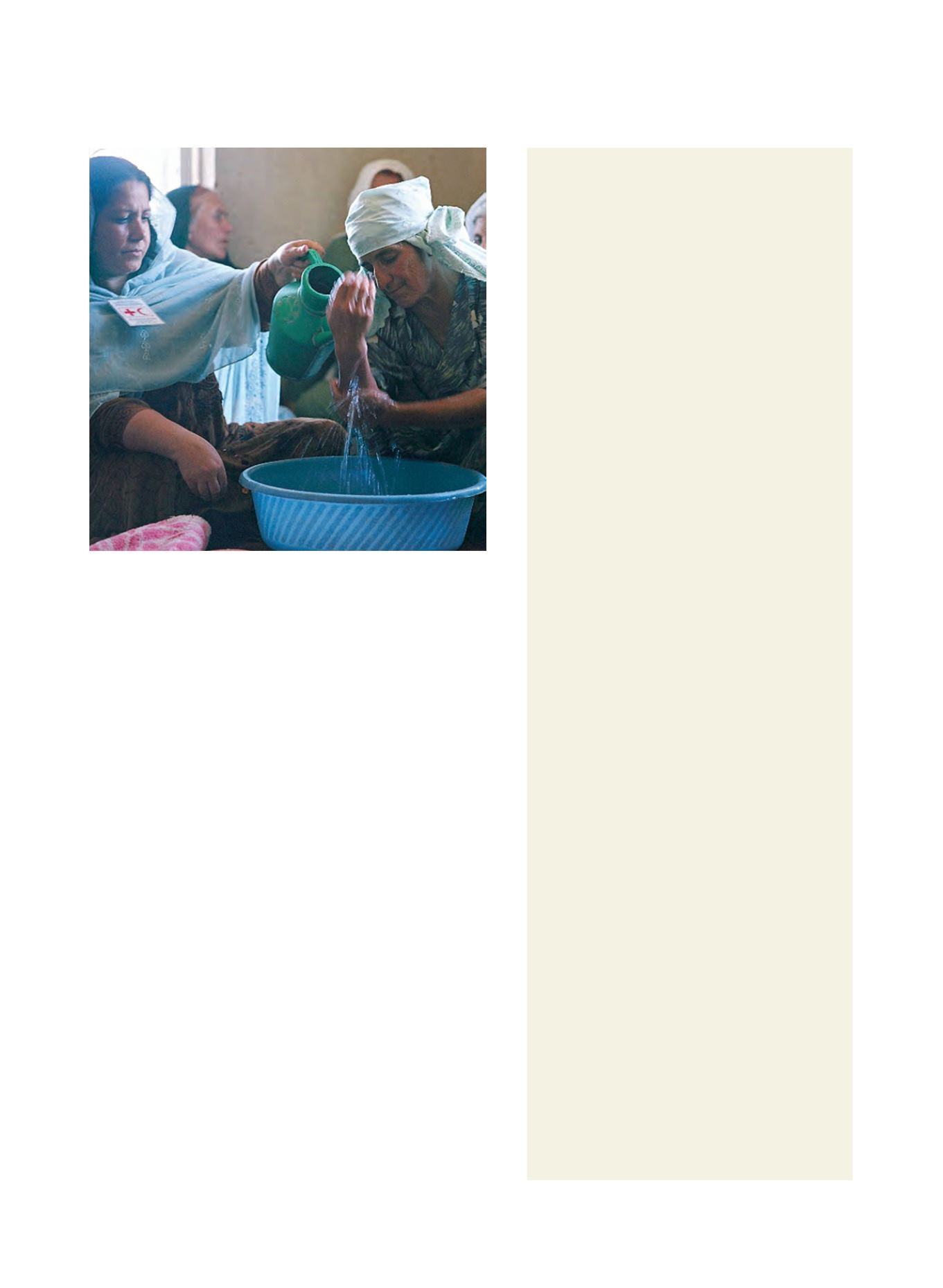
An Afghan Red Crescent trainer supervises a community volunteer as she
demonstrates proper hand-washing techniques. H2P projects will also develop
guidance for volunteers on what they need to do differently during an influenza
pandemic to protect themselves through infection control measures
Image: IFRC
Updating laws for pandemics and other disasters
The IFRC is working on another important aspect of
pandemic preparedness – ensuring that countries
have the best legal frameworks in place to contain and
respond to potential outbreaks. Three ‘Legal
Preparedness Projects’ are currently underway in
Cambodia, Laos and Viet Nam to review existing laws
and policies for communicable disease emergencies
and other disaster situations, and to make
recommendations for legislative improvement. The
Legal Preparedness Projects are funded by the Pooled
Fund of the Greater Mekong Sub-region Communicable
Disease Control Project of the Asian Development
Bank, and are conducted in close collaboration with
different government ministries, Red Cross and Red
Crescent National Societies, WHO and other key
organizations in each country.
Among the challenges of pandemic preparedness, and
indeed preparedness for other major disasters, is
ensuring that national laws, plans and systems are
compatible with regional and international prevention
and response mechanisms. Thus, a major objective of
these projects is to improve the implementation of
relevant international laws and standards and ensure
that domestic legal systems facilitate international
cooperation. In this regard, there are two international
instruments of central importance:
Guidelines for the Domestic Facilitation and
Regulation of International Disaster Relief and Initial
Recovery Assistance of 2007 (IDRL Guidelines)
The IDRL Guidelines are a set of recommendations for
governments on the legal requirements needed to
receive international assistance in the immediate wake
of a disaster that exceeds national capacities. They
cover issues such as rapid customs clearance for relief
goods and medications, the issuing of visas and
necessary legal status to incoming humanitarian
organizations, coordination of relief and recovery
efforts and the monitoring of quality and accountability
standards. Although non-binding, the IDRL Guidelines
were adopted by governments at the International
Conference of the Red Cross and Red Crescent in 2007
and have been recognized by a number of other
international forums. Their principles are drawn from a
large number of pre-existing treaties, resolutions and
other international standards.
International Health Regulations of 2005 (IHRs)
The IHRs are a legally binding instrument, adopted by
the World Health Assembly in 2005 to prevent and
control the international spread of disease. They
include a number of measures relating to disease
surveillance, alerts, prevention, containment and
response activities. A number of these measures
require the development or amendment of laws to
allow authorities to undertake necessary activities,
such as the inspection and quarantine of goods and
travellers, vaccinations and decontamination, the
management of international borders and the
exchange of information to assist international
prevention and response. Additionally the IHRs seek to
ensure that all such measures are consistent with
human rights obligations and minimize disruption to
international trade and travel.
It is hoped that the findings and recommendations
from these Legal Preparedness Projects will provide
valuable assistance to governments in identifying and
resolving the most pressing legal issues which stand in
the way of their readiness to respond to potential
pandemics and other disasters.