


 78 / 85

distancing (for example, limiting and banning national or international
events, closure of schools); training on behaviour to provide personal
protection (such as wearing face masks in certain situations).
FOPH has published recommendations for the population as a
whole on personal hygiene in case of an influenza pandemic. These
are part of an overall strategy, which includes further measures
such as vaccination, the treatment of patients with antiviral drugs,
and measures in the workplace. Personal hygiene measures can
contribute to reducing human-to-human transmission of the
influenza virus, thereby delaying or reducing the severity of the
pandemic. They are mainly aligned with pandemic phase 6 accord-
ing to WHO. They are directed toward members of the general
public who are not occupationally exposed. The following
measures are recommended:
Hand hygiene
– Wash your hands regularly and thoroughly with
soap and water.
Paper handkerchiefs
– Hold a paper handkerchief in front of your
mouth when coughing or sneezing. After use, throw the paper hand-
kerchief in a waste bin. Then wash your hands.
Code of conduct in public
– If possible, avoid close contact with
other people. When speaking with other people, keep at a distance
of at least one metre. When greeting people or saying goodbye, avoid
handshakes, hugs and kisses.
Wearing a facemask in certain situations
– The exact situations can
only be determined after the appearance of the pandemic virus.
However, members of the public are recommended to keep a supply
of 50 facemasks (surgical masks), in order to prevent a shortage of
supply. These masks are retailed.
As regards facemasks, there is a compulsory store supervised by
FONES of about 250,000 FFP2/3 masks for medical personnel. Also,
at the federal level, there is a supply of 30 million surgi-
cal masks. Ten million masks are for the federal
administration personnel, and 20 million are to be used
in case of an acute shortage of supply in the cantons,
especially for health service provision or for people who
have come into contact with sick people or who may be
infected.
The State Secretariat for Economic Affairs (SECO), in
cooperation with other partners, has drafted recom-
mendations for companies, which are intended to
provide them with support and guidance when planning
measures in case of a pandemic. In particular there is a
manual on how companies can prepare themselves, and
a document answering the most frequently asked ques-
tions about the legal and economic aspects of preparing
companies for a pandemic.
Evaluation by WHO
In October 2007, a delegation of experts under the lead-
ership of the WHO Regional Office for Europe
evaluated the preparedness of Switzerland for a
pandemic. This audit showed that Switzerland is one
of the best prepared countries in Europe. The evaluation
pointed out the appropriate decisions taken by the
Federal Council, and the efforts that have been made
at various levels in Switzerland. In addition, it was
recommended that the achievements be consolidated,
that the motivation of the parties be maintained, and
that the leadership role of the federal government be
strengthened.
[
] 78
Pre-pandemic vaccine
Pandemic vaccine
Phase 3
Phase 4
Phase 5
Phase 6: Pandemic
Time
1st
dose
2nd
dose
3rd
dose
Cross-protection against
Pandemic virus (PV)
Protection
Persons at risk of occupational exposure
1st
dose
2nd
dose
3rd
dose
Cross-protection against
Pandemic virus (PV)
Protection
General population
1st
dose
2nd
dose
Protection
3 weeks
about 6 months
3 weeks
about 6 months
about 6 months
Swiss clinical study
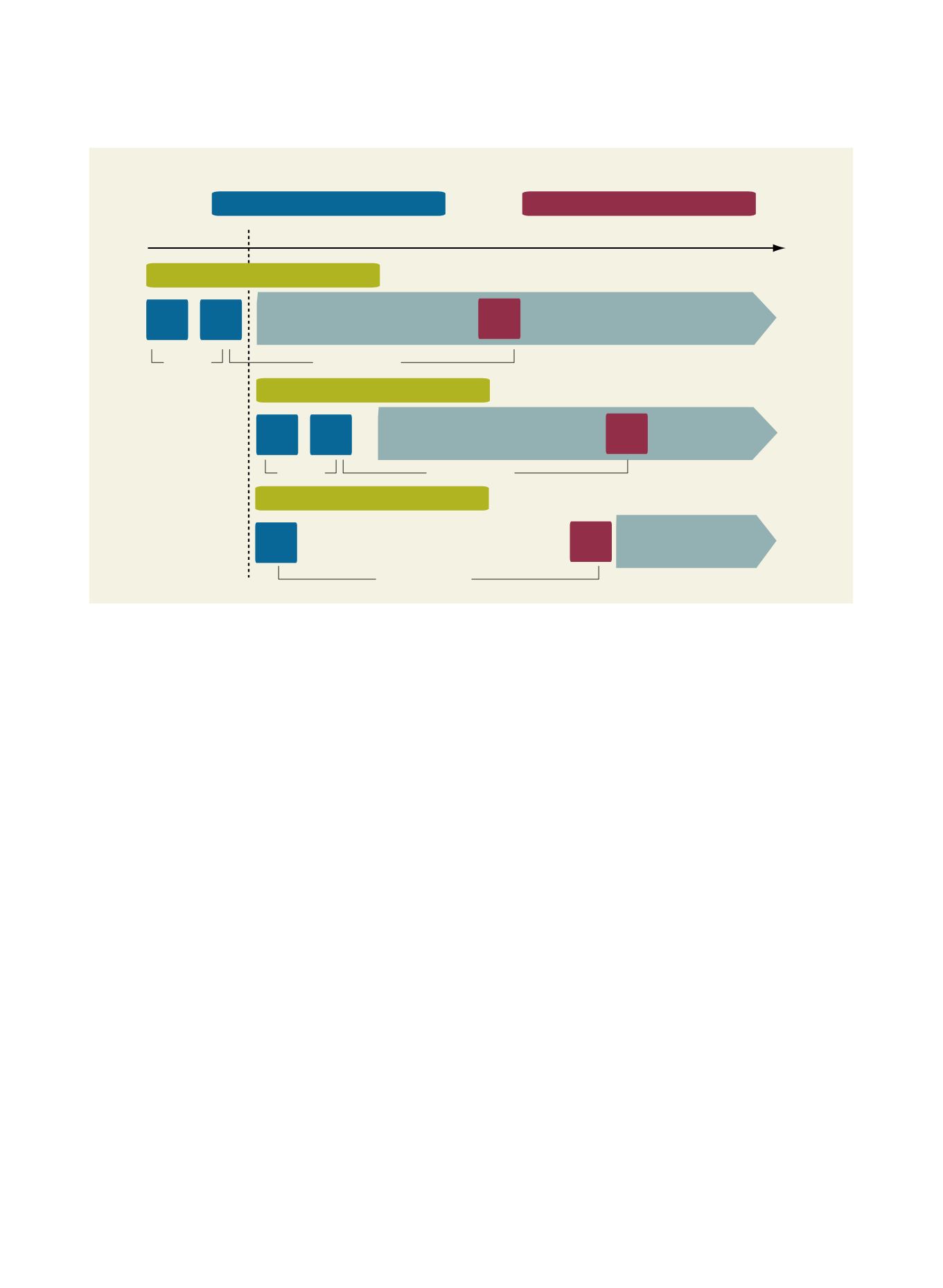
Swiss strategy for pre-pandemic and pandemic vaccination
Source: Swiss Federal Office of Public Health