


 74 / 85

[
] 74
developed and even tested in an exercise involving two of the coun-
ties.
The main part of the operational activities in healthcare and
communicable disease control takes place in the counties, and the
first version of the plan already took this into account by develop-
ing a special guidelines document for local planning in the counties.
It includes a number of technical documents focusing on different
areas, among others the use of antivirals and hospital hygiene during
a pandemic. Over the last two years, different kinds of assessment of
Swedish pandemic planning have been carried out. While the
European Centre for Disease Prevention and Control visited Sweden
and made its assessment report in 2007, the national audit office
examined various Swedish authorities and their work with pandemic
planning. In 2008, the NBHW visited all the 21 counties in order to
follow up the development of county plans. In the light of these find-
ings, the national plan and the guidelines for local planning will once
again be revised during the first half of 2009.
As mentioned above it has been realized that communications
during a pandemic will be one of the major challenges. In collabo-
ration with other national authorities, tools for these activities have
been developed and to a certain extent tested during the recent avian
influenza scare.
The measures being taken are aiming to satisfy needs within three
main areas: to provide to the general public appropriate guidance
and means to act according to the situation; to make clear to every-
one involved the areas of responsibility of national and local
agencies; and to prepare a system of cooperation and action for
successful and trustworthy communication whenever needed. Some
investigations on attitudes to the pandemic among the public and
health staff, and their expectations of information during a
pandemic, have also formed a basis for the strategies and materials
that are now being developed. Great importance is attached to the
role of healthcare workers. To support health staff in an already
stressful pandemic situation, training materials are being developed,
with the aim of helping in handling the situation at
work and communicating on an inter-personal level
among worried patients, colleagues and family.
Measures also include information materials for the
public on different areas of knowledge identified as
important during a pandemic, such as basic hygiene
measures and ways of transmission of influenza.
National as well as international collaboration has been
very useful in the development of strategies, messages
and channels of information.
Finally, in collaboration with the Swedish emergency
management agency there has been a major effort to
improve preparedness in society as a whole, especially
to keep essential functions running during a pandemic.
A tool to identify these functions has been developed,
and guidelines for how these functions should plan are
available. A follow-up during 2007 showed that this is a
difficult task but that many innovative efforts had been
made that have considerably improved our preparedness.
Planning ahead
Swedish pandemic planning has evolved from a medical
communicable disease perspective to a realization that
a pandemic will affect all of society, and therefore all
aspects of society need to be involved in preparedness.
Swedish preparedness for a pandemic has improved
during recent years. However, both according to our
own evaluation and that of international reviews
Sweden, like most other countries, still has some way
to go. This can be achieved in Sweden as in other coun-
tries with the continued commitment – political and
economic – of a broad collection of responsible actors
from all parts of society. There will also be a need for
coordination and support at international level.
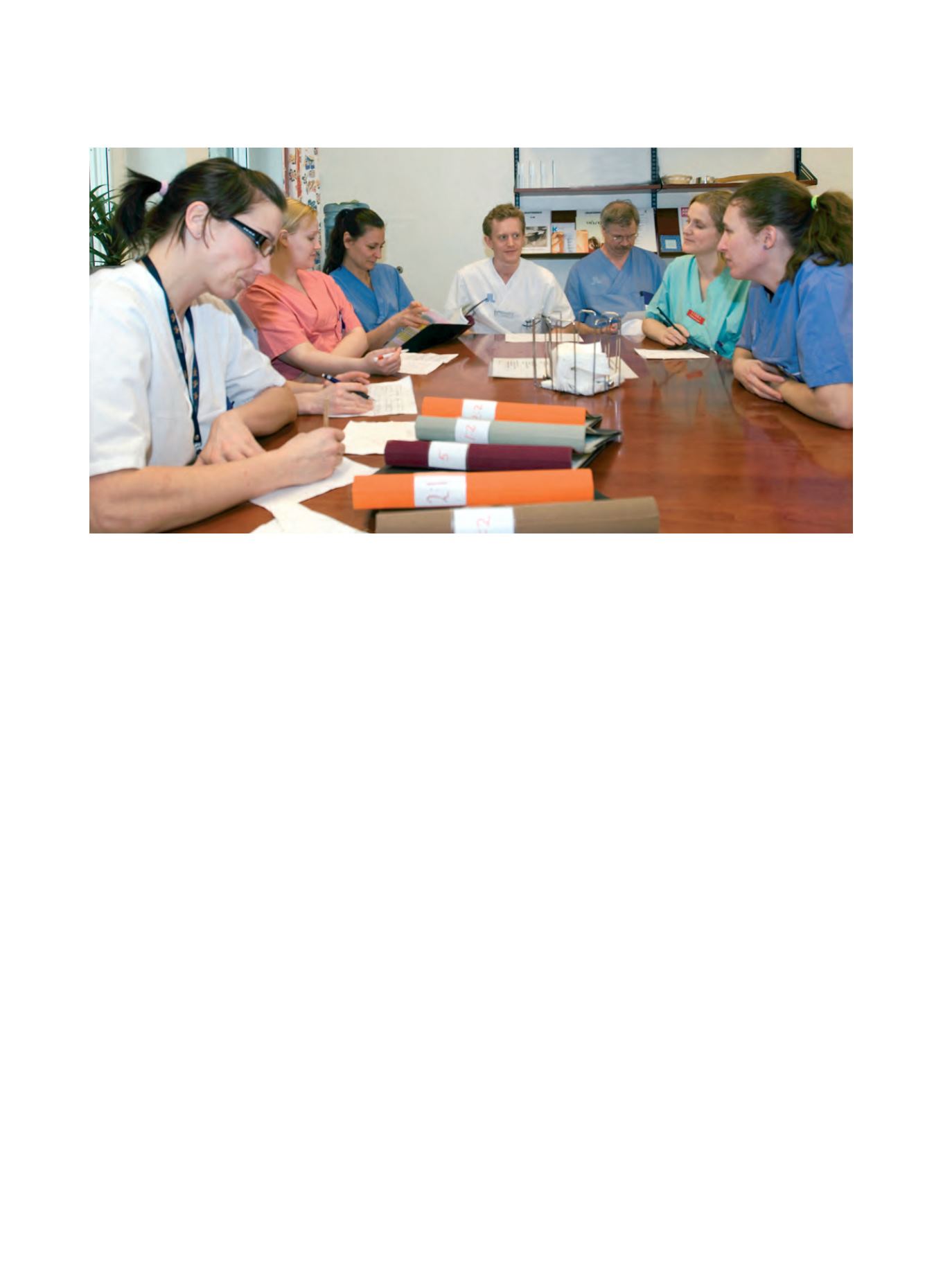
Management of a crisis shall be in the same hands as in peacetime. Planning for healthcare is often an integral part of hospitals’ emergency plans
Image: Staffan Larsson