


 77 / 85

[
] 77
Doctors working in hospitals must report suspected cases accord-
ing to specific, clearly defined criteria to the competent cantonal
authorities, which will transmit the notification to FOPH. Diagnostic
laboratories must notify any confirmation of the new influenza virus
subtype to the competent cantonal authorities and to FOPH.
For this purpose, FOPH has established an on-call service,
according to the guidelines in the International Health Regulations
(IHR).
Prevention
Vaccination is one of the most effective measures to limit the damage
caused by an influenza pandemic. For this reason, on 18 October
2006 the Federal Council instructed the Federal Department of
Home Affairs (FDHA) to procure eight million doses of pre-pandemic
vaccine from GlaxoSmithKline (GSK), in order to protect the entire
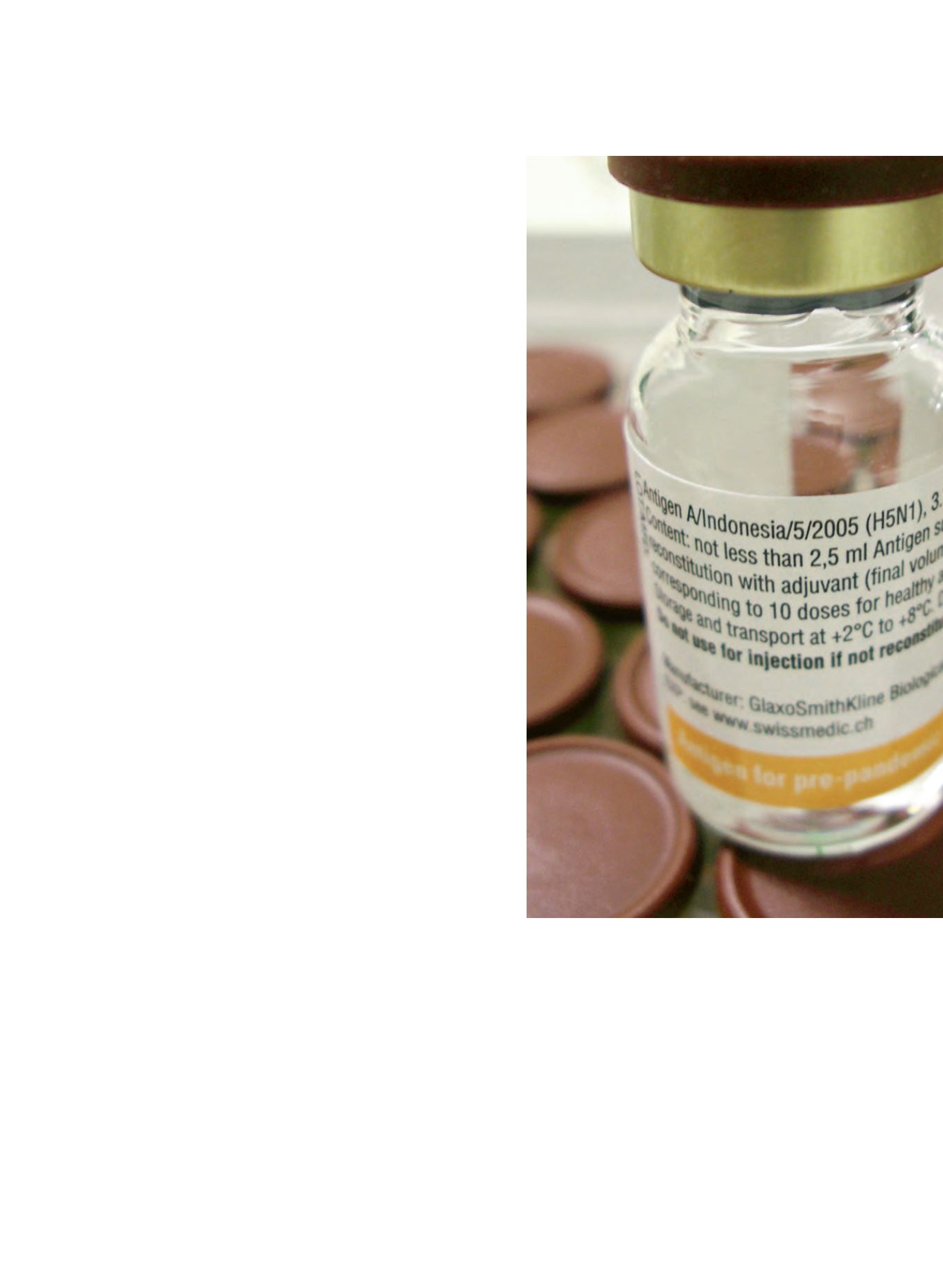
resident population of Switzerland. This is an H5N1 vaccine with
an additive (adjuvant), which extends its effectiveness to virus strains
related to the H5N1 virus currently circulating. This vaccine is stored
in Switzerland. A clinical study evaluating the tolerability of the pre-
pandemic vaccine in the working population and the simulation of
a mass vaccination is currently ongoing.
In parallel with the purchase agreement for pre-pandemic vaccine,
the FDHA has signed a reservation agreement for pandemic vaccine,
to ensure rapid supply in the event of a pandemic outbreak. The
pandemic vaccine will be more specific than the pre-pandemic
vaccine, as it will contain the virus that caused the influenza
pandemic. It can be expected that it would take about six months
from the moment when a pandemic virus and its characteristics are
well known until a vaccine can be developed and mass-produced.
The objectives of a pre-pandemic vaccine stockpile are as follows:
Minimize the spread of a mutated H5N1 influenza virus in Switzerland
– Protective vaccination for the following risk groups (two doses of
pre-pandemic vaccine):
• First line healthcare workers (HCW), laboratory personnel
• Persons in contact with infected poultry (poultry workers,
veterinarians, cullers)
• Persons travelling to the affected countries in the framework of
programmes to support them
Minimize the burden of disease during the pandemic
– Priming of the
population resident in Switzerland with one dose of pre-pandemic
vaccine, after testing cross-reactivity with the new pandemic virus,
followed by one dose of pandemic vaccine as soon as it becomes avail-
able.
Treatment
According to the Ordinance on the Obligation to Store Reserves of
Medicinal Products in April 2004, it became compulsory to store
reserves of neuraminidase inhibitors (Tamiflu
®
). On 9 December 2005
the Federal Council decided to store enough Tamiflu so that 25 per
cent of the resident population of Switzerland can be treated in case
of an infection and about 250,000 health professionals who are directly
exposed at work can be supplied with prophylaxis. This quantity meets
the WHO recommendations. The Federal Office for National
Economic Supply (FONES) is responsible for monitoring this oblig-
ation to store reserves and for organizing distribution to the cantons.
In addition, the federal government has stored an emergency
reserve of 10,000 quickly available treatments, with FOPH respon-
sible for managing and releasing the supply. This reserve is to meet
any shortages of Tamiflu on the market, before release
from the compulsory store.
During the last epidemic of seasonal flu, more strains
of the influenza virus occurred that were resistant to
Tamiflu. Therefore, an evaluation was started, including
at the level of the European Union, to support a strategy
for the use of antiviral drugs in case of a pandemic.
Non-medical measures
The following non-medical measures are envisaged, which
are generally used to combat infectious diseases: isolation
of patients; contact management and quarantine; social
Antigen (GlaxoSmithKline) stored for prepandemic vaccination
Image: Swiss Federal Department of Defence, Civil Protection and Sport