


 76 / 85

[
] 76
Vaccination of the population
– The administration of
a pre-pandemic vaccine and then of a pandemic vaccine
are the most effective population-based measures to
reduce the number of patients and the severity of the
disease.
Ensuring the provision of basic services to society
–
Institutions and businesses have to continue to func-
tion, despite a high rate of absence.
Information for health personnel, the authorities and the
population.
Development of the Swiss Pandemic Plan
The development of the Swiss Pandemic Plan entails
four stages: monitoring, prevention, treatment, and non-
medical measures, as outlined below.
Monitoring
Subtype H5N1 of the influenza A virus has been
detected in various species of wild birds in Europe.
Therefore, it cannot be ruled out that this subtype could
again be brought into Switzerland by wild birds and
spread here. To assess this danger in a more precise way,
wild birds are monitored in two different ways: passive
monitoring is mainly concerned with dead or sick birds,
whereas active monitoring involves the investigation of
live birds.
In addition to monitoring, Switzerland, Germany and
Austria initiated a joint three-year research programme
(2006-2008) in the region of Lake Constance (the
‘Constance’ research project). The objective was to
improve our understanding of bird flu and the mecha-
nisms by which it spreads, and to increase our
knowledge in order to protect poultry and wild birds
more effectively and in a more specific way from any
possible introduction of bird flu.
In addition, the monitoring of birds also contributes
to achieving the overall objectives of monitoring bird
flu in Switzerland:
• Reduction of the risk of animal to human transmis-
sion, with immediate establishment of any transfers
that could lead to the occurrence of a form of the
virus completely adapted to human beings
• Prevention of infections in exposed people, for
example personnel involved in combating epidemics
in animals; or prevention of transmission to those
surrounding a diseased person, such as medical staff
in particular
• Prevention of the introduction of the virus by means
of early detection of any sick people who have trav-
elled to Switzerland, in order to limit or delay the
spread of the virus.
In relation to the monitoring of human beings, during the
pandemic alert period the emphasis is on early detection
of cases of infection with a new HxNy influenza virus
subtype that has pandemic potential. The objective is to
halt the spread (phases 3 and 4) or at least to delay it
(phase 5, beginning of phase 6). Hospital doctors and labo-
ratories play an important part in this, and have the duty
to notify the competent authorities within two hours.
The strategy is based on the following principles:
Preventing the virus from entering the country
– If the monitoring
systems for human and animal diseases in another country discover
a new virus, then its introduction into Switzerland, and in particu-
lar contact with people and animals, must be prevented.
Prevention of adaptation of the animal virus to human beings
– In
the event of an animal infection, each focus of the virus has to be
eliminated, secondary infections are to be prevented and situations
must be avoided in which human beings would come in contact with
the virus.
Preparation of the health system
– All appropriate measures are to
be taken in the area of public health to slow down and limit the
spread of the virus between people and to ensure that the provision
of healthcare runs smoothly.
Provision of specific medicines
– The storage of antiviral drugs,
antibiotics, vaccines and various sorts of protective equipment makes
it possible to prevent a shortage of supply.
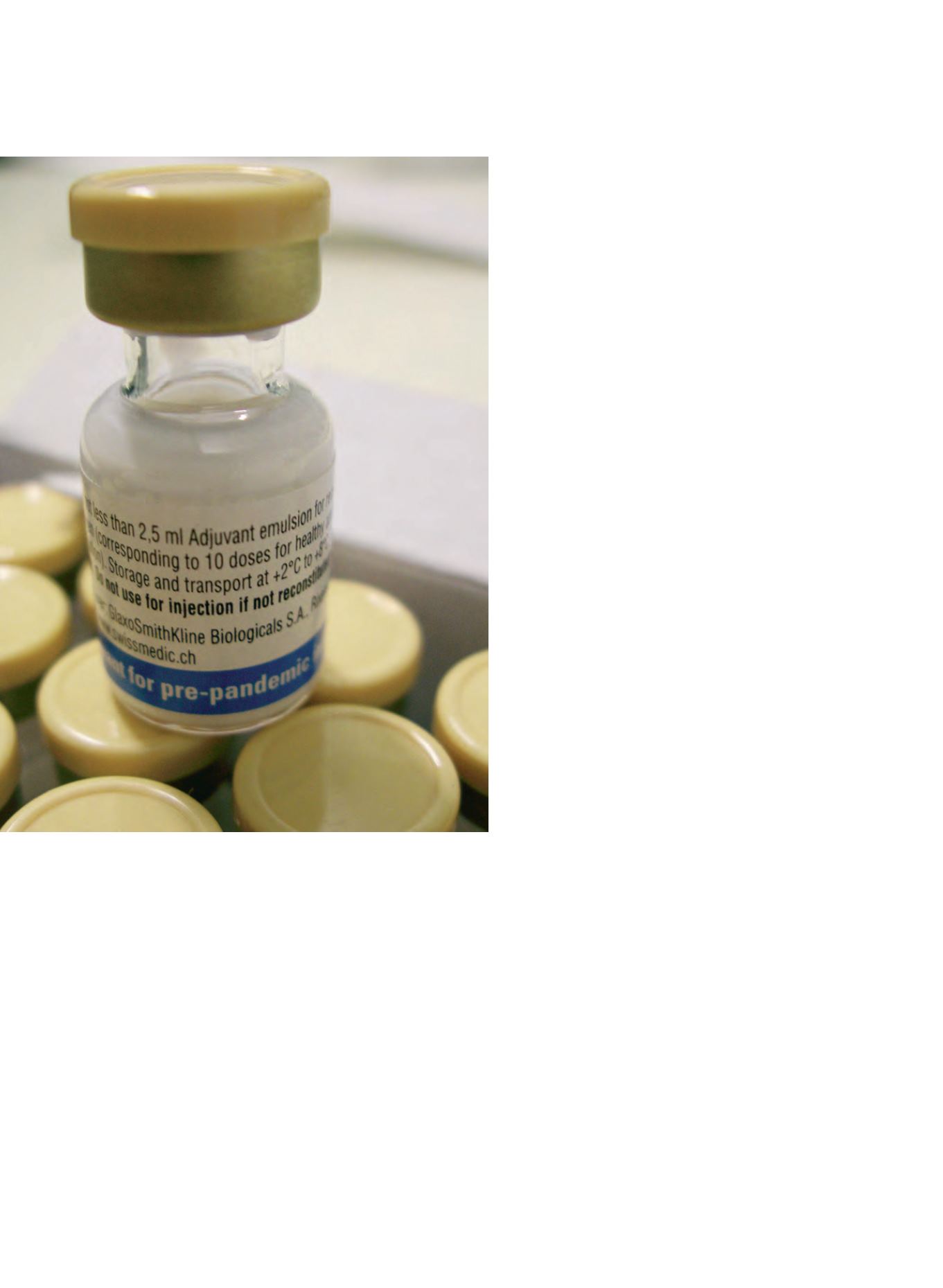
Adjuvants (GlaxoSmithKline) stored for prepandemic vaccination
Image: Swiss Federal Department of Defence, Civil Protection and Sport