


 72 / 85

[
] 72
Infectious disease control
and emergency management:
the Swedish approach
Dr Johan Carlson & Dr Anders Tegnell, National Board of Health and Welfare, Sweden
S
weden is a country of some nine million inhabitants in the
north of Europe. It is administratively organized into 21
counties, which are responsible mainly for the health care,
and 290 municipalities, which are responsible for most other
services to the inhabitants.
The Swedish system for communicable disease control is decentral-
ized to a very high degree. The major operational role lies within the
21 counties, varying in size from less than 100,000 inhabitants to
more than two million. In some of the counties with small popula-
tions, the geographical area might be very large, with a dispersed
population. Each county has a medical officer in charge of commu-
nicable disease control, who has a coordinating function regarding
the operational activities in the area.
At national level the National Board of Health and
Welfare (NBHW) fills the national coordinating func-
tion, but also develops guidelines and directives and
supervises activities in the counties. The Swedish Centre
for Communicable Disease Control (SMI) is the national
node for the surveillance system, and is tasked with
developing the knowledge that forms part of the basis for
the normative activities of the NBWH.
The general principle for the responsibilities for
preparedness and the management of a crisis is that it
should be in the hands of the same actor as the one who
is in charge of them in peacetime. This means that
responsibility for planning for healthcare and commu-
nicable disease control during a pandemic lies with the
healthcare authorities, and in practice pandemic plan-
ning for healthcare is often an integral part of the
hospitals’ emergency plans. For emergency planning in
other sectors the municipalities have a central respon-
sibility, while coordination for a bigger geographical area
lies with the county administrative boards.
Planning assumptions
Pandemic planning needs to be based on a concept of
the effects that the pandemic will have on people and on
the society. Several sources can be used to develop this
concept, but the main source is the knowledge of previ-
ous pandemics and, to a certain extent, the yearly
epidemics of seasonal influenza. However, these give only
a possible scenario, and the likely variations are big. This
is accepted in the Swedish planning process, and the
solution is an adaptable planning were many details in
the plan will have to be left for rather late adjustments.
Things that might be adjusted are, for example, needs
for hospital beds, risk groups that need special resources
and others. However, some assumptions need to be made
in case no better data becomes available. Swedish
assumptions are that the pandemic will start somewhere
outside Sweden and that it will resemble the Hong Kong
or Asian pandemic rather than the Spanish influenza.
One assumption that has increasingly become a focus
of the planning is that the pandemic will affect major parts
of society. Many people will be ill at one time and there
will be a lack of manpower in many of the functions of
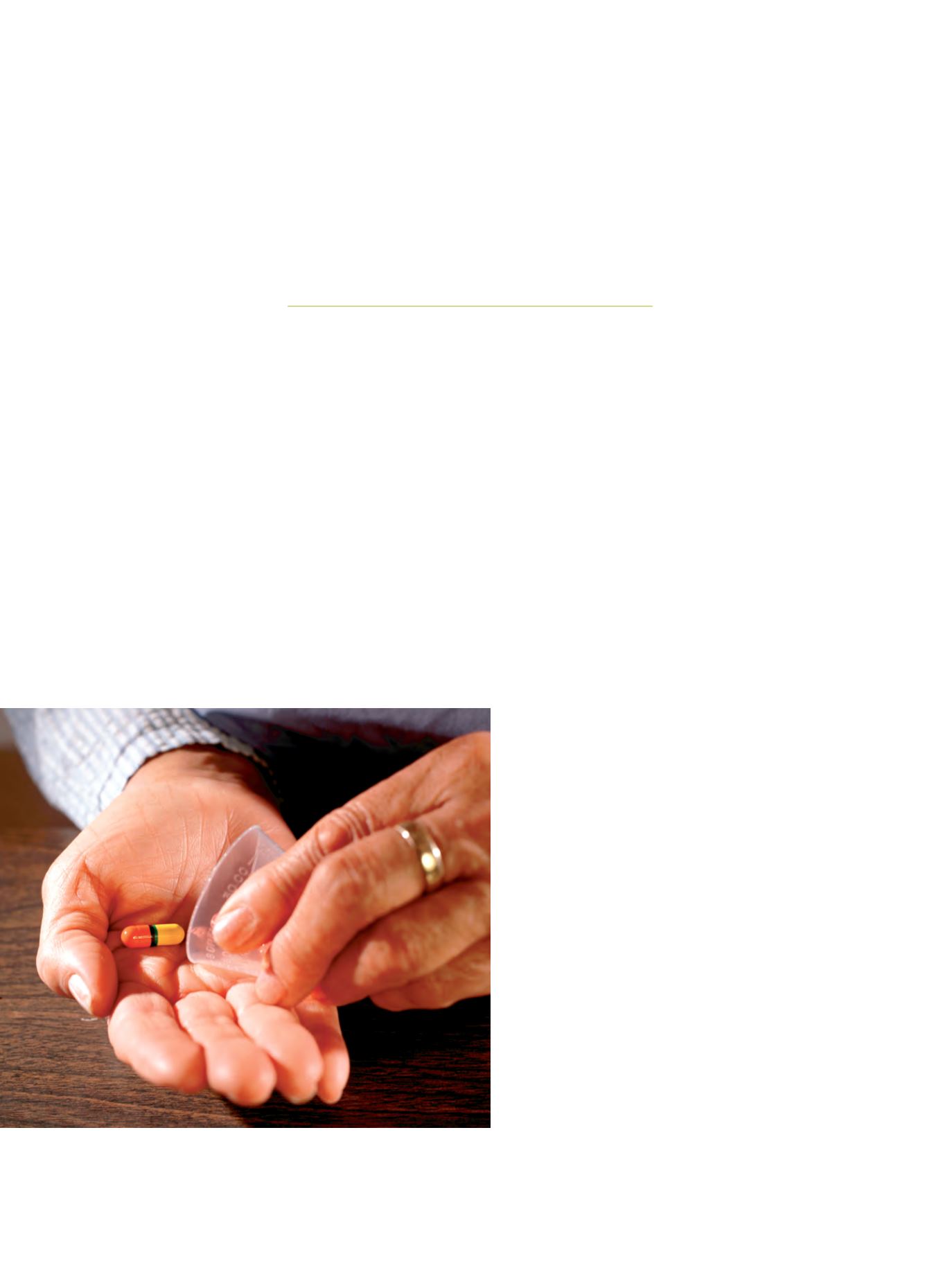
National stockpiles of antivirals and antibiotics have been purchased to ensure that
a variety of drugs is available whenever possible to deal with future changes in
resistance among viruses and bacteria
Image: Matton