


 152 / 196

[
] 150
assessments; and (3) a scheduled timeline for imple-
mentation. Initially, the ESN concept was finalized and
completed, with comments from participants of the
TBTI process incorporated in the design. Next, the
data management development process began, with a
separate data management committee working on
details of connectivity, data compatibility, common
metadata sharing, notification/alert features and tech-
nical data sharing capabilities. The final aspects of the
ESN will be an effort to better define the science
requirements that would support an alert notification
to EMD.
The planned schedule for implementing this ESN is as
follows:
12 June 2008
– peer review and comment.
1 July 2008
– assess additional comments and peer
review and incorporate into concept paper; and initiate
network development by NOAA-NCDDC.
1 August 2008
– final draft of concept paper completed
for additional review; begin briefing executive manage-
ment at network participants’ respective agencies; define
funding requirements and sources of income.
30 September 2008
– identify and assess data bases using
DHEC model; complete list of science projects needed
to support and assess mortality bases utility; begin to
define performance parameters associated with ESN
notifications.
1 January 2009
– initiate pilot ESN.
March/April 2009
– convene a workshop/symposium
describing the network to SC science and emergency
management community.
The future of the network
Federal and State Agencies in South Carolina involved
in the ESN have a demonstrated commitment to seeing
its initial implementation in January 2009. By combin-
ing their information regarding natural resource disease
and mortality events, South Carolina will have a
network that can detect the occurrence of multiple
environmental events that may occur in the environ-
ment. Most of these events will be unrelated, naturally
occurring events or accidental, unintentional environ-
mental releases; however, in the event of a covert
bioterrorist attack involving a biological or chemical
agent, the ESN can provide recognition of multiple
mortalities and disease events in a more timely and
information-rich manner that may result in earlier
detection, notification and warning to emergency
management officials. This earlier detection could save
lives and enable emergency management officials to
better control and manage these events. In addition,
ESN will enhance natural resources interagency
communication about the unusual mortality events, as
well as result in more coordinated and unified
responses among ESN agency partners. Further during
natural disaster events, such as hurricanes, the ESN
will provide enhanced communication among federal
and state natural resource agencies for better managing
clean–up and recovery efforts.
– Standard notification information content
• Agency points of contact
• Direct link to EMD and law enforcement
• Direct link to companion and domesticated animal network
• Direct link to state veterinarian
• Ease of expansion for other participants
• Directly relates to natural resource and
environmental agency missions
• Directly relates to homeland security national preparedness
capability development
Implementation requirements
Critical implementation requirements fall under three categories:
(1) Funding and technical personnel commitment; (2) science
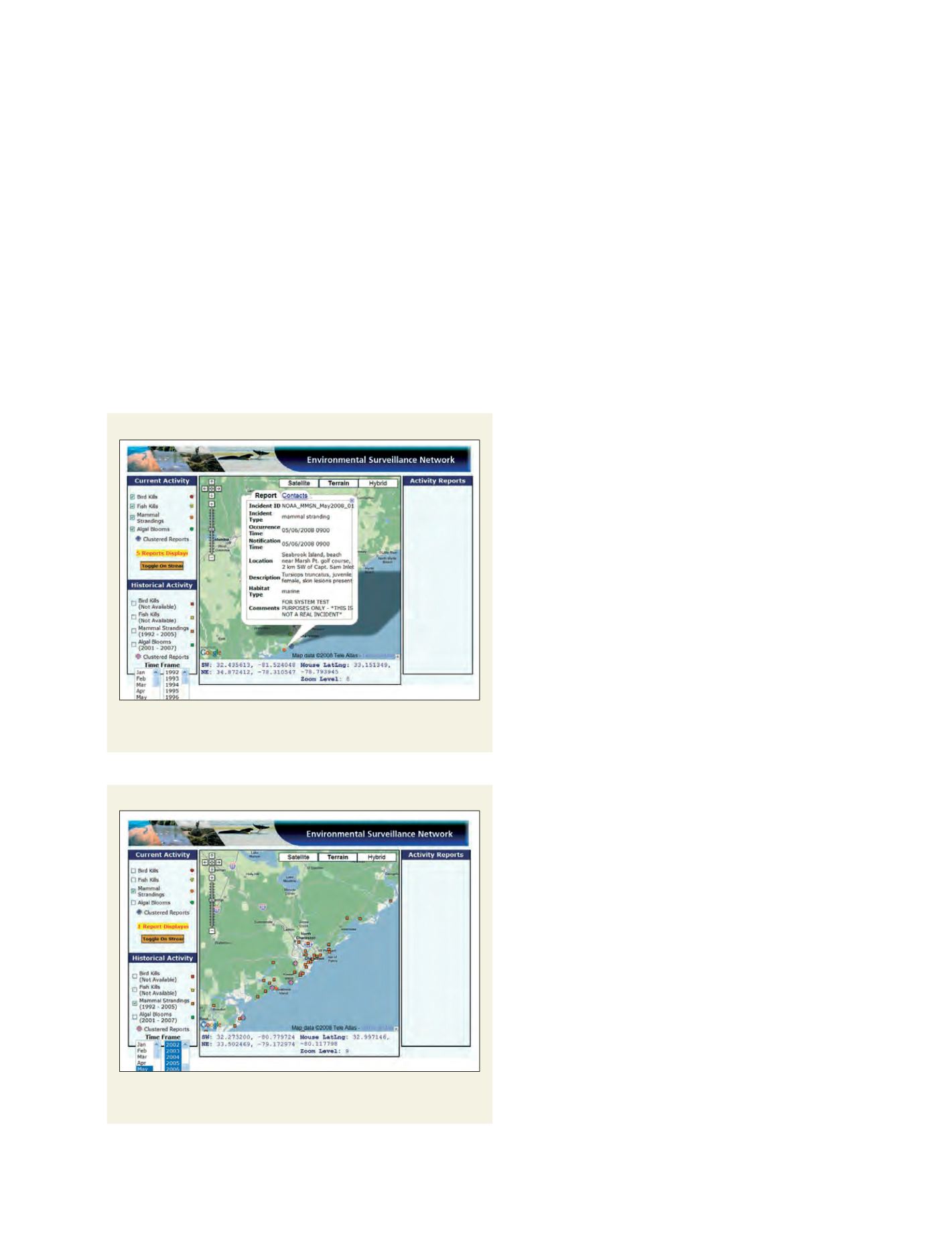
Source: NOAA NESDIS/NCDDC and NCCOS/CCEHBR
Web mapping
Environmental Surveillance Network historical data overlays of marine mammal
strandings
Source: NOAA NESDIS/NCDDC and NCCOS/CCEHBR
Web mapping
Once an ESN notification is received, users can click on the map icons and more
information about each event will pop up