


 150 / 196

[
] 148
The workshops highlighted the need for more routine communica-
tion with the law enforcement, public health, natural resource and
environmental research community for two major reasons:
1. Emergency managers were unaware that mortalities in the
natural environment could indicate a potential public health
crisis
2. During the recovery phase environmental and natural resources
restoration issues become major components in supporting
public health.
The workshops also identified the fact that many different federal and
state agencies were gathering environmental data, but they rarely
share information, since there is no common system to report and
link data. Even more important it was revealed that emergency
managers had little understanding of the potential implications relat-
ing to reports of natural resource mortalities. Following the workshop,
a commitment was made among participants to develop the ESN, as
a system to address this data gap. These findings match a GAO study
conducted in 2003 that reviewed preparedness levels across state and
local jurisdictions. A key finding was that state and local jurisdictions
expressed a desire for more sharing of best practices.
7
Environmental agencies are developing approaches to measuring
ecosystem health within the context of socio-economic realities.
The Integrated Ecosystem Assessment provides information so
managers and scientists can evaluate an ecosystem, develop options
for future action, and identify gaps in the understanding of the
issues.
8
The ESN is a component of the integrated assessment
process that more quickly highlights the mortalities of important
ecosystem keystone species. Additionally, the ESN is a part of the
Department of Homeland Security’s national preparedness capabil-
ity development process of: environmental monitoring and
assessment; natural resources restoration; and natural hazards moni-
toring.
Environmental insults are assessed within the context of long-term
and site-specific data sets. Ecosystem characterization and modelling
of ecosystem stressors are fundamental for scientists and policymak-
ers to identify the knowledge and data gaps that limit our
understanding, forecasting abilities and ultimately our
decision-making. The critical first step is to create a noti-
fication process among the agencies and experts that
regulate keystone species. These data sets are compiled
by agencies and experts alike. This network provides for
linking these data sets into real-time reporting of mortal-
ity events that allow quick notification among experts
and quick evaluation to determine if there are links
between and among the reported mortalities.
Development of the South Carolina environmental
surveillance network
The South Carolina Environmental Surveillance
Network is a real-time surveillance network of mortal-
ity incidents (such as fish kills, bird kills, animal disease
outbreaks, harmful algal blooms and marine mammal
strandings) that:
• Notifies participating network science and regula-
tory experts of mortality incidents
• Allows for quick assessments of potential links
between and among mortalities
• Provides a mechanism to alert the emergency
management community of incidents that could
impact commerce and the public health.
The ESN founding network participants are initially
composed of state and federal agencies that have regu-
latory responsibility over natural resources. Most of
these agencies have some natural resources responsibil-
ity including terrestrial, freshwater and marine
environments. The State Law Enforcement Division and
Emergency Management Division are also participants.
Initially, the participants are developing the network and
sharing the notification and communication responsi-
bilities. The agency and the subject matter species are
also listed for each agency within the ESN.
Expansion of the network is planned and future
participants managing species of concern will be encour-
aged
to
participate.
NOAA-CCEHBR
and
NOAA-NCDDC will manage the network initially.
ESN development and training: a consensus build-
ing process
The ESN was developed as part of the Team Based
Training Institute (TBTI) of the University of South
Carolina Center for Public Health Preparedness (USC-
CPHP) funded by US Centers for Disease Control and
Prevention (CDCP). The TBTI was a series of in-person
workshops held over a six-month period with the goal
of providing teams of stakeholders the opportunity to
unite in their efforts to strengthen their communities’
preparedness to prevent, protect against, respond to, and
recover from threatened or actual emergencies. The
TBTI utilized a standardized planning process aligned
with the National Preparedness Guidelines. The plan-
ning process allowed for flexibility and adjustment
dependent upon the individual group’s focus and accom-
plishment. The USC-CPHP and TBTI are funded by
Cooperative Agreement U90/CCU424245-03 from the
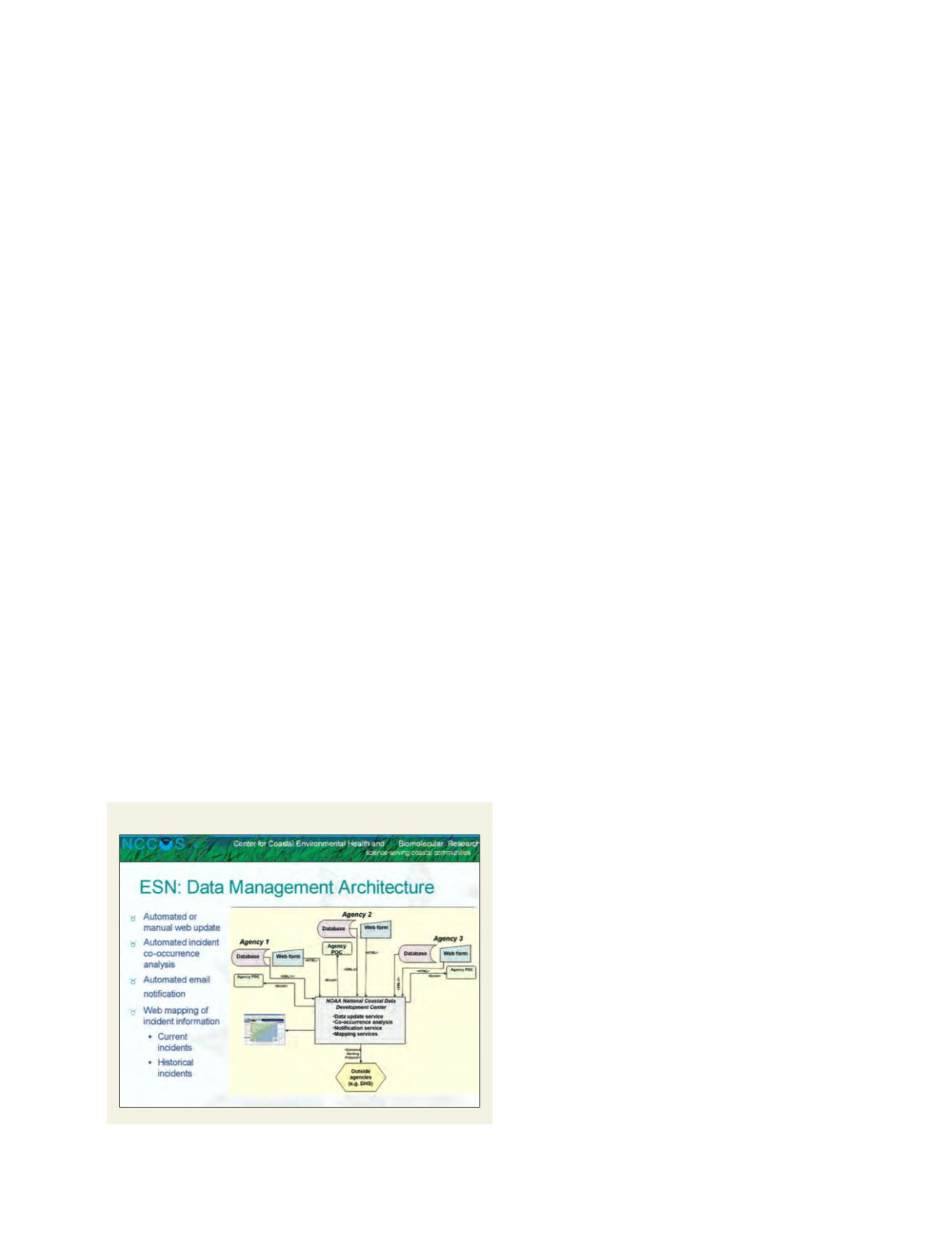
Data management architecture of the South Carolina ESN
Source: NOAA NESDIS/NCDDC