


 156 / 196

[
] 154
ORHAB personnel resulted in proactive testing of razor clams. The
samples came back negative for toxin (< 4 ppm DA), assuring that
the popular May harvest could occur with safe shellfish.
11
Recognition of ORHAB’s value by the State of Washington created a
sustainable source of funding using license fees for recreational
harvesting of razor clams. The forecasts generated by ORHAB have
increased the commercial, subsistence and recreational harvest of
razor clams and lowered the health risks to consumers.
Expansion of the programme
In the Gulf of Maine almost annual blooms of
Alexandrium fundyense
can cause human illness and death from Paralytic Shellfish Poisoning
due to a potent neurotoxin that accumulates in shellfish. A concerted
effort to understand
Alexandrium
dynamics in the Gulf of Maine has
led to significantly enhanced regional response capabilities. This
effort began in 1998 with the NOAA and National Science
Foundation-supported ECOHAB-Gulf of Maine project, and has
continued through a variety of projects. New molecular methods for
rapidly detecting and mapping
Alexandrium
are now used to track the
bloom in almost real time. These data, combined with oceanographic
and meteorological data from ships and moorings, are coupled with
a biophysical model to forecast the spread of the bloom.
12
This fore-
cast is used to provide weekly updates of probable bloom magnitude
and location to marine resource managers so they can focus
sampling. The model, coupled with annual cyst location maps, is
also used to predict bloom potential prior to the bloom season. Model
results are presently provided in a demonstration mode to 150
regional shellfish managers and researchers via a listserv. This inte-
gration of ocean observing system data with models is an example
of the predictive, regional, ecosystem-based research being supported
by NOAA to address coastal ocean issues.
Preliminary work has also begun in adapting the Florida HAB fore-
cast concept to other regions of the US. These include the Great Lakes,
where toxic cyanobacterial blooms degrade water quality and release
hepatotoxins and along the California coast where ASP is a problem.
In each of these instances, satellite imagery results integrated with local
meteorology, the best hydrological models available and local sampling
capacity are used to determine if relevant forecasts are possible.
Real world issues
Some issues need to be solved before development and implemen-
tation of a HAB warning system. The transition of research into
application and operation is not a straightforward proposition.
Funding is often available either for research or for operations.
Unfortunately, as the transition from research to operation is a hybrid
capability bridging these activities, transition projects do not fit into
the existing planning modes and suffer from lack of funding.
However, this bridge is indispensable to allow for the use of new
management knowledge.
Each HAB organism is unique and the causes and impacts of each
are different, resulting in significant differences between regions (e.g.
morphology, currents, temperature). Although some aspects of fore-
casting HABs can be transferred between types of HABs and regions,
forecasts are generally not entirely transferable from one region to the
other. Considerable additional research and information is needed
for each new forecast and further efforts are required in order to
provide the Nation with a National Warning System for HABs.
The potential liability associated with any forecast is another issue to
consider. In the case of an inaccurate forecast, for example an error on
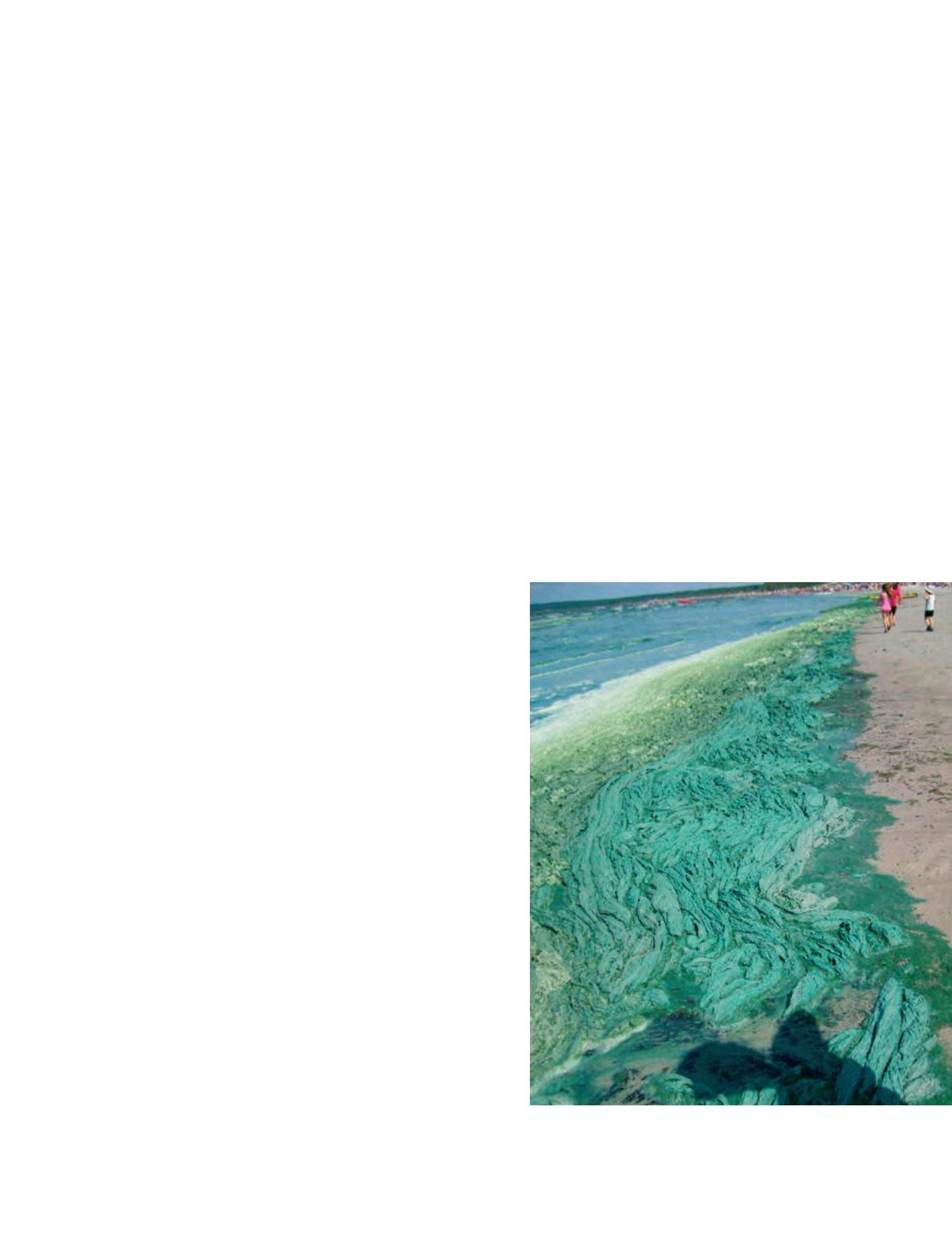
Cyanobacteria HAB scum along the shores of the Lake of the
Woods (Ontario, Canada)
Image: Hedy Kling, Algal Taxonomy and ecology Inc. (Canada)
the landfall location of a HAB, who is responsible if some
people get sick or die or if a beach is closed and nothing
happens? What are the possibilities for lawsuits? This also
brings to light the different roles of the public versus private
sectors in operating forecasts. Should the operation of such
ecological forecasts be reserved to Federal or State entities
or should there be a close collaboration between public
and private sectors in the same manner that presently exists
for weather forecasts? These are some of the questions that
NOAA is presently addressing.
NOAA is a US Federal Agency, and a member of the
President’s Office of Science and Technology Policy
Subcommittee on Disaster Reduction. One of its goals is
to provide its users with useful tools that can assist the
US in becoming a safer and more resilient nation. The
research performed on HABs by NOAA/NCCOS and its
collaborators at all levels of government (federal, state,
local and tribal), academia, and private industry has led
to advanced capabilities for HAB detection and predic-
tion not possible only a decade ago. HAB forecasts result
in faster and better focused responses by health and
natural resource managers, reduce losses to coastal
communities, allow for better resources management, and
could serve as a basis for international collaboration.