


 155 / 196

[
] 153
cates new blooms considered as candidates for HABs. Summer and
autumn blooms following upwelling winds and near fronts are flagged
as potential HABs.
5
The chlorophyll concentration in the anomaly
also provides an estimate of the number of cells present.
6
Once poten-
tial HABs are identified, their presence is rapidly confirmed by in situ
sampling by the State of Florida environmental managers.
After the bloom is confirmed, a team of experts integrate and inter-
pret the data with wind and current models to predict likely bloom
movement and landfall. Nowcasts and forecasts are issued through a
website for the public
7
and through bulletins for managers. Both of
these are critical for strategic planning of sampling efforts and timely
dissemination of advisories. After almost 15 years of preliminary
research, NOAA was able to validate this approach
8
and by 2004 suffi-
cient capability existed for NOAA to start the operation of the HAB
Forecast System for the West Coast of Florida, providing monitoring
and forecasting capabilities to local coastal managers.
9
Advisories are
now provided to over 250 officials in the region and are used for diverse
purposes ranging from redirecting tourists from potentially affected
areas, to preparing county health officials for increased caseloads, to
preparing agencies for unusual mortality events of marine mammals.
Presently, the only fully operational unit is the forecast provided for
the eastern Gulf of Mexico. In addition, since 2006, a demonstration
project has also been successful for the Texas coast of the US.
ORHAB forecast
– Another success story is the forecast developed
in the Pacific Northeast by the Olympic Region HAB (ORHAB) part-
nership in response to seemingly random closures of
shellfisheries due to razor clam contamination by algal
biotoxin. Of particular concern were blooms of the algae
Pseudo-nitzschia
that produces Domoic Acid (DA). When
ingested, DA is responsible for Amnesic Shellfish
Poisoning (ASP) in humans. With five years of support
from NOAA, ORHAB developed collaboration among
federal, state and local management agencies, coastal
Indian tribes, marine resource-based businesses, public
interest groups and academic institutions. Their focus
on HAB research led to increased local ability to monitor
and mitigate the effects of such events. ORHAB partners
investigated the origins of toxic blooms, monitored
where and when they occurred, assessed the environ-
mental conditions conducive to blooms and
contamination by toxins of shellfish. Ultimately, ORHAB
developed and adopted a combination of analytical tech-
niques,
including
twice-weekly
microscopic
determination of total
Pseudo-nitzschia
cells and levels
of DA in seawater particulates to provide managers with
an effective early warning of DA problems.
10
In May 2002, the first ‘ORHAB Alert’ was sent to
coastal managers indicating a rapid rise in
Pseudo-
nitzschia
cells in several areas along the Olympic coast.
Teamwork between Washington State agencies and
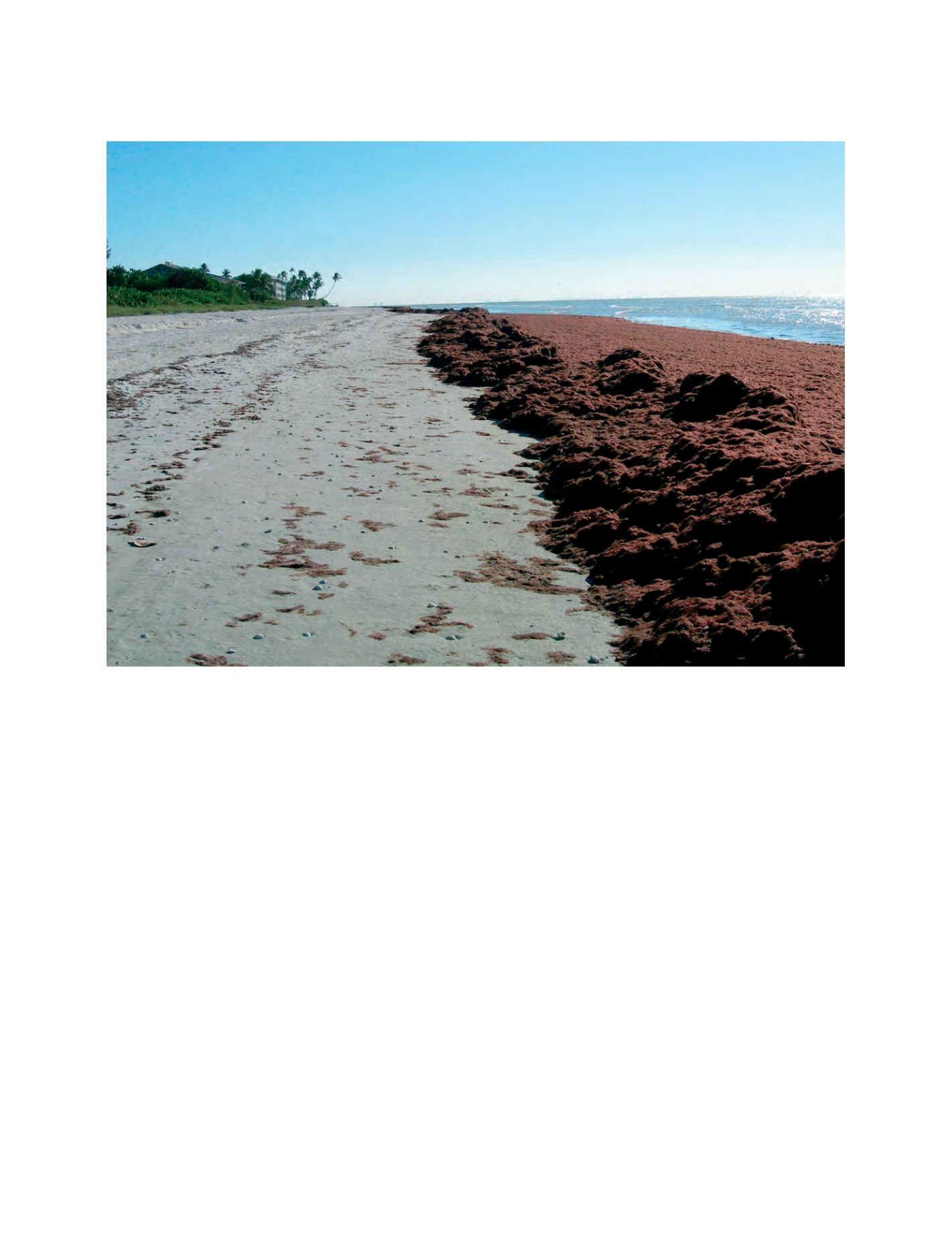
Red algae accumulation on Sanibel Island, Florida (US) in January 2007
Image: Mike Valiquette, Purre Water Coalition (Florida, US)