


 175 / 196

[
] 173
response capabilities being overwhelmed and thus requiring signif-
icant external aid assistance. Such an event may be termed
‘catastrophic’. The potential for a government being overwhelmed
in a disaster is proportional to the percentage of the population seri-
ously impacted and the country’s level of development. Typically in
developed countries, if a very low proportion of the population is
affected by a disaster, internal resources can be readily mobilized for
response and recovery. For example, when Cyclone Larry hit north-
ern Queensland in 2006 it seriously affected less than one per cent
of Australia’s population; thus, Australia was well equipped to
support those affected by the disaster without external assistance.
In contrast, a similar percentage of Papua New Guinea’s
population was directly affected by Cyclone Guba in
2007, yet this disaster required significant foreign
support in the post-disaster phase.
Natural Hazard Risk Assessment of the Asia-
Pacific region – preliminary results
Here we present some key findings from our prelimi-
nary natural hazard assessment of the Asia-Pacific
region, followed by two case studies that illustrate some
of the findings.
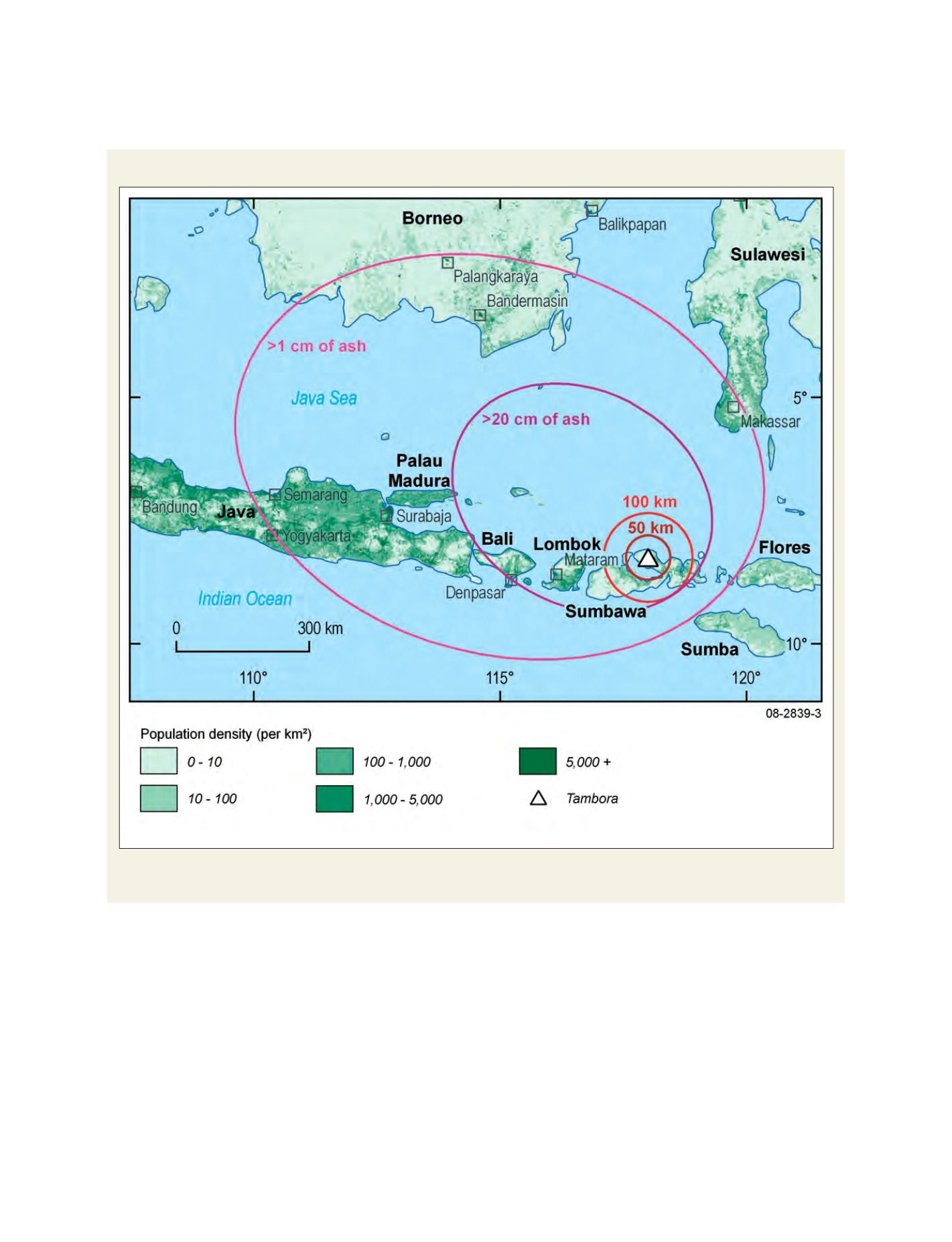
The current population density of Indonesia is overlaid by the ash-dispersal pattern from the 1815 Tambora eruption
The area 100km from the volcano received between 50 and 100cm of ash, and pyroclastic flows are thought to have extended about 30km from the volcano.
More than 1cm of ash covered over 500,000km
2
of the Java sea and surrounding islands
Source: Population data from Landscan